
Schedly resources
24/7 Online Booking To Capture More Appointments
Your customers want to book appointments when it suits them-not just during your business hours. That's where 24/7 online booking makes the difference.
At Schedly, we've seen businesses capture 30-40% more appointments simply by letting customers schedule outside traditional hours. This guide shows you exactly how to set up a system that works around the clock and keeps your calendar full.
How 24/7 Online Booking Captures More Appointments
The numbers prove it: when you enable customers to book outside your business hours, appointment capture increases dramatically. A 2025 study published in Frontiers in Digital Health tracked a private ophthalmology practice that implemented 24/7 online booking and found that 22.8% of all scheduled appointments came through the system, with unused appointment slots dropping from 22.7% before implementation to just 10.3% after. This wasn't a minor improvement-it fundamentally changed how the practice operated. The same study showed that online bookings had a no-show rate of just 1.8%, compared to 5.9% for appointments booked offline. Customers who book themselves at 2 AM show up far more reliably than those who call during business hours. Practices with higher online booking volume experienced significantly fewer empty slots, with a strong correlation between the two. What makes this work is straightforward: customers book when they have time to think, not when you're available to answer the phone. A Bitkom survey found that 66% of people believe service providers should offer online booking, and 22% specifically choose providers that offer 24/7 scheduling. You capture appointments that wouldn't exist without this option.
Automated Reminders Slash No-Show Rates
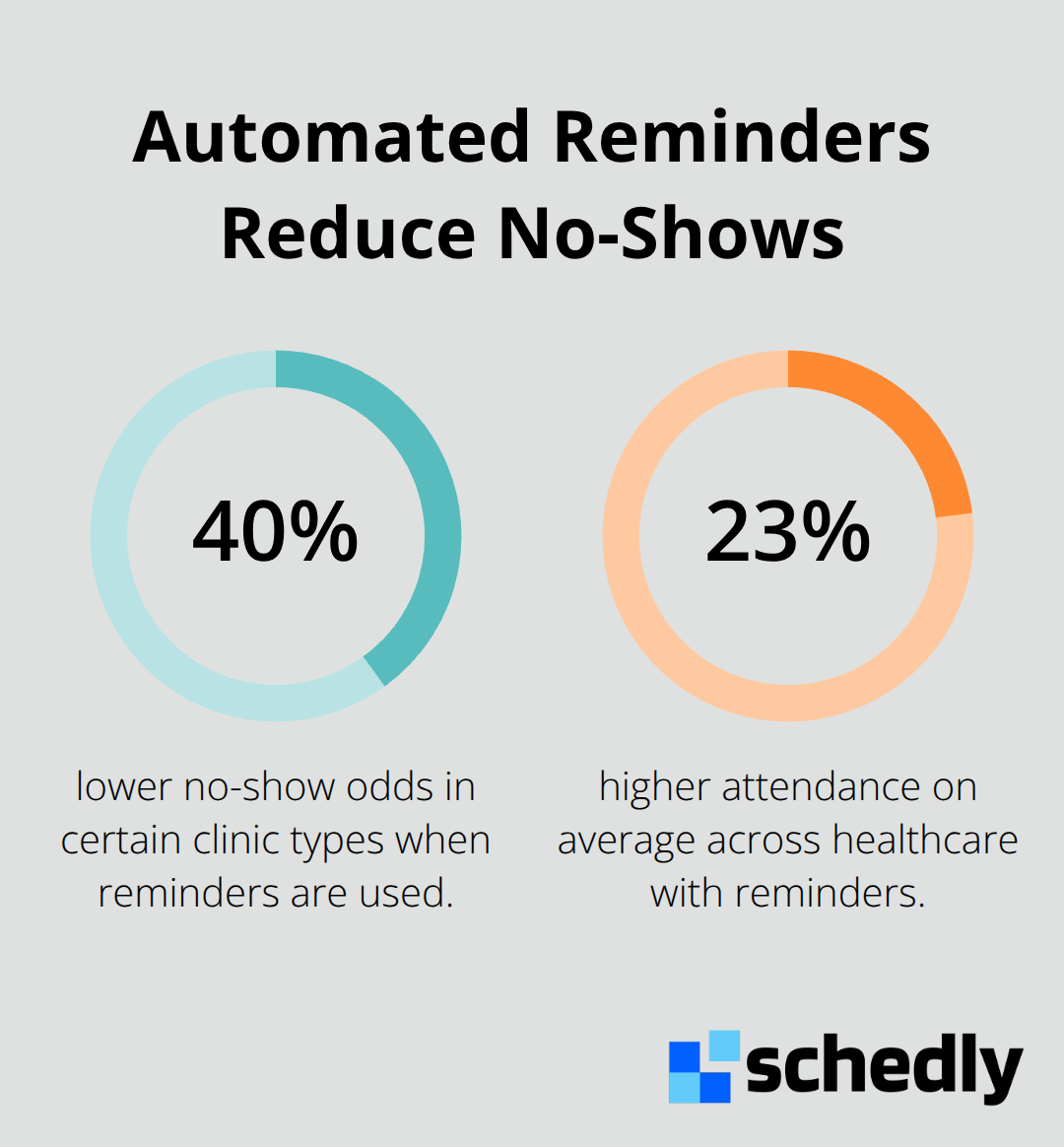
Reducing no-shows matters far more than most businesses realize. The same ophthalmology hospital in the 2025 study increased SMS reminders from 11.4% to 25.4% of scheduled appointments over 18 months, and this shift correlated directly with lower no-show rates. Reminders reduced no-show odds by 40% in certain clinic types. Across healthcare broadly, reminders increase attendance by approximately 23%, according to research cited in the Frontiers study.
Friction-Free Booking Wins Customers
Press Ganey research based on 6.5 million patient encounters found that 80% of healthcare consumers say online scheduling influences their provider choice, and about 25% will walk away if booking isn't as easy as making a dinner reservation. That's a real dealbreaker for one-quarter of potential customers. The same research identified that 48.4% report pre-appointment roadblocks including cumbersome scheduling, and friction before the appointment reduces likelihood to recommend by 13.1 points. What removes this friction? A system where customers see real-time availability, select their preferred time in seconds, and confirm with a single click. No phone tag. No back-and-forth emails. No uncertainty about whether their preferred slot is actually available. When your 24/7 booking integrates with your calendar system and syncs across all your locations or service providers, double bookings disappear and customers get accurate availability instantly. Customers complete the booking instead of abandoning it halfway through. They also remember the experience positively and recommend you to others.
Real-Time Availability Prevents Scheduling Conflicts
Customers hate booking a time slot only to receive a call hours later saying it's no longer available. Real-time calendar integration solves this problem entirely. When your booking system connects directly to your calendar (whether that's Google Calendar or another platform), every appointment shows instantly across all channels. A customer booking at 11 PM sees the exact same availability as someone booking at 11 AM. This accuracy builds trust and eliminates the frustration that causes customers to choose competitors. The technical side matters less than the result: no double bookings, no scheduling conflicts, and no wasted time managing overlaps.
Who Benefits Most from 24/7 Online Booking
Healthcare Practices Recover Lost Revenue
Healthcare practices operate under constant pressure to fill appointment slots while managing patient no-shows that cost practices thousands monthly. When a private ophthalmology practice implemented 24/7 online booking, 22.8% of all appointments came through the system, directly translating to recovered revenue from slots that would have remained empty. Medical offices face a specific advantage: patients think about scheduling outside business hours, whether after work or late at night when they finally decide to address a health concern. The no-show rate for online bookings dropped to 1.8% versus 5.9% for phone bookings, proving that patients who self-schedule show up far more reliably. Hospitals and clinics that implemented SMS reminders alongside 24/7 booking saw no-show rates decline measurably, with text message reminders cutting no-show rates by as much as 38% in certain clinic types. A Bitkom survey showed that 66% of people believe providers should offer online booking, meaning your practice competes directly against competitors who already offer this feature.
Salons and Fitness Studios Fill Every Slot
Salons and fitness studios operate on thin margins where every cancelled or no-show appointment directly impacts revenue. A salon with 8 stylists booking 6 clients daily loses significant income from even one no-show per stylist per week. Fitness studios with class-based scheduling fill spots instantly when customers book at midnight before a morning workout, eliminating empty classes that waste instructor time. These service-based businesses benefit enormously because customers often book spontaneously-deciding to schedule a haircut or personal training session when motivation strikes, not necessarily during 9-to-5 office hours. The ability to capture these impulse bookings transforms how these businesses manage capacity and revenue.
Professional Services Win Market Share
Real estate agents and professional service providers like lawyers and consultants operate in competitive markets where client experience determines referrals and repeat business. 80% of consumers say online scheduling influences their provider choice, and nearly a quarter will abandon booking entirely if the process feels cumbersome. Real estate agents competing for buyer meetings lose deals to agents offering instant online scheduling, while law firms that require phone calls to book consultations appear less accessible than competitors with 24/7 booking. Professional services build reputation on convenience and responsiveness; a consultant who offers midnight booking availability signals that they value client time and operate professionally.
The Universal Competitive Advantage
The common thread across all three sectors is that 24/7 online booking directly captures revenue that traditional business-hours-only scheduling leaves on the table. Healthcare practices recover unused slots, salons fill classes and reduce no-shows, and professional service providers win clients from competitors who lack online booking. The question is not whether your industry benefits-it is whether you implement 24/7 booking before your competitors do. Once you understand who benefits most, the next step involves setting up your system correctly to maximize those benefits.
Setting Up Your System for Maximum Booking Capture
Your 24/7 booking system only works if your availability data stays accurate and your team acts on what the data tells you. Start with a calendar audit right now. Most businesses operate with fragmented scheduling-one person's Google Calendar, another's Outlook, a shared spreadsheet for rooms or equipment. This fragmentation destroys your 24/7 system before it launches. When a customer books at 2 AM and the system shows availability your team doesn't actually have, you've created a worse problem than no online booking at all.
Connect your booking system directly to your master calendar and activate two-way sync so every appointment entered anywhere updates everywhere instantly. Calendar sync between your booking system and master calendar integrates with Google Calendar, Outlook, and Apple Calendar. For healthcare practices and salons managing multiple providers or stylists, assign availability at the individual level rather than blanket availability for your entire business. A private ophthalmology practice that implemented 24/7 online booking found that resource-level scheduling prevented conflicts and maintained high utilization. If you operate multiple locations, your system must show location-specific availability so a customer booking a salon appointment at 11 PM doesn't reserve a slot at your downtown location when they need the uptown one. Test your calendar sync intentionally-create conflicts and watch how your booking system responds. Discover problems before customers do.
Connect Your Tools to Eliminate Manual Work
Your booking system sits in the middle of your business operations, so it needs to communicate with your CRM, payment processor, and communication tools. When a customer books through your 24/7 system, that data flows directly into your CRM without anyone typing it in again. If you use Salesforce or another CRM platform, your booking system must integrate with it. Integrations with Google Calendar, Zoom, Salesforce, Stripe, Square, and other essential tools eliminate bottlenecks that undermine 24/7 booking.
When payment processing integration connects with your booking system, customers pay upfront and your revenue becomes secured immediately rather than waiting for an invoice or phone call. Square, Stripe, and PayPal let customers pay during booking without leaving your system. For SMS reminders to work effectively, your booking system needs direct integration with your messaging platform so reminders send automatically without manual intervention. A hospital that increased SMS reminders from 11.4% to 25.4% of scheduled appointments accomplished this through automation, not staff effort. Your CRM should capture customer preferences, booking history, and communication preferences so follow-up messages feel personalized rather than generic. If your team manually enters booking data into multiple systems, you lose the efficiency gains that 24/7 booking provides. Audit your current tools and identify which ones your booking system should connect to, then verify those integrations exist before you launch 24/7 booking.
Monitor Booking Patterns to Inform Decisions
Your booking data reveals patterns that inform everything from pricing to staffing. Track which time slots fill fastest and which remain empty. If evening slots consistently book within minutes while midday slots sit empty, you have a pricing or marketing problem to solve, not a scheduling problem. Compare no-show rates by booking method-if customers who book online show up at higher rates than those who call, you have proof to push more customers toward online booking. A 2025 study found a 1.8% no-show rate for online bookings versus 5.9% for phone bookings in a private practice, which provides quantifiable evidence to reduce phone booking options.
Identify which customer segments book most frequently through your 24/7 system and which ones still prefer phone calls. If 70% of your customers under age 35 book online but only 30% over age 55 do, your marketing and interface design should reflect those patterns. Watch cancellation rates across time periods-some businesses see higher cancellations for appointments booked far in advance, while others see more cancellations for same-day bookings. Your analytics dashboard should show revenue impact by comparing what you'd earn with your old booking system versus your current 24/7 system. Most businesses see 30-40% appointment capture increases, but your specific number matters for your business case. Use your booking data to forecast demand seasonally so you adjust staffing and pricing accordingly rather than facing surprises from fluctuations.
Final Thoughts
Your competitors are already implementing 24/7 online booking. The question is whether you move first or follow. Businesses that enable round-the-clock scheduling capture appointments their competitors miss because they remain available when customers actually want to book. A private ophthalmology practice saw 22.8% of all appointments come through their online system, translating directly to revenue that would have disappeared under traditional business-hours-only scheduling.
When 80% of consumers say online scheduling influences their provider choice, you're not just offering a convenience feature-you're meeting a baseline expectation that your market now demands. Practices and service businesses without 24/7 online booking appear outdated, while those offering it signal professionalism and customer focus. Your market share grows because customers choose you over competitors who require phone calls or limit booking to office hours.
The operational benefits extend beyond appointment capture. Your team stops answering repetitive scheduling calls and focuses on actual customer service instead. Your no-show rates drop because customers who self-schedule show up more reliably, and your calendar utilization improves because you capture bookings that wouldn't exist otherwise. Start with Schedly and watch your appointment capture increase within weeks.