
Schedly resources
Automated Appointment Scheduling: Save Time and Cut Admin Tasks
Your team spends hours juggling calendar requests, confirming appointments, and chasing down no-shows. Automated appointment scheduling eliminates this friction entirely.
At Schedly, we've seen firsthand how businesses waste thousands of dollars annually on administrative overhead that automation can handle instantly. The solution isn't complex-it's about connecting your calendar to a system that books, confirms, and reminds without human intervention.
What's Really Costing You in Manual Scheduling
Employees spend an average of 4.2 hours per week just managing their calendars, according to a Microsoft report. That's nearly two full workdays consumed by calendar coordination, conflict resolution, and back-and-forth emails. The professional workforce loses approximately 36 minutes daily on meeting setup and logistics coordination. Over a year, that adds up to roughly 150 hours per employee spent on administrative overhead that produces zero revenue.
The financial impact cuts deep. A manager earning $75,000 annually costs a company roughly $36 per hour in fully loaded labor costs. Multiply that by the hours spent on scheduling, and thousands of dollars annually per manager vanish into manual calendar management. Small businesses absorb this cost across already stretched teams, while larger organizations multiply the problem across dozens or hundreds of staff members.
The Cascade of Cancellations and Rescheduling
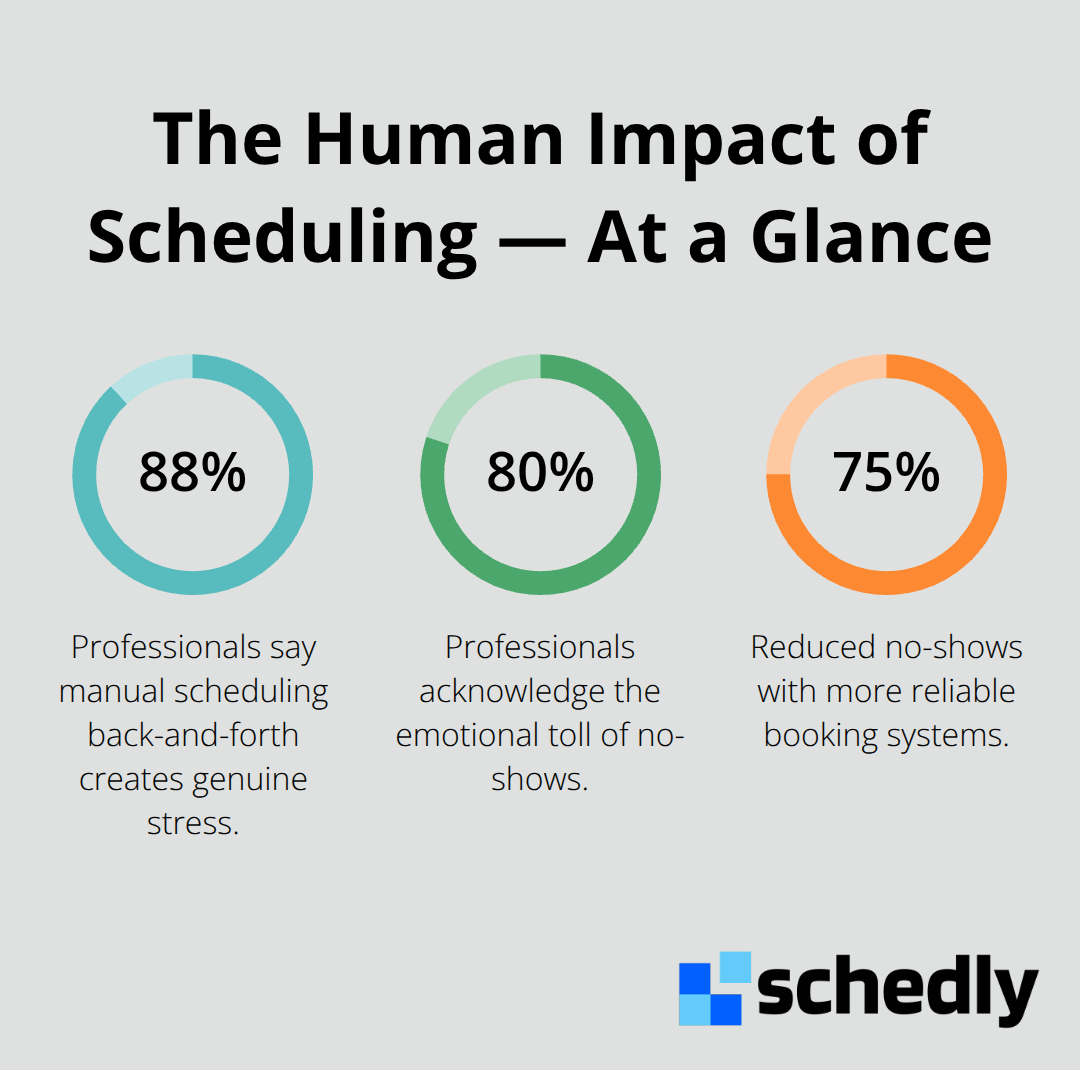
The average employee reschedules or cancels 4.7 meetings per week. Each cancellation triggers a cascade of follow-up emails, new time proposals, and rescheduling attempts. Eighty-eight percent of professionals report that the back-and-forth of manual scheduling creates genuine stress. This constant friction exhausts teams and fractures focus time.
Beyond internal meetings, client no-shows represent a direct revenue loss. Digital appointment notifications improve attendance rates, according to a BMJ Open systematic review and meta-analysis. This single statistic reveals why manual scheduling is economically indefensible for service-based businesses. A healthcare clinic losing appointments to no-shows doesn't just waste administrative time-it leaves appointment slots completely empty.
How Scheduling Errors Damage Customer Trust
Scheduling errors damage customer satisfaction immediately. Clients who experience double-booked appointments, missed confirmations, or timezone confusion lose confidence in your professionalism. A salon double-books stylists or a consulting firm misses billable client slots, and the problem compounds exponentially. 75% reduced no-shows result from more reliable booking systems, demonstrating how critical scheduling policies are to business outcomes.
The stress compounds for your team as well. Eighty percent of professionals acknowledge the emotional toll of no-shows. Your staff spends energy managing chaos instead of delivering excellent service. Automated systems eliminate this friction entirely-they handle confirmations, send reminders, and enforce policies without human intervention. This shift frees your team to focus on what actually matters: serving clients and growing your business.
How Automated Scheduling Actually Works
Real-Time Calendar Synchronization Prevents Double-Bookings
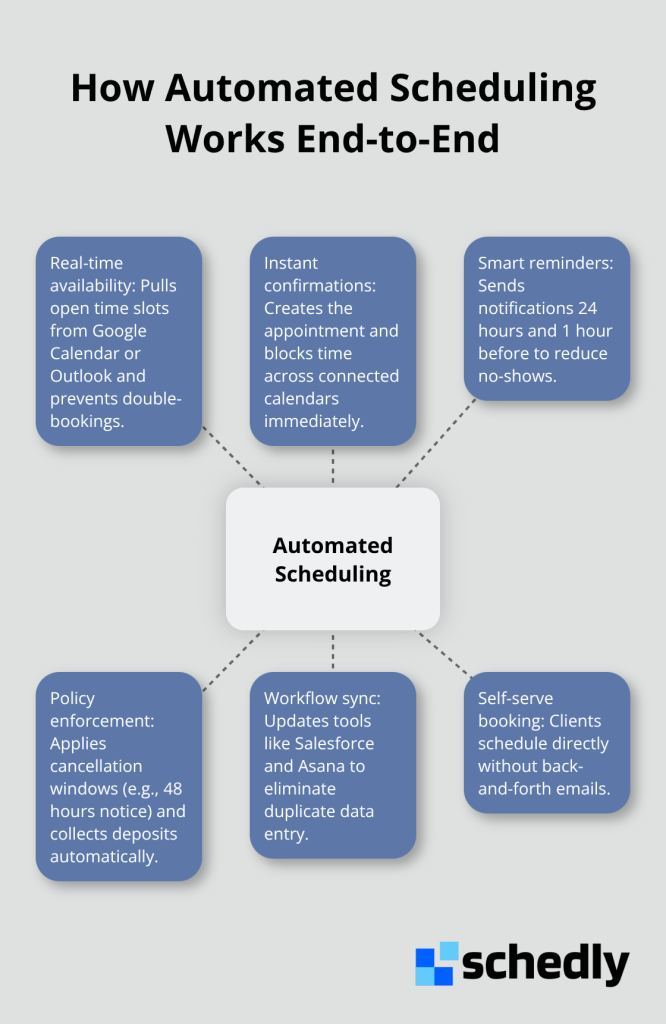
Automated scheduling systems connect your calendar directly to a booking interface that handles the entire appointment lifecycle without manual intervention. When a client visits your scheduling page, they see only the time slots you've marked as available-the system pulls this data in real-time from your calendar, Google Calendar, or Outlook, eliminating the possibility of double-bookings before they happen. The moment someone books a slot, the system creates the appointment, sends an instant confirmation email, and blocks that time on all connected calendars simultaneously. This real-time synchronization separates functional automation from broken systems that still require manual verification.
Schedly integrates directly with Google Calendar and Zoom, meaning when a client books a meeting, the calendar event appears immediately and a video conference link generates automatically. No back-and-forth emails. No manual calendar updates. The appointment exists across all your systems the moment the booking completes.
Reminders and Policies That Enforce Themselves
The second layer of automation handles the friction that manual scheduling creates: reminders and follow-ups. Automated systems send these reminders on a schedule you control-typically 24 hours before the appointment and again one hour before. This timing matters because it reduces no-shows without overwhelming clients with notifications.
The system also enforces your policies automatically. If you require 48 hours notice for cancellations, the system prevents cancellations within that window. If you charge a deposit, the system collects payment before confirming the appointment. These aren't optional features-they're essential safeguards that manual processes simply cannot enforce consistently.
Workflow Automation Eliminates Duplicate Data Entry
Workflow automation extends further by syncing appointment data with your other tools. If you use Salesforce for customer relationships or task management platforms like Asana, appointments automatically update those systems, eliminating duplicate data entry. Schedly offers integrations with popular apps like Salesforce, ensuring your scheduling operation connects seamlessly with the rest of your business infrastructure. The result is a scheduling operation that runs without daily human oversight, freeing your team to handle the work that actually requires human judgment and creativity. This automation becomes especially valuable when you consider which industries stand to gain the most from these systems.
Industries That Benefit Most From Automated Scheduling
Healthcare Practices Face the Highest Stakes
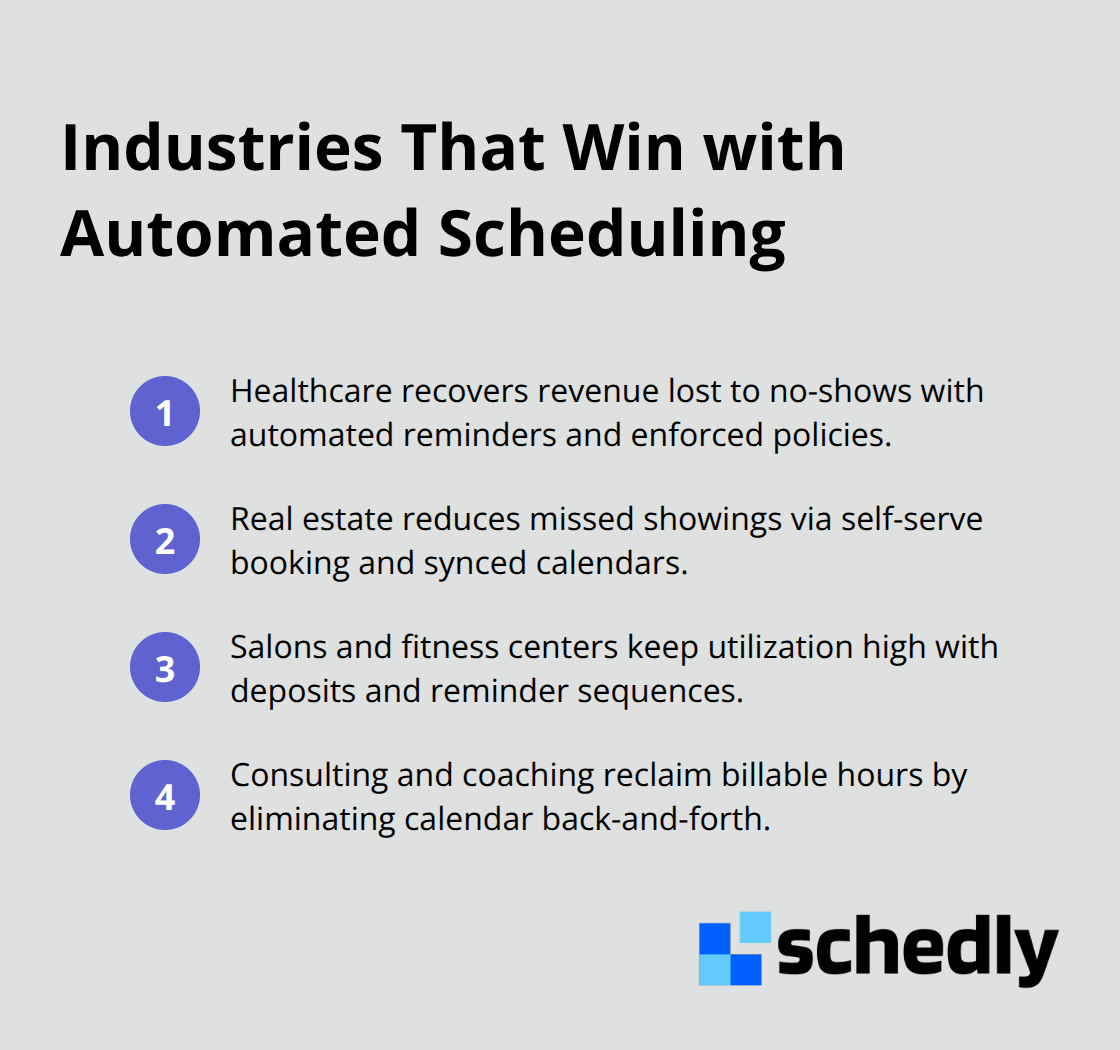
Healthcare clinics and medical practices suffer the most when scheduling fails. A patient no-show doesn't just waste a doctor's time-it represents lost billable hours that never return. Medical practices lose approximately 2-3% of annual revenue to no-shows, according to industry data. When a dermatologist schedules a 30-minute appointment and the patient doesn't arrive, that slot generates zero revenue while overhead costs continue. Automated reminders sent via email, SMS, or WhatsApp reduce missed appointments. Patients receive instant confirmations with appointment details when they book, reducing confusion about timing and location. Healthcare providers also benefit from enforced cancellation policies-requiring 24 hours notice before cancellations prevents last-minute gaps in the schedule that waste provider capacity.
Real Estate Agents Operate in High-Value Environments
Real estate agents work in a similar high-value environment where time directly translates to money. A property showing that fails to happen because of a scheduling miscommunication means a lost sale opportunity. Real estate teams manage dozens of showings weekly across multiple properties, making calendar conflicts inevitable without automation. Agents can share branded scheduling pages with clients and prospects, allowing self-service booking without back-and-forth phone calls or emails. When a prospect books a showing through an automated system, the agent receives instant notification, the appointment syncs with their calendar, and automated reminders ensure the prospect actually arrives.
Service Businesses Depend on Consistent Utilization
Salons, fitness centers, and service-based businesses operate on thin margins where utilization rates determine profitability. A hair salon with ten stylists needs to fill appointment slots consistently to cover payroll and overhead. When clients cancel last-minute or no-show, those slots remain empty and revenue vanishes. Automated systems enforce policies that reduce this waste-requiring deposits upfront, charging cancellation fees for late cancellations, and sending multiple reminders as appointment time approaches. Fitness centers benefit from the same principle: a personal training slot that goes unfilled because the client forgot about the appointment costs the business real money. Automated scheduling allows fitness centers to set up recurring appointments for ongoing client commitments and collect payment automatically.
Consulting and Professional Services Reclaim Billable Hours
Consulting firms, coaching practices, and tutoring services face identical challenges. A consultant who spends 30 minutes daily managing calendar requests and chasing confirmations loses billable hours that directly impact revenue. Automated scheduling lets clients book directly, see real-time availability, and receive reminders, transforming the consultant's calendar from a source of friction into a revenue-generating system. The consultant focuses on client work instead of calendar administration (a shift that compounds productivity gains across the entire practice).
The Universal Pattern Across All Industries
The common thread across all these industries remains simple: when appointment slots go unfilled, revenue disappears. Automation fills those slots and keeps them filled. Whether a healthcare provider loses a patient slot, a real estate agent misses a showing, or a salon wastes a stylist's time, the financial impact hits the same way. Automated scheduling systems eliminate the administrative friction that causes these losses, allowing businesses to operate at full capacity without the overhead that manual processes demand.
Final Thoughts
The shift from manual scheduling to automated appointment scheduling represents one of the highest-ROI operational changes a business can make. You eliminate thousands of dollars in annual administrative overhead, reduce no-shows that drain revenue, and free your team to focus on client relationships instead of calendar management. The financial case is straightforward: when employees stop spending hours on scheduling coordination, that time converts directly into billable work, client service, or business growth.
Automated appointment scheduling works by connecting your calendar to a booking system that handles the entire appointment lifecycle without human intervention. Clients see real-time availability, book instantly, receive confirmations automatically, and get reminders that actually prevent no-shows. Your calendar stays synchronized across all platforms, policies enforce themselves, and appointment data flows into your other business tools without duplicate entry. Schedly connects directly with Google Calendar, Zoom, Salesforce, and other tools you already use, so you don't need to rebuild your entire workflow.
As your business grows, manual scheduling becomes exponentially more painful while automated systems scale effortlessly. A healthcare practice adding a second provider, a real estate team expanding to five agents, or a salon hiring additional stylists all face the same reality: manual scheduling breaks under growth. Automation grows with you, and your team stops managing calendars and starts managing clients.