
Schedly resources
Credit Card Gateway Setup: Launch Secure Payments Today
Payment fraud costs businesses billions annually, and a weak credit card gateway setup leaves you vulnerable. At Schedly, we've seen firsthand how the right payment infrastructure protects both your revenue and your customers' trust.
This guide walks you through securing your payment system from day one, covering everything from choosing a processor to maintaining compliance long-term.
Why Payment Security Matters
Fraud costs U.S. businesses reported losses exceeding $16 billion annually, according to the FBI's Internet Crime Complaint Center. A single breach wipes out months of profit and destroys customer confidence permanently. When you process credit card payments without proper security measures, you expose customer data that criminals will monetize immediately. The cost of recovering from a breach averages $4.45 million per incident, which includes notification expenses, legal fees, and lost business. Payment security isn't optional for any business handling customer transactions.
Fraud Prevention Protects Your Revenue
Fraudsters target businesses with weak payment infrastructure because they know the payoff is easy. Card-not-present fraud increased in 2024, making online businesses prime targets. Proper gateway security with encryption and tokenization reduces your exposure to chargebacks and stolen card data. Stripe reports that businesses using their fraud detection system prevent up to 50% of attempted fraud before it happens. This means you keep the revenue instead of disputing charges months later.
A properly configured gateway with real-time monitoring flags suspicious transactions instantly-multiple transactions from different locations within minutes, unusually large orders, or mismatched billing addresses. These automated checks catch fraud before your customers even notice something wrong. The PCI Security Standards Council requires all businesses processing cards to implement specific security controls, but following these standards actually protects your bottom line, not just your compliance record.
Customer Trust Determines Long-Term Survival
Customers abandon purchases when they feel unsafe entering payment information. A survey by Deloitte found that 71% of consumers consider data security a deciding factor when choosing where to shop. When your payment page displays security indicators like SSL certificates and transparent fraud protection, conversion rates improve. Customers who see that you take security seriously complete transactions at higher rates.
Clear privacy policies, secure checkout flows, and communication about how you protect data build this trust. Companies that communicate their security practices gain competitive advantage because customers increasingly demand transparency. Customers return to businesses where they feel their information is handled responsibly, creating loyalty that extends far beyond individual transactions.
Compliance Violations Create Real Financial Risk
PCI DSS compliance violations result in fines ranging from $5,000 to $100,000 per month depending on the violation severity. More importantly, non-compliance creates legal liability when breaches occur. Payment Card Industry standards exist because massive breaches taught the industry hard lessons about what happens without proper controls. Meeting these standards means regular security audits, encrypted data storage, restricted access to payment information, and documented security procedures.
Established gateways like Stripe and PayPal handle much of this burden for you, which significantly reduces your compliance workload. Small businesses often assume they're too small to be targeted, but hackers specifically target small businesses because they typically have weaker defenses and fewer security resources. The right payment infrastructure protects you from both financial loss and regulatory penalties.
Now that you understand why payment security matters, the next step is selecting and setting up a gateway that meets your business needs.
Which Payment Processor Should You Choose
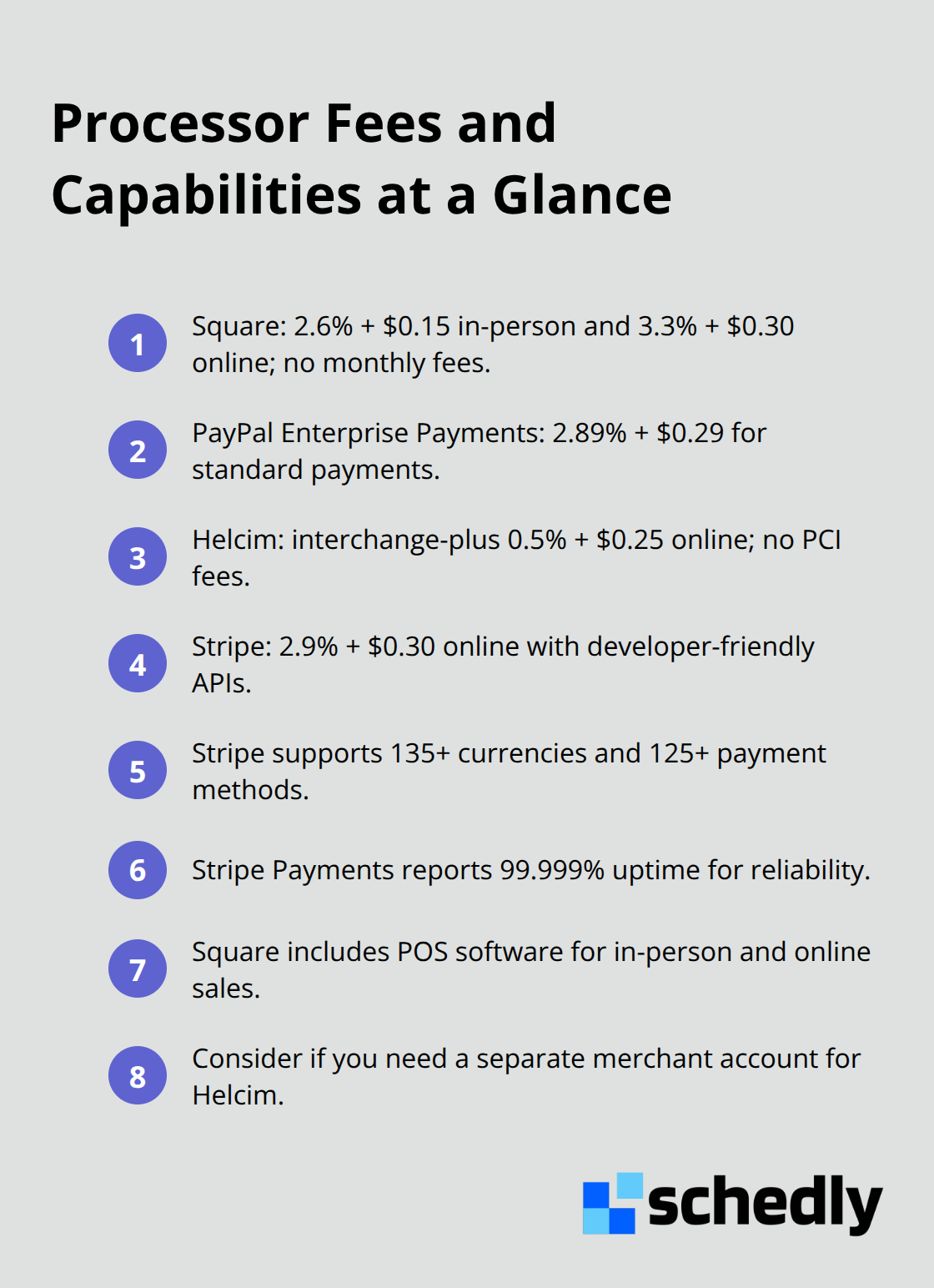
Selecting the right processor determines how smoothly your business handles payments and how much you'll actually spend on fees. Your transaction volume matters most here. If you process less than $5,000 monthly, flat-rate gateways like Square or PayPal keep costs predictable with no surprises. Square charges 2.6% plus 15 cents for in-person transactions and 3.3% plus 30 cents online, with no monthly fees or long-term contracts. PayPal Enterprise Payments runs 2.89% plus 29 cents for standard payments, making both solid choices for small operations. However, if you're processing more than $5,000 monthly, interchange-plus pricing becomes your advantage. Helcim uses this model at 0.5% plus 25 cents online with transparent fee breakdowns and no PCI fees, which saves hundreds monthly compared to flat-rate options. Stripe handles 135+ currencies across online checkout and charges 2.9% plus 30 cents for online transactions, making it ideal if you sell internationally or need developer-friendly APIs. The processor choice isn't just about fees though. Stripe Payments reports 99.999% uptime, which matters when your payment system goes down during peak sales.
Integration Difficulty Varies by Platform
Integration difficulty varies dramatically between processors. Shopify Payments integrates directly into Shopify stores with zero custom coding, making it the fastest path if you already use Shopify. Jotform offers 150+ integrations including Stripe and PayPal with no additional transaction fees, which simplifies payment collection through forms without touching code. However, Stripe integration demands technical work. You'll generate API keys, protect secret keys on your server while using publishable keys on the client side, and build endpoints to handle payment intents. This takes 2-4 weeks for a developer unfamiliar with Stripe, though their JavaScript, Python, and Ruby libraries accelerate the process.
Sandbox Testing Prevents Live Disasters
Start with a sandbox environment before touching production. Use test card numbers to simulate transactions, edge cases like insufficient funds, and expired cards. Only move to production keys once you've verified the complete payment flow works end-to-end. Stripe Checkout provides the fastest integration path if you don't need customization, while Stripe Elements gives you UI control at the cost of more development time. Fraud detection matters during setup. Enable Stripe Radar immediately and configure it to your risk tolerance rather than leaving defaults active. Link and accelerated checkout options reduce friction and checkout abandonment, with some merchants reporting 20-30% faster completion times.
Live Transactions Reveal Hidden Problems
Live transactions reveal problems that sandbox testing misses. Process 10-20 real test transactions before going fully live, monitoring for settlement timing and how funds appear in your bank account. Deposits take one to two business days with most processors. Helcim deposits can stretch to two business days, so budget accordingly if cash flow timing matters. Monitor your first week of live transactions obsessively. Set alerts for failed transactions, unusual patterns, and chargebacks. Your processor's dashboard should show authorization rates and decline reasons. High decline rates suggest your fraud rules are too aggressive and reject legitimate customers. Stripe Billing supports subscriptions and metered usage if you offer recurring revenue, but this requires additional configuration and testing of renewal flows. Tax automation becomes essential once you scale. Stripe includes tax calculation for sales tax and VAT across jurisdictions, preventing compliance headaches as you expand. Test refunds and disputes thoroughly because customer-initiated chargebacks follow different rules than refunds you process. A customer disputing a charge creates liability and fees, while refunds you initiate simply reverse the transaction cost-free.
Once your payment system runs smoothly in production, your attention shifts to the ongoing security practices that protect both your business and your customers' data. The next chapter covers the specific protocols your team must follow to maintain that protection.
Securing Your Payment Operations Daily
Set Up Real-Time Fraud Alerts
Your payment system runs continuously, which means threats operate continuously too. Real-time fraud alerts catch fraud before it damages your business, but this requires setting up actual alerts rather than hoping your processor flags problems. Configure your payment processor's dashboard to send notifications for transactions exceeding a threshold you set-typically 2-3 times your average order value. Stripe Radar catches roughly 50% of fraud attempts automatically, but you still need human oversight because sophisticated fraudsters test your system with small charges before attempting larger ones.
Set alerts for multiple transactions from different geographic locations within 15 minutes, mismatched billing and shipping addresses, and velocity spikes in transaction volume. Check your processor's fraud reports weekly during your first month, then monthly once patterns stabilize. Most businesses discover their fraud detection is either too aggressive (rejecting legitimate customers) or too lenient (allowing suspicious transactions) only after reviewing actual transaction data. Adjust your risk settings based on what you observe, not what feels right theoretically.
Document Your Fraud Control Changes
Document every rule change you make because regulators expect audit trails showing your fraud controls evolved intentionally, not randomly. This documentation protects you during compliance audits and demonstrates that you actively manage fraud risk rather than relying solely on automated systems. Your processor's logs provide the foundation, but you should maintain your own records of when you adjusted thresholds and why.
Maintain PCI Compliance Year-Round
PCI compliance requirements aren't a one-time checkbox-they're an ongoing operational requirement that costs money and attention. The PCI Security Standards Council requires annual security audits, encrypted storage of any card data you retain, restricted access to payment systems, and documented procedures your team follows. Most businesses mistake using a hosted payment processor as complete compliance, but you still own responsibility for your systems that touch payment data.
Never store card numbers, even encrypted ones, unless you have a specific business reason and proper certification. Stripe and PayPal handle tokenization, meaning they return a token representing the card instead of the actual number, which eliminates your storage burden entirely. If your team accesses production systems, they need individual login credentials with activity logging-shared passwords and unmonitored access create liability when breaches occur.
Update Systems and Test Thoroughly
Update your payment infrastructure whenever your processor releases security patches, which typically happens monthly. Test updates in a sandbox environment first because broken updates cause transaction failures that damage revenue and customer trust simultaneously. This testing phase prevents live outages that interrupt customer transactions and erode confidence in your payment system.
Train Your Team on Payment Data Handling
Train your team that payment data requires different handling than other business information. Employees should never email card numbers, write them in notes, or discuss them in unsecured channels. A single employee forwarding a customer's card details to a personal email creates breach liability that fines and legal costs will dwarf any savings from skipping training. Conduct security training annually at minimum, covering password management, phishing recognition, and your specific company procedures for handling payment information.
Final Thoughts
Your credit card gateway setup succeeds when you treat security as an ongoing operational practice rather than a one-time project. The foundation you've built through this guide covers the essentials: selecting a processor that matches your transaction volume, integrating it properly with sandbox testing before going live, and establishing fraud alerts that catch problems before they cost you money. These steps prevent the majority of payment security failures that damage businesses, but the real protection comes from what happens after launch through monthly reviews of fraud reports, annual security audits, and regular updates to your payment infrastructure.
Your team's behavior determines whether your security measures actually work, since employees who understand why payment data requires special handling become your strongest defense against breaches caused by human error. The cost of training your team on security protocols is negligible compared to the cost of recovering from a breach or paying PCI compliance fines. Consistent monitoring, regular team training, and documented compliance procedures that evolve as threats change protect both your revenue and your customers' trust.
If you manage customer bookings alongside payments, Schedly integrates secure payment processing through Stripe and PayPal directly into your scheduling workflow, eliminating the friction of separate payment systems and keeping customer data centralized where your team can manage it securely. Schedly's automation reduces manual payment handling, which decreases the opportunities for security mistakes. Start implementing these practices immediately and adjust your approach based on what you observe in your actual transaction data.