
Schedly resources
Customizing Your Booking Flow: How to Ask the Right Questions Before the Call
In the fast-paced world of modern scheduling, the importance of creating an efficient booking flow cannot be overstated. It’s no longer enough to simply add time slots to a calendar—your booking process is a strategic tool that can determine the success of your meetings. By customizing your booking flow and asking the right questions before the call, you can gather critical information, set clear expectations, and ultimately drive better outcomes. Whether you’re a consultant, sales professional, or service provider, refining this process transforms ordinary interactions into meaningful connections that deliver value.
This comprehensive guide explores the importance of pre-call questions, how to craft them effectively, common mistakes to avoid, and actionable best practices. By the end, you’ll have the tools you need to design a booking flow that not only saves time but enhances the quality of your engagements.
Understanding the Importance of Pre-Call Questions
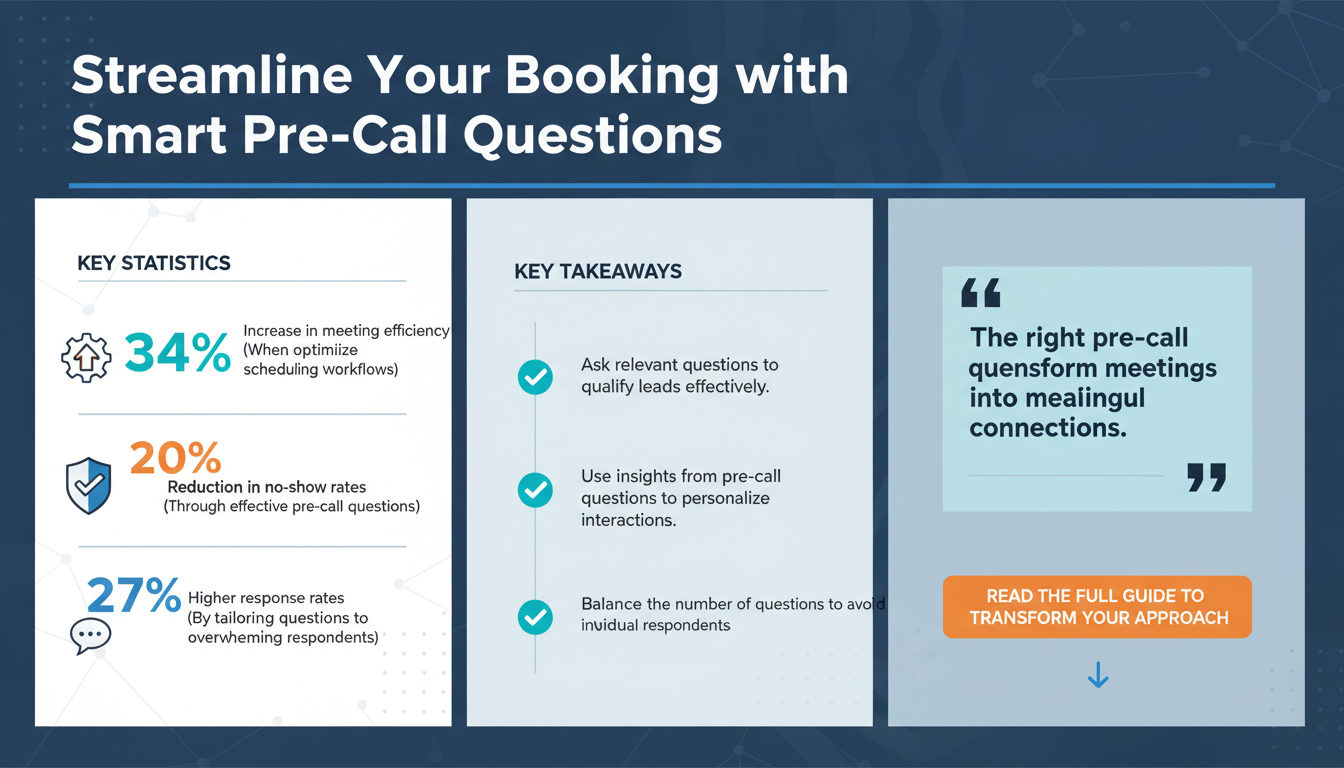
Pre-call questions are the backbone of an effective booking flow. They serve as a foundation for gathering essential insights, qualifying leads, and preparing for productive conversations. Research from Forrester highlights that businesses optimizing their scheduling workflows experience a 34% increase in meeting efficiency and a 20% reduction in no-show rates. This underscores the pivotal role of strategically crafted pre-call questions in streamlining operations.
Here are some key benefits of asking the right pre-call questions:
- Improved qualification: Determine whether a prospect or client is the right fit before investing time in a meeting.
- Personalized interactions: Use the data gathered to tailor your conversation, increasing your chances of building rapport and achieving desired outcomes.
- Efficient preparation: Equip yourself with the knowledge needed to address specific challenges or objections during the call.
For example, imagine you’re a marketing consultant trying to understand a potential client’s pain points. Pre-call questions such as “What marketing challenges are you currently facing?” or “What are your top priorities this quarter?” can provide actionable insights that allow you to hit the ground running.
However, crafting effective pre-call questions requires thoughtfulness and precision. Asking too many questions can overwhelm respondents, while failing to ask enough can leave you underprepared. Striking the right balance is critical to achieving an optimal booking flow.

How to Identify the Right Questions for Your Booking Flow
To craft impactful pre-call questions, it’s essential to first identify the purpose of your call. Are you qualifying a lead, diagnosing a problem, or pitching a solution? Each objective requires a tailored approach to question selection. The R.I.G.H.T Framework provides a systematic way to ensure your questions are effective.
The R.I.G.H.T Framework for Pre-Call Questions
This framework ensures your questions are:
- Relevant: Focus on questions directly tied to the purpose of the meeting.
- Insightful: Ask questions that reveal key details about the respondent’s needs or challenges.
- Goal-oriented: Align every question with your desired outcome.
- Human-centric: Phrase questions conversationally to make respondents feel comfortable.
- Tailored: Adapt questions based on the individual’s industry, role, or objectives.
Let’s look at examples of tailored questions based on goals:
- Goal: Qualify a lead → “What specific challenges are you currently facing in [area]?”
- Goal: Diagnose a problem → “Can you describe the impact of [issue] on your operations?”
According to Gartner, tailoring questions to individual respondents increases response rates by 27%. This highlights the importance of customization in achieving meaningful engagement.

Common Mistakes in Designing Your Booking Flow
Even seasoned professionals can fall into traps when designing their booking flows. Avoiding these common mistakes is essential to creating a streamlined and effective process:
- Overloading the form: Asking too many questions can deter respondents. Limit your form to 3-5 high-impact queries.
- Using generic language: Avoid vague or overly formal wording that feels impersonal.
- Failing to prioritize: Place the most critical questions at the start of your form to ensure they’re answered.
- Neglecting mobile optimization: With 58% of bookings now happening on smartphones (Statista), it’s vital to ensure your booking flow is mobile-friendly.
Case Study: A financial advisor redesigned their booking form after noticing a high drop-off rate. By reducing the number of questions and simplifying wording, they improved form completion rates by 45% in just one month.

Best Practices for Crafting Effective Booking Forms
To maximize the effectiveness of your booking flow, follow these best practices:
1. Keep It Simple
Limit the number of questions to avoid overwhelming respondents. Focus on essentials and save deeper inquiries for the actual call.
2. Use Conditional Logic
Conditional logic allows you to streamline the form by revealing follow-up questions based on previous responses. For example, if a respondent selects “Yes” to needing additional services, the form can display relevant queries automatically.
3. Offer Context
Provide brief explanations for each question. Adding notes like, “This helps us better understand your needs,” can increase response quality.
4. Optimize for Devices
Ensure your booking form is responsive and user-friendly on both desktop and mobile devices. Research from McKinsey shows intuitive forms improve completion rates by up to 40%.
Examples of Strategic Pre-Call Questions
Strategic pre-call questions can transform your booking flow from transactional to insightful. Here are examples tailored for different industries:
Consulting
- “What is the biggest challenge your team is facing this quarter?”
- “How do you currently measure success in [area]?”
Sales
- “What are your top priorities for improving [product/service]?”
- “Have you explored similar solutions before, and what were the results?”
Healthcare
- “What symptoms are you experiencing, and how long have they persisted?”
- “Do you have any preferences for treatment methods?”

FAQ: Answering Common Questions About Booking Flow Customization
1. How many questions should I include in my booking flow?
Limit your form to 3-5 essential questions. This ensures high completion rates without overwhelming respondents.
2. Can I automate my booking flow?
Platforms like Schedly enable automation and conditional logic to streamline workflows. Learn more about Schedly’s automation features.
3. What if respondents skip critical questions?
Use required fields for must-have information, and follow up during the call to fill any gaps.
4. How can I track the success of my booking flow?
Monitor metrics like completion rates, response quality, and meeting outcomes. Tools reviewed on G2 can provide advanced analytics.
5. Should I customize questions for existing clients?
Absolutely! Tailoring questions for returning clients demonstrates attentiveness and builds stronger relationships.
Conclusion: Elevate Your Booking Flow Today
Customizing your booking flow is an essential step toward improving efficiency, enhancing interactions, and achieving better outcomes. By asking the right pre-call questions, you can effectively prepare, build rapport, and ensure every meeting delivers value. Whether qualifying leads, solving problems, or pitching solutions, a well-designed booking flow is your key to success.
Ready to optimize your scheduling process? Explore Schedly’s pricing plans or check out our guide on automation best practices.