
Schedly resources
Healthcare Provider Scheduling That Saves Time And Boosts Access
Healthcare provider scheduling is broken in most facilities. Long wait times frustrate patients, manual processes drain staff, and inefficient shifts tank both morale and revenue.
At Schedly, we've seen firsthand how the right scheduling system transforms operations. Automated booking, real-time coordination, and data-driven staffing decisions don't just save hours-they directly improve patient access and your bottom line.
Why Healthcare Scheduling Failures Cost More Than You Think
The Financial Toll of Broken Scheduling Systems
Hospitals and practices lose up to $150,000 annually due to inefficient appointment scheduling and missed visits. That's not a rounding error-that's real money walking out the door. When patients can't access appointments quickly, they don't wait patiently. They switch providers. A study from Health Affairs found that practices offering rapid access within 7 days see mixed effects on patient satisfaction, yet most facilities still operate on a 3 to 4 week booking window. The gap between what patients need and what healthcare delivers creates a cascading failure.
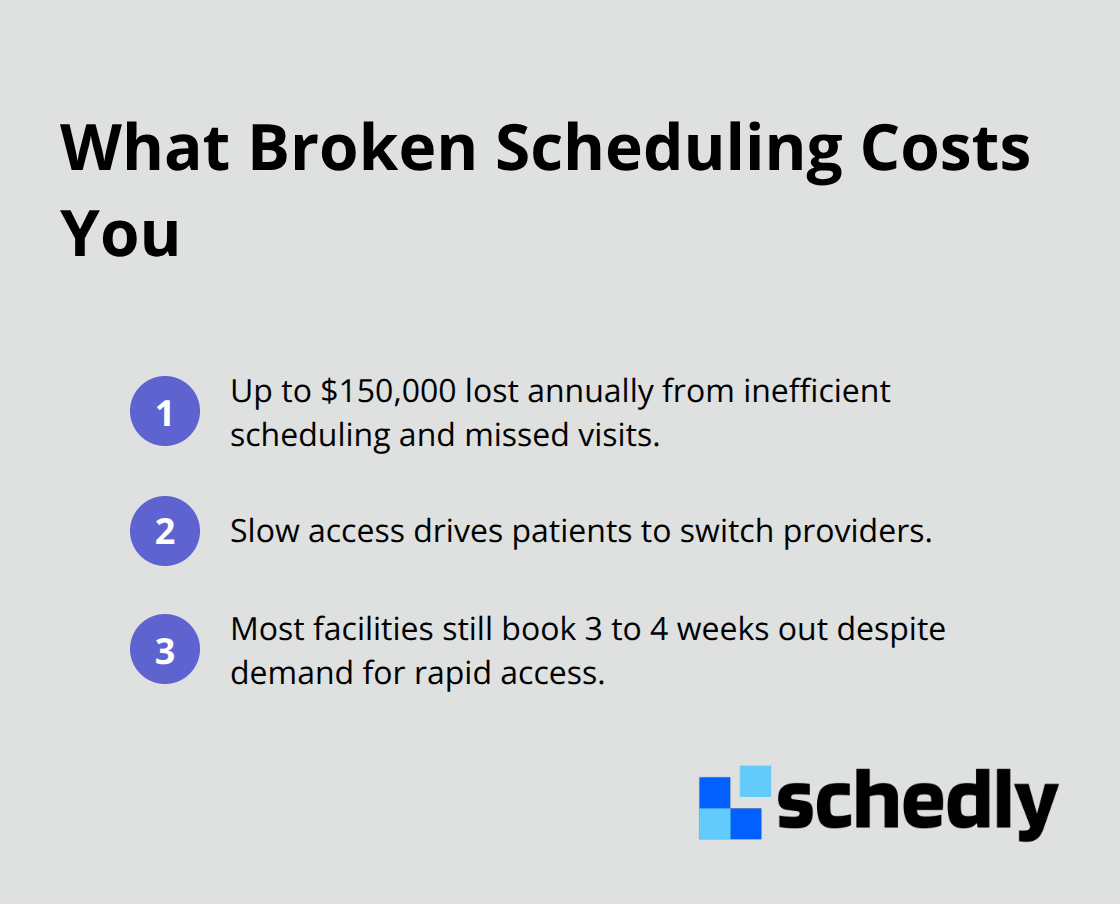
Long wait times directly reduce revenue and damage patient loyalty. Younger patients especially refuse to tolerate outdated phone-based scheduling-68 percent say they're more likely to return to providers offering digital self-scheduling and instant confirmations. When your competitors offer online booking and you don't, you lose market share.
Manual Processes Destroy Staff Productivity
Behind every scheduling failure sits a front-office team drowning in manual work. Staff spend hours on phone calls, data entry, and paperwork that automation could eliminate in seconds. The problem compounds when scheduling information doesn't sync with your electronic health records. Double bookings happen. Insurance eligibility checks occur at check-in instead of before the appointment. Patients arrive unprepared. Clinicians run behind. The day spirals into chaos.
Healthcare facilities that rely on spreadsheets, binders, or disconnected systems report that automation boosts staff productivity by 30 to 40 percent. That time gets redirected toward actual patient care instead of administrative drudgery. More critically, manual scheduling creates the conditions for clinician burnout. When providers can't trust their schedules, when they face constant interruptions to handle booking problems, their stress skyrockets.
The Hidden Cost of Clinician Burnout
Team-specific workload and staffing directly influence burnout odds among primary care teams, research from the Journal of General Internal Medicine confirms. Inefficient scheduling doesn't just waste hours; it fractures the entire operation and pushes experienced staff toward the exit. The moment your best clinicians leave, recruitment costs spike and patient care suffers. Modern scheduling systems address this by removing the administrative friction that exhausts your team. When staff no longer battle disconnected systems and manual processes, they focus on what matters-patient care and their own well-being. This shift transforms not just productivity metrics but the entire culture of your facility. The question isn't whether you can afford to modernize your scheduling. The question is whether you can afford not to.
How Modern Scheduling Software Transforms Operations
Automation Reclaims Hours of Administrative Work Daily
Automated scheduling systems eliminate the administrative work that consumes your front-office staff's entire day. A practice switching from phone-based booking to real-time online scheduling typically cuts appointment-related administrative time by 30 to 40 percent according to healthcare efficiency research. That translates to hours reclaimed daily. When patients book themselves through an online portal integrated with your electronic health records, no staff member manually enters data, verifies insurance eligibility, or searches for available slots. The system handles all of it instantly.
Insurance verification happens in real time during the booking process, not at check-in when problems surface. This integration matters enormously: automated scheduling systems that connect directly to your EHR improve data accuracy and compliance reporting. Staff who previously spent two to three hours daily on booking administration now redirect that energy toward patient communication, care coordination, and actual clinical support.
24/7 Access Attracts Patients Your Competitors Lose
Offering 24/7 online scheduling fundamentally changes how patients experience your practice. 68% of patients are more likely to return to providers offering digital self-scheduling and instant confirmations. Your competitors who still rely on phone-based booking during business hours are losing these patients.
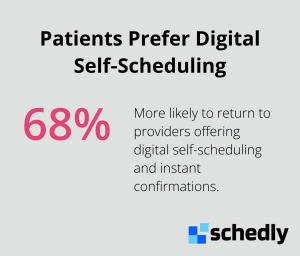
Younger patients especially refuse to tolerate outdated phone-based systems. They expect the same frictionless booking experience they get from retail and hospitality. Meeting this expectation directly impacts your ability to attract and retain patients in an increasingly competitive market.
Real-Time Coordination Synchronizes Your Entire Team
Real-time staff coordination powered by modern scheduling software prevents the gaps and overlaps that plague manual systems. When your nurses, physicians, and administrative staff access the same live schedule from any device, double bookings vanish. Telehealth slots can be interspersed with in-person visits or organized into dedicated blocks throughout the week, ensuring seamless transitions between care types.
Automated reminders sent 24 to 48 hours before appointments reduce no-show rates dramatically, stabilizing your daily patient flow and protecting revenue. The scheduling system becomes the operational backbone that synchronizes your entire team. With everyone working from the same source of truth, coordination problems disappear and your facility operates as a unified operation rather than disconnected departments.
These operational improvements create the foundation for the next critical step: translating efficiency gains into measurable business outcomes. The time your staff reclaims and the access you provide must connect directly to your bottom line through strategic implementation and continuous measurement.
Making Scheduling Changes Stick Without Disrupting Operations
The gap between modern scheduling software and actual implementation is where most healthcare facilities fail. You can purchase the best system available, but if it doesn't connect to your existing electronic health records or if staff resist the change, you gain nothing. Successful implementation requires three specific, measurable actions that directly address the technical and behavioral barriers preventing adoption.
Integrate Scheduling with Your Electronic Health Records First
Your scheduling system must sync bidirectionally with your electronic health records in real time. When a patient books an appointment online, their demographics, insurance information, and medical history populate automatically into your EHR without manual entry. This eliminates the double-entry problem that wastes staff time and creates data conflicts.
Configure your system to flag insurance eligibility issues during booking, not at check-in. Pre-visit insurance verification reduces administrative burden and improves reimbursement outcomes. Test the integration thoroughly in a single clinic before rolling out system-wide. Assign one staff member to monitor the first week of data flow and document any sync failures. This pilot approach prevents catastrophic errors and gives your team confidence before full deployment. Set a specific timeline for integration completion, typically 2 to 4 weeks depending on your EHR vendor's API capabilities.
Configure Automated Reminders at the Right Time
Automated reminders must send 24 to 48 hours before appointments, not the day-of texts that patients ignore. Automated appointment reminders reduce no-shows, directly protecting your revenue. Include a one-click rescheduling option in every reminder so patients can change appointments without calling.
Send reminders via the patient's preferred channel: text for younger demographics, email for older patients, or both. Track which reminder method drives the lowest no-show rate for each patient segment and adjust accordingly. Your analytics dashboard should display no-show rates by appointment type, provider, and time of day. Identify patterns, such as whether afternoon slots have higher no-show rates than morning slots, and adjust staffing or overbooking strategies accordingly. Hospitals that actively monitor no-show data weekly rather than monthly catch problems faster and respond with targeted interventions.
Use Analytics to Drive Staffing Decisions
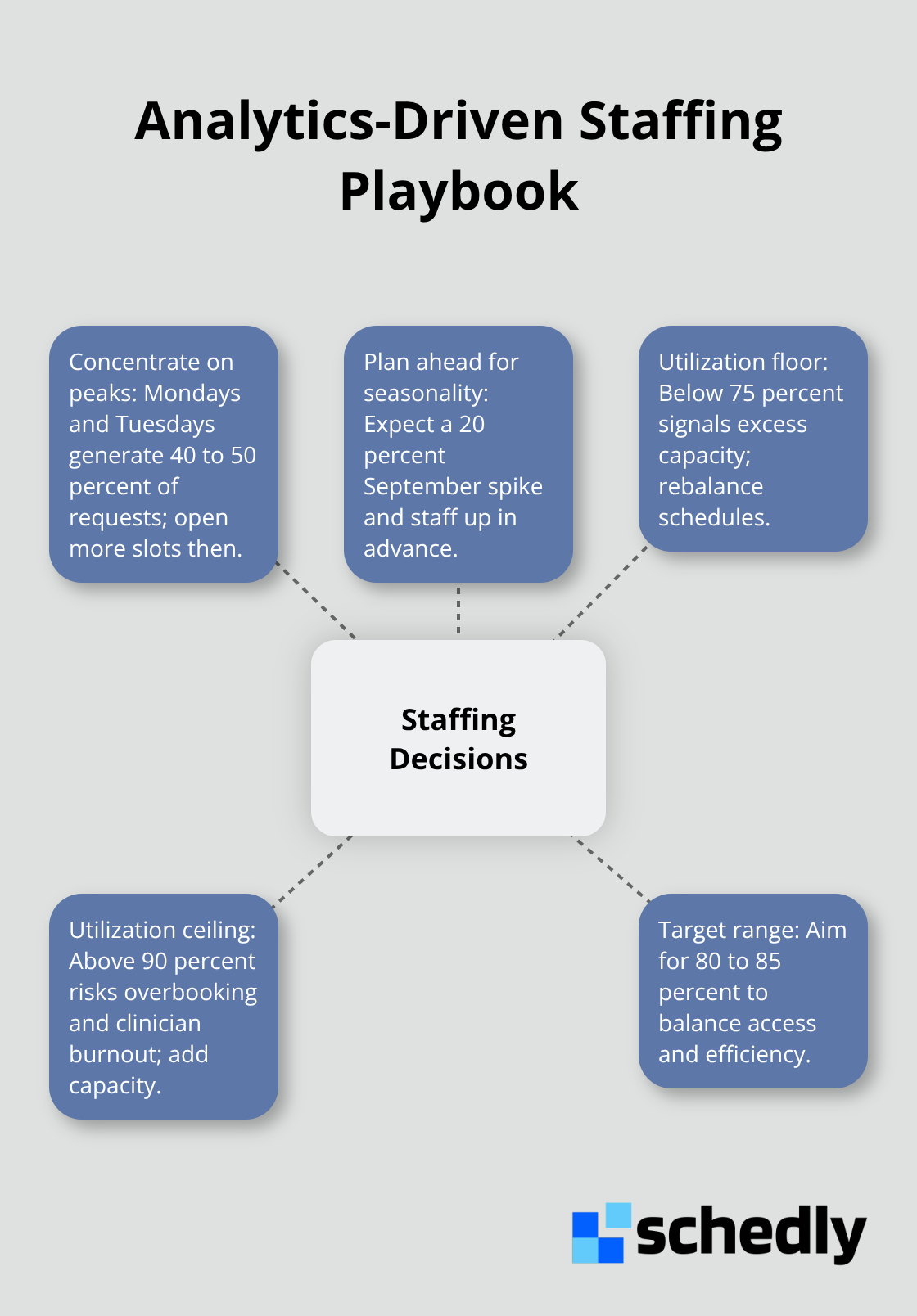
Analytics should drive staffing decisions, not intuition. Pull data on peak demand times by day of week, time of day, and appointment type. Most practices discover that Mondays and Tuesdays generate 40 to 50 percent of weekly appointment requests, yet they staff Fridays as heavily as Mondays. Adjust your scheduling templates to open more slots during peak demand windows and consolidate low-demand time into administrative blocks.
Use predictive analytics to forecast next month's demand based on historical patterns and seasonal trends. If you see a 20 percent spike in appointments every September, schedule additional clinical staff and open more appointment slots in advance. This prevents the reactive hiring and overtime that drain budgets. Monitor appointment utilization rates weekly: what percentage of available slots actually get booked? If your utilization sits below 75 percent, your schedule contains too many open slots and you're wasting resources. If it exceeds 90 percent, you risk overbooking and clinician burnout.
Final Thoughts
Better access translates directly to patient loyalty and revenue growth. When patients book appointments within hours instead of weeks, they complete their visits and follow treatment plans. Practices offering rapid access within 7 days report higher patient satisfaction and lower dropout rates, while healthcare provider scheduling systems that prioritize speed attract patients your competitors lose.
Optimized schedules lower operational costs by eliminating waste. Staff reclaim 30 to 40 percent of their administrative time through automation and redirect those hours toward revenue-generating activities or reduce overtime expenses. Real-time EHR integration prevents costly errors like double bookings and missed insurance verifications, while automated reminders reduce no-shows and protect the $150,000 in annual revenue that inefficient scheduling typically costs healthcare facilities.
Data-driven scheduling decisions improve both quality and profitability simultaneously. Analytics reveal which appointment types, providers, and time slots generate the highest utilization and patient satisfaction, allowing you to adjust staffing to match actual demand instead of guessing. At Schedly, we built our platform to handle exactly this challenge-visit Schedly to see how modern scheduling software works in practice.