
Schedly resources
How Adding Padding Between Bookings Improves Quality

Back-to-back bookings drain your team and frustrate your clients. When there's no appointment buffer time between services, staff scramble to prepare, documentation piles up, and quality suffers.
At Schedly, we've seen how even small gaps between appointments transform both operations and client satisfaction. This guide shows you exactly how to implement padding that works for your business.
Why Padding Actually Improves Results
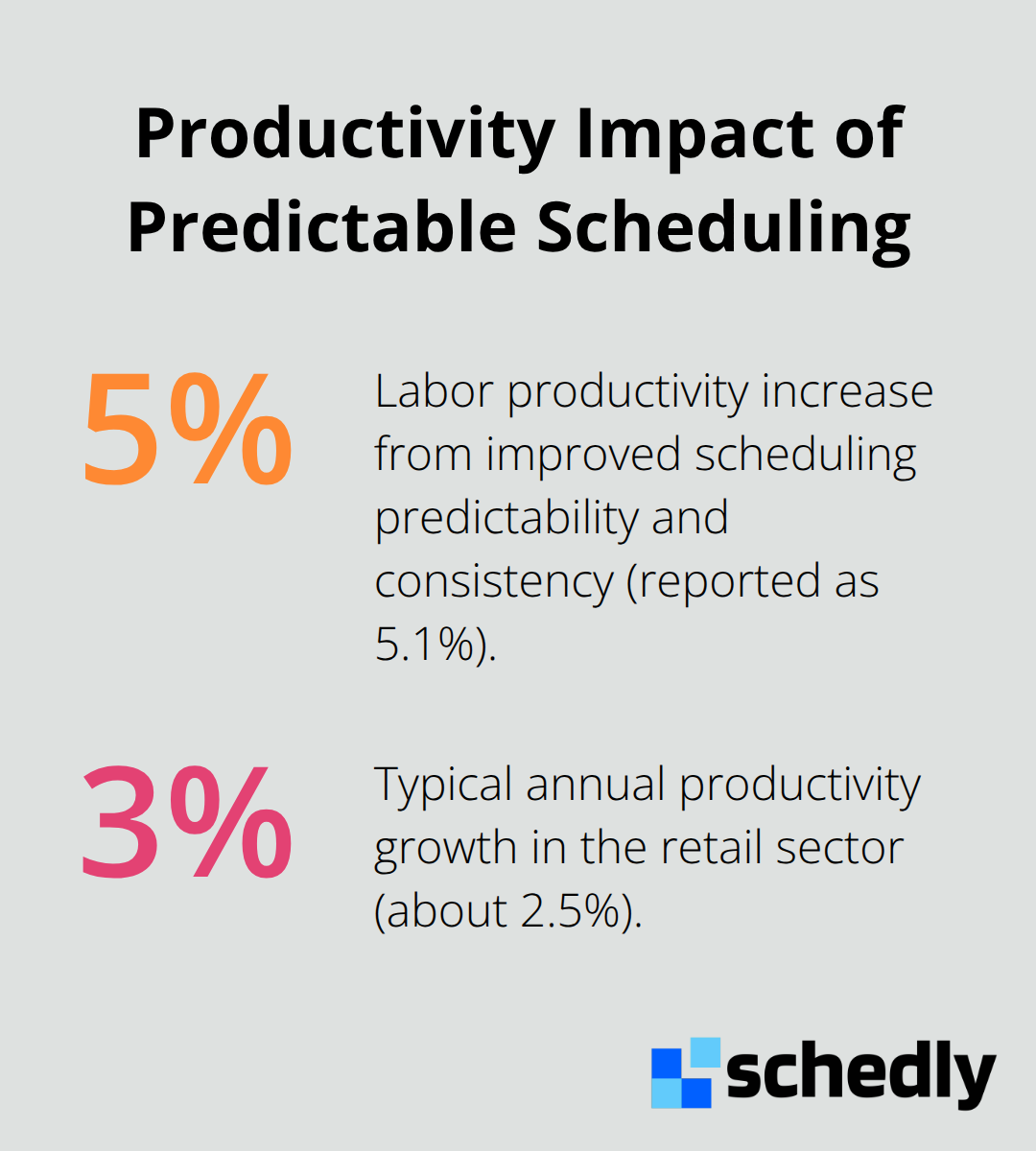
Padding between bookings isn't a luxury-it's a necessity that directly impacts your bottom line. When your team moves from one appointment to the next without breathing room, quality deteriorates fast. A study by Kesavan et al. published in Management Science examined scheduling interventions across 28 retail stores and found that improving schedule predictability and consistency boosted labor productivity by 5.1%, which far exceeded the retail sector's average annual productivity growth of about 2.5%. That productivity gain came partly because employees had time to prepare, wrap up properly, and transition mentally between tasks.
Preparation Time Separates Good Service from Great Service
Your clients notice the difference immediately. When a therapist has 10 minutes between appointments instead of back-to-back bookings, they review client notes, set up the treatment room properly, and arrive mentally present. When a consultant has 15 minutes after a client call, they document key decisions and prepare materials for the next meeting instead of scrambling. This isn't about being leisurely-it's about your team actually delivering what clients paid for. Scheduling interventions improve employee stress and task performance. Preparation time reduces errors. Your clients perceive this as professionalism; your business experiences it as reduced complaint volume and higher retention rates.
Administrative Work Requires Dedicated Time
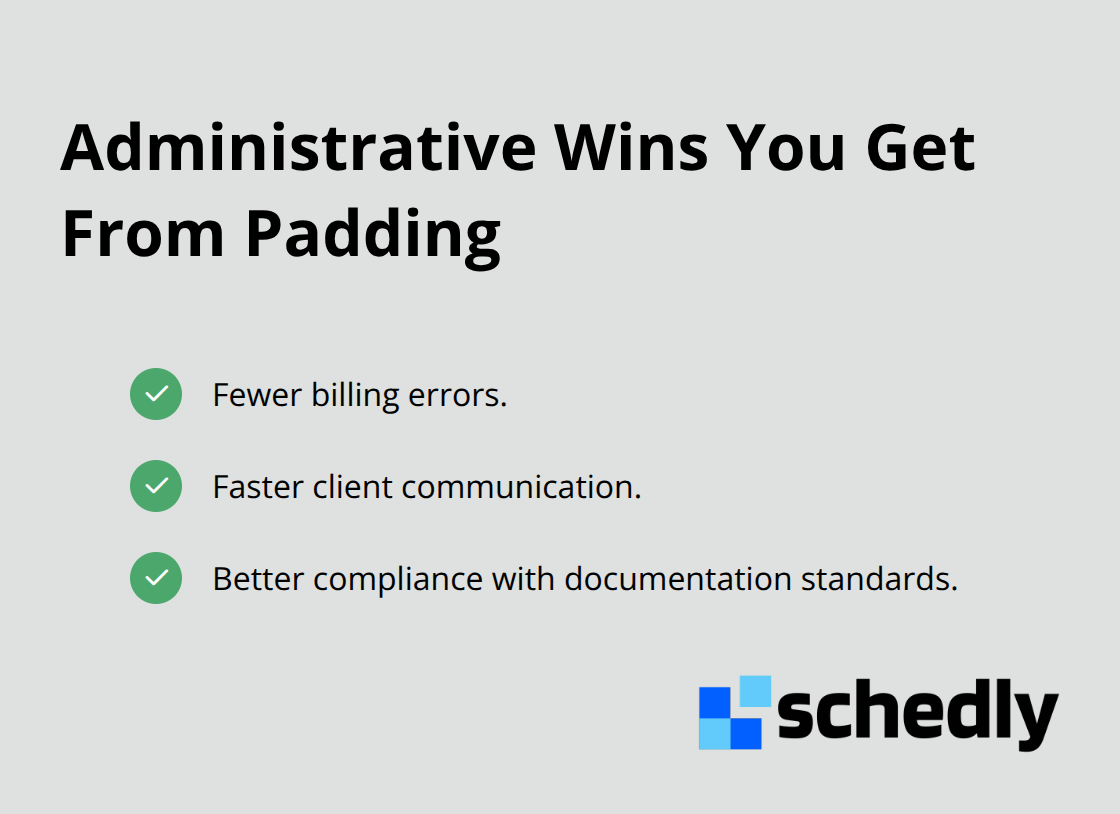
Documentation, payment processing, client notes, and follow-up emails don't disappear because your schedule is tight. They either get completed properly with padding, or they pile up and cause chaos later. When you force staff to handle these tasks between back-to-back appointments, quality suffers. Notes become incomplete, follow-ups get missed, and clients fall through the cracks. Padding gives your team time to handle these tasks while they remain focused on the client who just left. This prevents the administrative backlog that eventually forces someone to stay late or work through lunch to catch up. The ripple effect is significant: fewer billing errors, faster client communication, and better compliance with documentation standards if your industry requires it.
How Padding Protects Against Unexpected Delays
Real appointments rarely end exactly on time. A client asks one more question, a procedure takes longer than expected, or a payment issue requires extra attention. Without padding, these normal delays cascade into the next appointment. Your team arrives late, clients wait, and frustration builds. Padding absorbs appointment delays and prevents cascade. Your staff can still wrap up the current client properly, handle any last-minute issues, and transition to the next appointment without stress. This reliability builds client trust and reduces the anxiety your team feels throughout the day.
Now that you understand why padding matters, the next step is determining how much padding your business actually needs.
What Padding Actually Delivers
The gap between appointments isn't wasted time-it's where quality gets built. Consider what happens in a typical service business without padding. A therapist finishes a 60-minute session at 2:00 PM, and the next client arrives at 2:01 PM. The therapist hasn't documented the previous session, hasn't reviewed the next client's file, and hasn't used the bathroom. The client sits in the waiting room while the therapist scrambles. Now add 15 minutes of padding. The therapist documents session notes while details remain fresh, reviews the incoming client's history, and arrives mentally present. The second client experiences a professional who's ready, not rushed. This difference compounds across every appointment in your schedule.
Preparation Transforms Service Quality
A salon that adds 10 minutes between haircuts reduces styling errors and client complaints. A consultant who has 15 minutes between calls captures action items and prepares relevant materials instead of jumping straight into the next conversation. Kesavan et al. research in Management Science showed that when retail stores implemented scheduling improvements including adequate time between tasks, store-level labor productivity increased by 5.1%. That wasn't from working faster-it came from having time to work properly.
A dentist with 10 minutes between patients sanitizes equipment thoroughly, reviews X-rays, and confirms treatment plans. Without that buffer, corners get cut. Your team actually prepares instead of improvises when padding exists in your schedule.
Administrative Work Happens During Business Hours
Payment processing, client notes, follow-up scheduling, and compliance documentation happen while your team still has mental energy. Without padding, administrative work piles into end-of-day crises. Someone stays 30 minutes late three times a week to catch up on paperwork that should have been handled throughout the day. Padding prevents this situation entirely. Your staff completes these tasks between appointments while they remain focused on the client who just left, not hours later when fatigue sets in.
Padding Absorbs Real-World Delays
Legal consultations run 10 minutes long because the client had one more question. Medical appointments exceed their scheduled time because a patient needs extra explanation. These situations happen constantly in service businesses. With 15 minutes of padding built in, the attorney documents the conversation and transitions smoothly. Without padding, the next client is now 10 minutes late, then 20 minutes late, and by day's end your team is stressed and clients are frustrated. Padding acts as a scheduling shock absorber that protects both your operations and your reputation.
The businesses that implement this see fewer cancellations, higher client retention, and staff that actually enjoy their workday instead of dreading the next back-to-back shift. The question becomes: how much padding does your specific business actually need, and how do you configure it in your scheduling system?
Setting the Right Padding Duration for Your Business
Different services require different padding amounts, and guessing wastes both time and money. A 15-minute massage requires different padding than a 60-minute legal consultation, just as a quick salon touch-up differs from complex dental work. Start by analyzing what actually happens between your appointments. If your team consistently documents notes, handles payments, and prepares materials within 10 minutes, then 10 minutes becomes your baseline. If clients frequently arrive with questions that extend into transition time, add 5 more minutes. That efficiency comes from knowing exactly how much time each transition actually requires rather than padding randomly.
Track Your Actual Transition Times
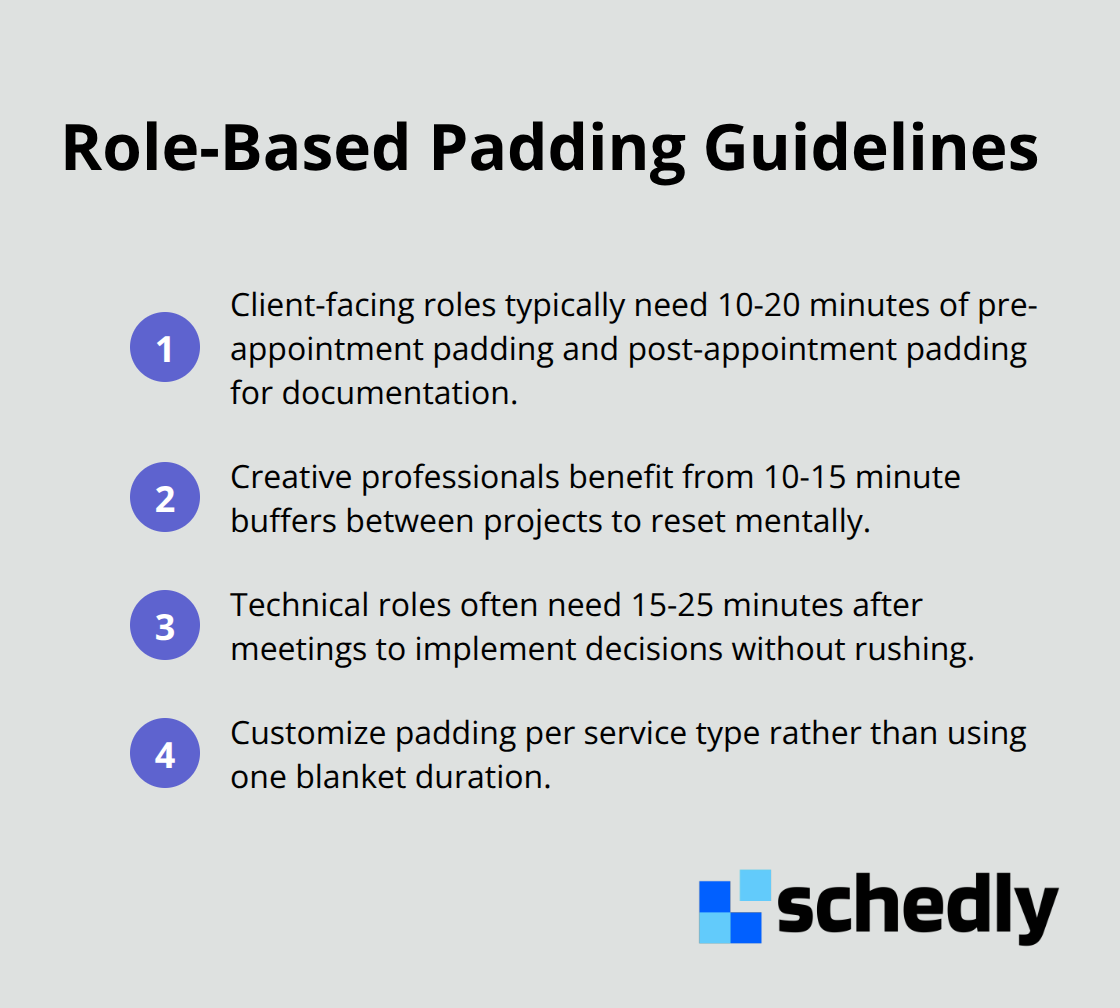
Monitor your appointment end times for two weeks and note when staff genuinely finished with the previous client versus when the next one arrived. This data tells you whether 5, 10, 15, or 20 minutes fits your operations. Client-facing roles typically need 10-20 minutes of pre-appointment padding to review history and post-appointment padding for follow-up documentation.
Configure Padding Rules by Service Type
Set pre-appointment padding to the time your team needs to prepare, and post-appointment padding to the time required for documentation and setup for the next client. For example, a therapy session might have 10 minutes pre-padding and 15 minutes post-padding, while a brief consultation call might use 5 minutes each way. The software blocks this time from client view, so customers see only the genuinely available slots. Most platforms allow you to establish these defaults at the service level, meaning all instances of that service automatically include the correct padding without manual adjustment.
Monitor and Adjust Your Padding Strategy
Start with conservative estimates and monitor actual utilization for 30 days. If your team consistently finishes documentation early, reduce padding by 5 minutes. If administrative work still piles up by mid-afternoon, increase it. The data matters more than assumptions. Track whether clients complain about wait times, whether your team stays late to finish paperwork, and whether appointment quality metrics improve. These metrics reveal whether your padding duration is working. Adjust quarterly based on seasonal patterns, staffing changes, or new service types you add to your business (this ensures your padding strategy remains aligned with your actual operations).
Final Thoughts
Appointment buffer time forms the foundation of reliable service delivery, and the businesses that implement it see measurable improvements across client satisfaction, staff retention, and operational efficiency. Your team produces better work when they have time to prepare, document, and transition mentally between clients. The Kesavan et al. study proved this isn't theoretical-retail stores that improved scheduling consistency and predictability increased labor productivity by 5.1%, far outpacing the sector's typical 2.5% annual growth.
Start small with your padding implementation by choosing one service type and setting conservative buffer durations based on what your team actually needs. Monitor for 30 days, then adjust based on real data rather than assumptions. If documentation still piles up by afternoon, increase your post-appointment padding; if your team consistently finishes early, reduce it slightly.
The practical payoff compounds quickly as your staff stops staying late to finish paperwork, clients experience fewer delays, and unexpected appointment overruns no longer cascade into the rest of your day. Schedly provides the scheduling software you need to customize buffer time by service type and automatically block it from client view, allowing you to set pre- and post-appointment padding rules across your entire booking system.