
Schedly resources
How Scheduling Software Unlocks Revenue You're Missing

Most service businesses leave money on the table every single day. No-shows, cancellations, and missed booking opportunities drain your revenue without you even realizing it.
At Schedly, we've seen how the right scheduling software transforms this picture. By automating reminders, capturing last-minute bookings, and streamlining operations, you can recover lost revenue and boost customer lifetime value significantly.
Stop Leaving Revenue on the Table With No-Shows
No-Shows Cost You More Than You Think
No-shows and cancellations are silent revenue killers. A 2023 study from the Journal of Medical Internet Research found that no-show rates across service industries average between 20-30%, meaning nearly one in four appointments never happen. For a salon with 20 daily bookings, that's 4-6 lost revenue slots every single day. The problem isn't that customers intentionally waste your time-they forget. Life gets chaotic, and without a reminder, your appointment slips their mind entirely.
Automated Reminders Recover Lost Bookings
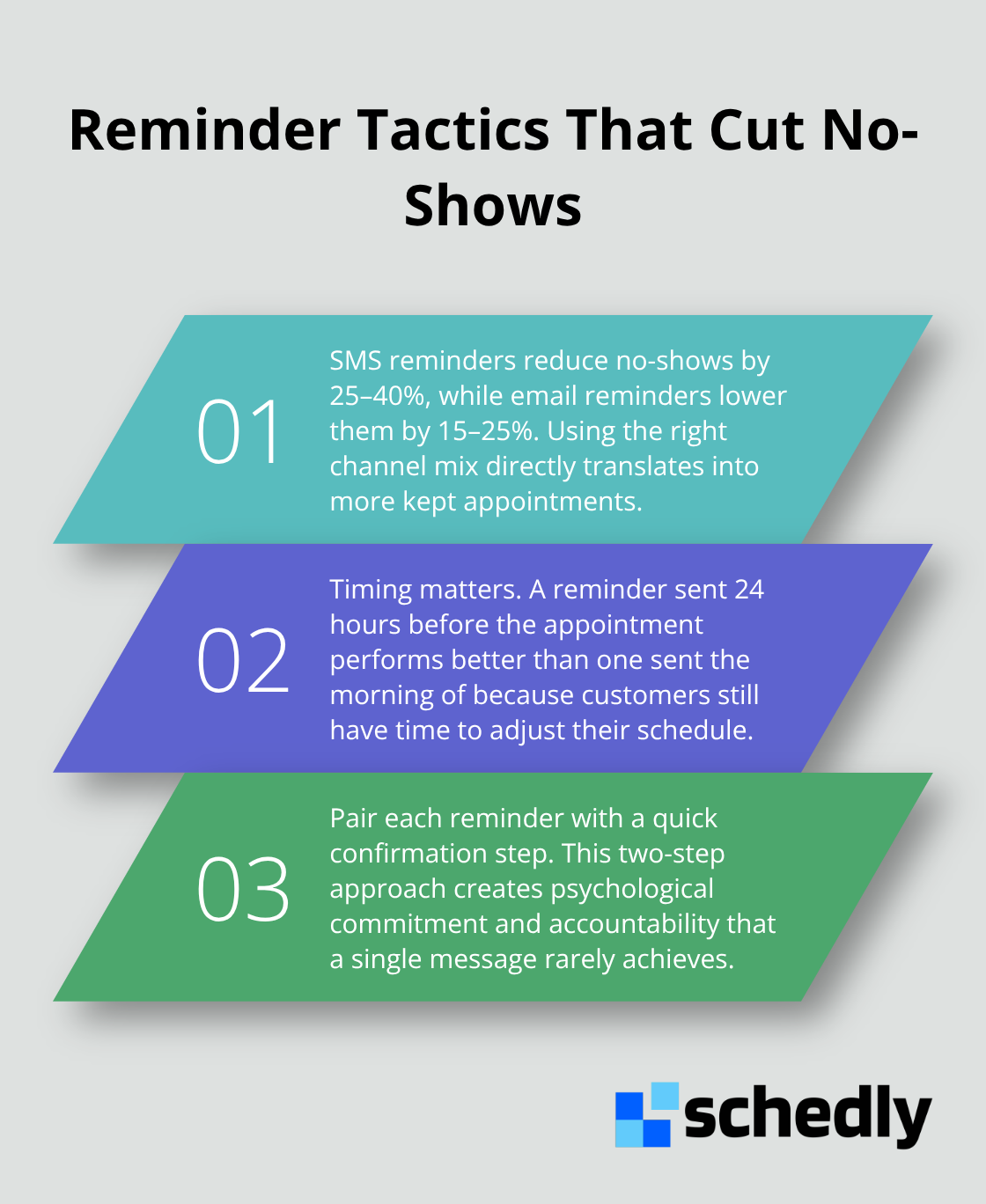
Automated reminders fix this immediately. Research shows that SMS reminders alone reduce no-shows by 25-40%, while email reminders drop the rate by 15-25%. Timing matters enormously. A reminder sent 24 hours before the appointment performs better than one sent the morning of, because customers still have time to adjust their schedule if needed.
Schedly sends notifications across SMS, email, and push notifications, giving you multiple channels to reach clients before they miss their slot. The real magic happens when you combine reminders with a confirmation step. When clients confirm their appointment after receiving a reminder, they psychologically commit to showing up. This two-step process-reminder plus confirmation-creates accountability that a single message never achieves.
Real-Time Visibility Prevents Double-Bookings
Real-time availability visibility inside your scheduling system prevents another major revenue leak: double bookings and staff conflicts. When your team uses outdated spreadsheets or fragmented calendars, someone inevitably double-books a therapist or assigns the same service slot to two customers. Modern scheduling software syncs across all devices in real time, so any staff member sees exactly who is booked, when, and where. This prevents the nightmare scenario where you overbooking and have to cancel on a customer, damaging trust and losing the revenue.
Capture Every Available Opportunity
Beyond preventing conflicts, real-time availability data reveals your actual capacity. Many businesses discover they turn away potential bookings simply because staff don't know who's free. With visibility into live schedules, your front desk instantly books walk-ins and last-minute requests, capturing revenue that would otherwise vanish. The system also flags gaps in your schedule, helping you identify times when you're chronically underbooked-actionable intelligence for marketing campaigns or pricing adjustments.
These operational fixes set the stage for something bigger: intentional revenue growth through features specifically designed to capture and convert more bookings.
Where Your Hidden Revenue Really Hides
Most service businesses have untapped revenue sitting in plain sight. Customers call after hours and reach voicemail instead of booking. Your staff misses upsell opportunities because the booking flow doesn't prompt clients to add services. Your office manager wastes hours on manual scheduling tasks that automation should handle. These aren't small inefficiencies-they compound daily and drain your bottom line. The global appointment scheduling market reached USD 0.48 billion in 2025 and is expected to hit USD 2.25 billion by 2034, growing at 18.75% annually. This explosive growth reflects a simple truth: companies finally capture the revenue they've been leaving on the table.
Last-minute bookings Command Premium Rates
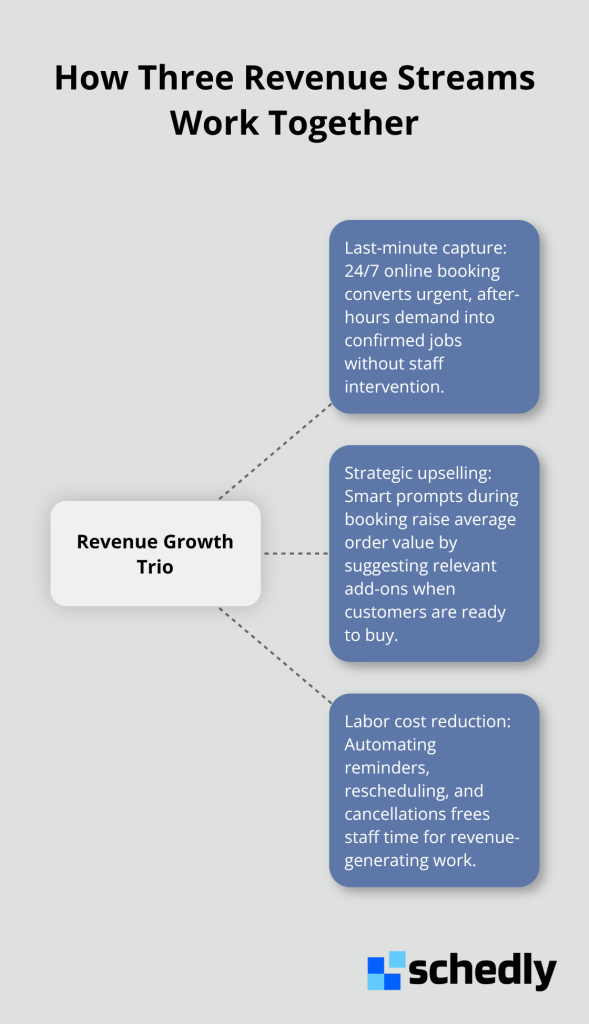
Last-minute bookings represent your highest-margin revenue. When a customer needs same-day service, they typically accept premium rates because urgency drives their decision. Yet most businesses lose these opportunities because their scheduling system only works during business hours. A customer calls at 8 PM on a Friday, hears a voicemail, tries a competitor, and books elsewhere. With 24/7 online booking, customers enter their service request anytime, your system instantly checks live availability, displays open slots, and confirms the appointment automatically. The customer gets booked. You get the revenue. No human intervention required.
This matters enormously for moving companies, salons, and repair services where last-minute demand is constant. One extra booked job from a Friday-night emergency call covers your monthly software subscription. The math is straightforward.
Strategic Upselling Happens at the Right Moment
Upselling during the booking process works because customers are already in a buying mindset. When someone books a 60-minute massage, a well-designed booking flow suggests adding a facial, aromatherapy, or premium oils. Research shows that strategic prompts at checkout increase average order value by 15-30%. Your scheduling software should make these suggestions automatic based on service type and customer history. If a client has never added a premium service, the system prompts them. If they've purchased add-ons before, it recommends their favorites. You're not being pushy-you're being helpful.
Administrative Work Drains Your Profit Margin
Administrative overhead is where most businesses hemorrhage money without realizing it. Your office manager spends 2-3 hours daily on scheduling tasks: sending reminders, processing cancellations, and rescheduling clients. That's 10-15 hours weekly on work that should be automated. Administrative scheduling overhead costs represent significant annual expenses. Scheduling software eliminates this work entirely. Reminders send automatically. Customers reschedule themselves through a link. Cancellations process instantly. Your team reallocates those recovered hours to revenue-generating activities like client consultations, service delivery, or sales.
One moving company freed up 12 hours weekly through automation, allowing their office manager to focus on customer service and retention instead. That time shift directly increased customer lifetime value and repeat bookings.
Three Revenue Streams Compound Together
Last-minute capture, strategic upselling, and labor cost reduction don't operate in isolation. A business that implements all three doesn't just recover lost revenue-it restructures its entire booking process to generate more revenue from the same customer base. The real power emerges when these three mechanisms work together, each amplifying the others. This foundation sets the stage for the next critical piece: features specifically designed to accelerate cash flow and expand your service capacity across multiple locations.
The Features That Actually Drive Revenue
The difference between scheduling software that merely organizes appointments and software that generates revenue comes down to three specific capabilities working together. First, 24/7 online booking means your business captures sales when competitors sleep. A customer needing emergency plumbing at 11 PM fills out your online form, sees available slots, and books instantly without leaving your system. You wake up Monday with a confirmed job. Second, integrated payment processing removes friction from the booking journey. Customers complete payment during the appointment confirmation rather than later, accelerating cash flow and reducing payment disputes. Third, multi-location management prevents the scheduling chaos that kills revenue when you operate across multiple sites. Your team sees real-time capacity across all locations, routes customers to the closest available slot, and eliminates the guesswork that leads to overbooking or underutilization.
After-Hours Bookings Capture Pure Revenue
After-hours bookings represent pure captured revenue because they happen when your phone isn't staffed. The moving industry sees this constantly. A family plans a last-minute relocation for Friday evening, calls your main line at 8 PM, and reaches voicemail. They try three competitors and book with the first one who answers. With 24/7 online booking, that customer completes their entire booking journey without human contact. They enter move details, your system checks live truck availability across all locations, displays open time slots, and confirms the appointment with automated details about crew arrival and pricing. The customer receives a confirmation email, and your dispatch team sees the job instantly integrated into their schedule.
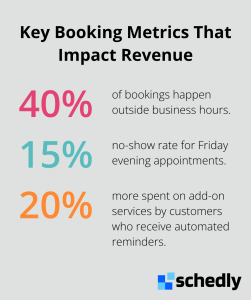
Research shows that 40% of bookings happen outside business hours, meaning nearly half your potential revenue arrives when your office is closed. For a moving company with 5–10 trucks, one additional last-minute Friday job per week translates to roughly 50 extra jobs annually, generating substantial incremental revenue. This revenue stream exists independent of your marketing efforts or sales team activity.
Payment Processing Accelerates Your Cash Position
Integrated payment processing during booking eliminates the collection friction that drains cash flow. When customers pay at the point of booking rather than after service delivery, your cash position improves immediately and payment disputes drop dramatically. A salon collecting payment during the online booking process captures revenue before the appointment occurs, improving weekly cash flow visibility. Customers who prepay also show up at higher rates because they've made a financial commitment.
Stripe and PayPal integration through modern scheduling systems handles this seamlessly, processing payments securely without customers leaving your branded booking page. For service businesses operating on thin margins, accelerated cash flow reduces reliance on lines of credit or working capital financing, lowering your effective cost of operations. The payment certainty also simplifies your accounting and reduces the administrative work your team spends chasing late payments.
Multi-Location Management Transforms Fragmentation
Multi-location management transforms fragmentation into efficiency. Without centralized scheduling, each location operates independently, creating blind spots. Your downtown salon has a 2-hour wait while your suburban location sits empty. A customer calls asking for the soonest appointment, and your staff books them at the busier location instead of the closer one with availability. Centralized scheduling across all locations shows real-time capacity everywhere simultaneously.
When a customer requests an appointment, your system automatically suggests the closest location with availability, optimizing their experience and your utilization. For a business with 3–5 locations, this routing alone increases per-location revenue through reduced wasted capacity and faster customer access to service. Your team also spots patterns instantly: Tuesday mornings are consistently slow at Location B, signaling a marketing opportunity. Wednesday evenings at Location C are overbooked, indicating pricing power. These insights drive strategic decisions about staffing, marketing spend, and service pricing that a fragmented system never reveals.
The Real ROI of Scheduling Software
A moving company with five trucks loses roughly four to six jobs monthly to missed calls and voicemails. At an average job value of $1,500, that's $6,000 to $9,000 in monthly revenue sitting on the table. Scheduling software that captures even half of those missed opportunities pays for itself within weeks, and the ROI compounds when you factor in reduced no-shows, eliminated administrative overhead, and increased customer lifetime value from better service delivery.
Your team's time represents your largest controllable cost. Office managers spend 10-15 hours weekly on manual scheduling tasks that automation eliminates entirely. If your office manager earns $25 per hour, that's $250-375 weekly in labor costs you recover, translating to $13,000-19,500 annually in freed labor capacity. More importantly, your team redirects those hours toward customer service, retention, and sales activities that directly generate revenue and strengthen customer lifetime value.
Data-driven insights reveal which services, time slots, and customer segments generate the highest margins. Your scheduling system tracks every booking, cancellation, and payment, showing you that Friday evening appointments have a 15% no-show rate while Tuesday mornings have zero cancellations, and customers who receive automated reminders spend 20% more on add-on services. Schedly provides the analytics dashboard and automation features that make this ROI visible and measurable, helping you identify exactly where revenue leaks exist and how much you're recovering through automation.