
Schedly resources
How to Match Demand With Actual Staff Capacity

Most service businesses lose money because they book more appointments than their staff can handle. Overbooking, no-shows, and poor scheduling resource allocation create chaos that frustrates customers and drains your team.
At Schedly, we've seen firsthand how the right approach transforms this problem. When you match demand with actual capacity, you stop leaving revenue on the table and start building a predictable, profitable operation.
How to Forecast Demand and Know Your True Capacity
Extract Patterns From Your Booking History
Your booking data tells a story that most businesses ignore. The appointments you scheduled last month, the no-shows that wasted slots, the customers who cancelled at the last minute-these patterns reveal exactly how much work your team can actually handle. Extract patterns from your booking history by analyzing metrics like occupancy rates, booking pace, cancellation rates, and seasonal trends over at least two years. You'll spot that Mondays at 10 AM fill up instantly while Wednesday afternoons sit empty. You'll notice that 15% of customers don't show up, which means your actual capacity is significantly lower than your theoretical maximum.
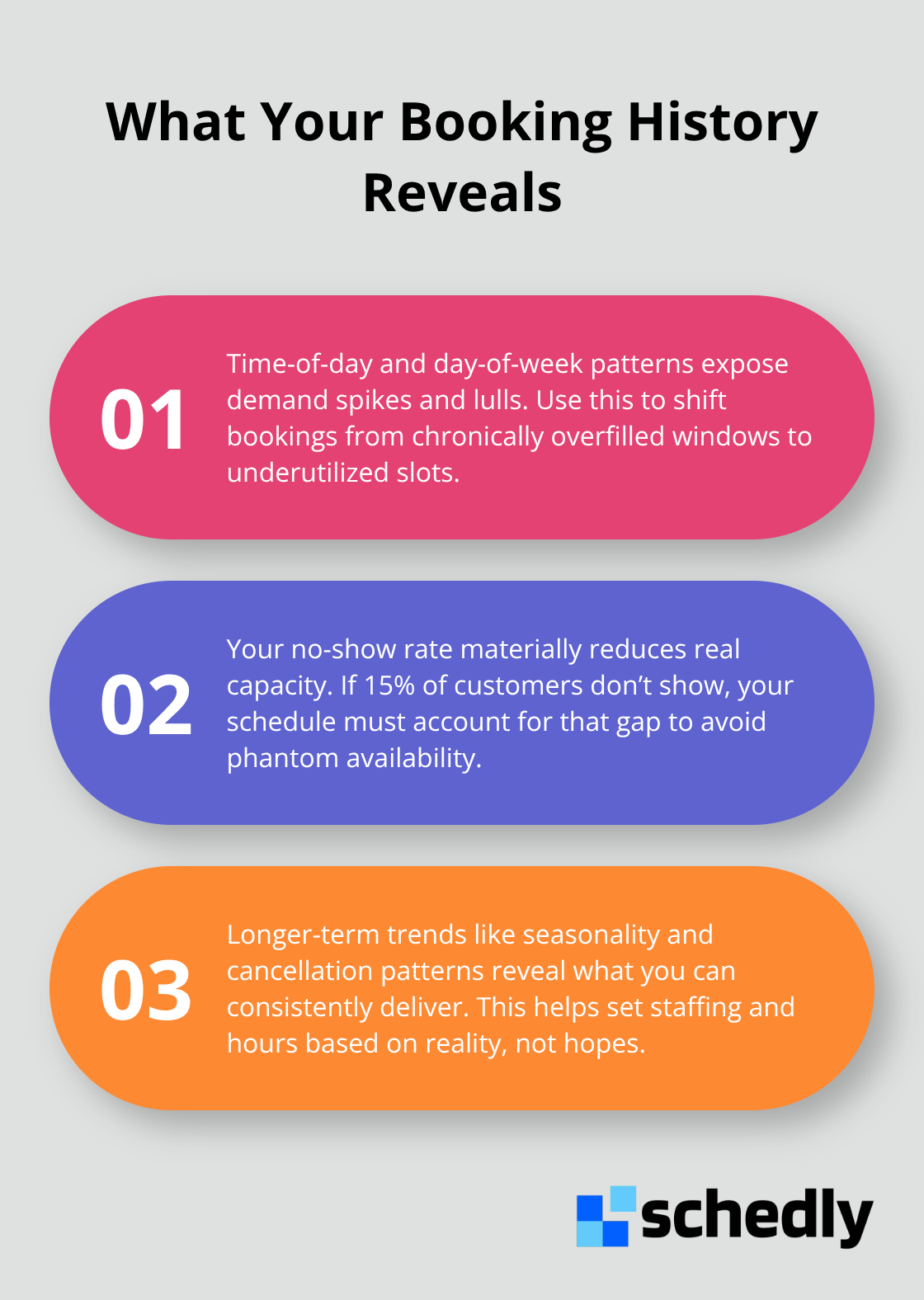
A salon that books eight haircuts per day might only serve six because of no-shows and cancellations. This gap between what you book and what you actually deliver is where revenue disappears.
Calculate Your True Service Duration
Calculate your true service duration by taking your scheduled appointments, subtracting no-shows and cancellations, then dividing by the actual service time including buffer between clients. If a haircut takes 45 minutes but your staff needs 10 minutes to reset, sanitize, and prepare notes, your real service duration is 55 minutes. Realistic time standards allow you to convert operational volume data into practical staffing requirements that reflect actual workloads.
Plan for Seasonal Demand Shifts
Plan for seasonal demand shifts by forecasting demand early, identifying roles most impacted by volume increases, and building a flexible labor plan. A fitness studio packed in January empties by March. A dental practice handles more emergency appointments in winter. Tax consultants work chaos hours in April. Pull your data by month and quarter to identify when demand spikes and when it drops. If you operate with the same staff size year-round, you're either overstaffed during slow periods or understaffed during rushes.
The solution isn't hiring full-time employees to cover peak season-that creates expensive bench time during slow months. Instead, plan for your baseline with permanent staff, then layer in part-time employees or contractors during predictable surges.
Match Staff Skills to Your Bookings
Track which staff members can perform which services with quality and speed. A new massage therapist might complete four sessions daily while an experienced one handles six because they work faster and clients often rebook with them. This skill variation means you can't simply divide total demand by average service time and call that your required headcount. When you assign staff based on their specific availability and expertise, you prevent the scenario where you have bodies on the clock but nobody qualified for the bookings you've accepted. This mismatch between available staff and actual capacity creates the scheduling chaos that costs you money and frustrates your team.
Where Your Scheduling Actually Falls Apart
Most service businesses operate with a dangerous gap between what they think they can deliver and what actually happens on the ground. You accept a booking, your team completes it, and somewhere in that process, reality collides with your plan. The collision points are predictable, measurable, and fixable if you know where to look.
Buffer Time Is Not Optional
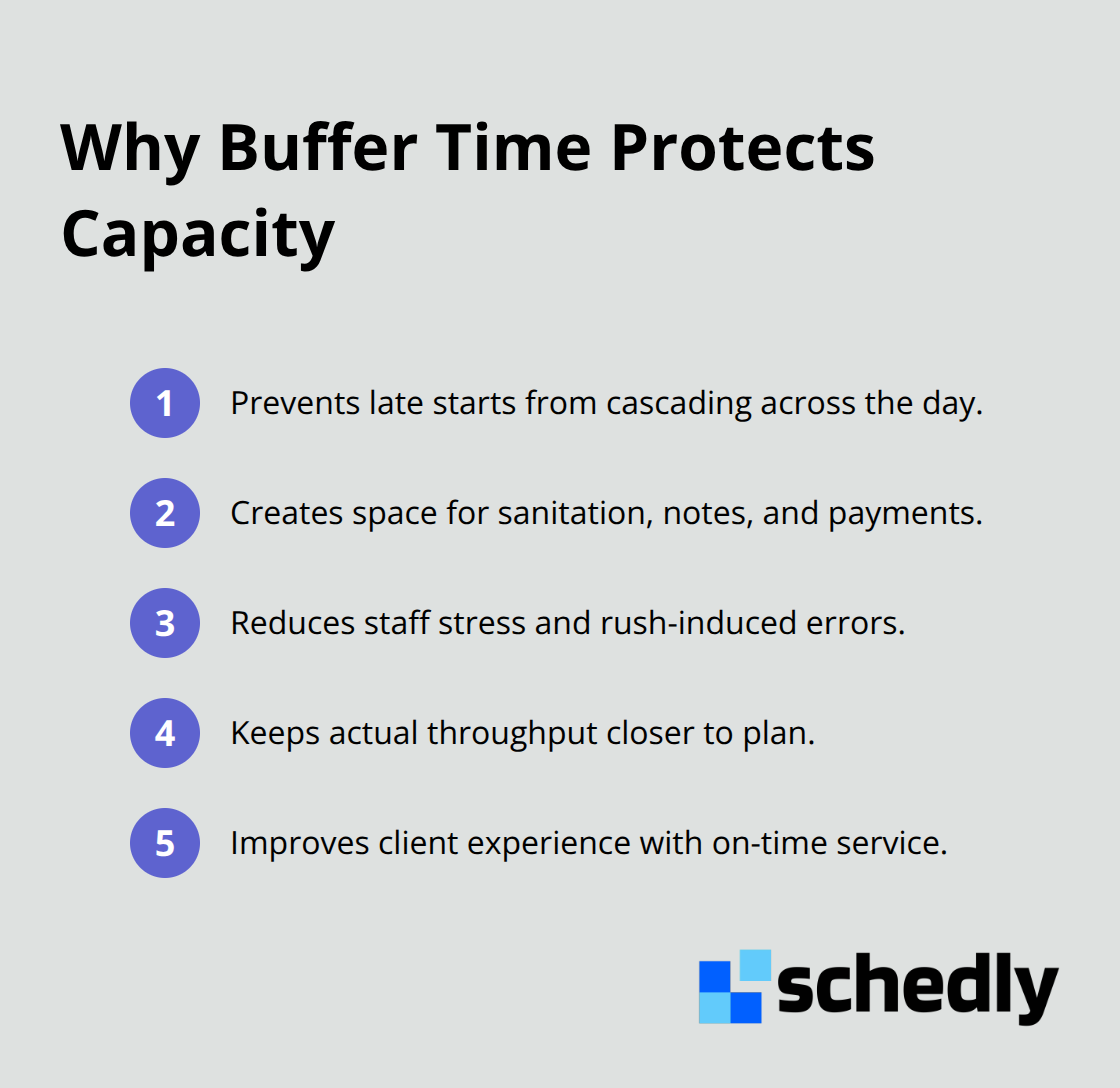
A haircut scheduled for 45 minutes does not mean your stylist stands ready to start the next client at 45 minutes. Your team needs time to sanitize tools, update client notes, handle a difficult payment situation, or simply catch their breath. Without this transition time built into your schedule, every appointment cascades into the next one running late. Clients arrive to find staff still finishing previous sessions. Your 2 PM client waits 15 minutes while your team scrambles.
Research on service operations shows that failing to account for transition time reduces actual capacity by 20 to 30 percent compared to theoretical capacity. If your salon books appointments back-to-back with zero buffer, you operate at 70 to 80 percent of your real capacity. Your team falls behind and feels exhausted from constant rushing.
Skill Differences Create Real Bottlenecks
You might have five employees, but not all five can perform every service at the same speed or quality level. A newly hired massage therapist works slower than someone with five years of experience. Your advanced dental hygienist handles complex cases while your junior hygienist manages routine cleanings. When you ignore these skill differences and performance variation and assign work based purely on availability, you create bottlenecks at the most critical roles.
You accept a booking for your best technician, but they are already booked solid, so you assign it to someone less experienced who takes 40 percent longer. Your customer gets a mediocre experience, your schedule slips, and your experienced staff member becomes resentful about carrying the team. Matching specific staff to specific services based on their actual performance data prevents this chaos.
No-Shows and Cancellations Follow Patterns
No-shows and cancellations are not random events you cannot predict. They follow patterns specific to your business. Afternoon appointments have higher no-show rates than morning slots. Certain service types see more cancellations than others. Customers who book same-day appointments cancel more frequently than those who book weeks in advance.
If you have operated for more than six months, you have enough data to calculate your actual no-show rate. Most service businesses see 10 to 20 percent no-shows, yet they continue booking as if 100 percent of appointments will happen. If 15 percent of your customers do not show, your true capacity is 15 percent lower than your schedule suggests. You essentially double-book invisible slots.
Build Your Schedule Around Reality
Your theoretical capacity is what the math says you can handle if everything goes perfectly. Your operational capacity is what actually happens when you account for transition time, skill variations, and no-shows. These two numbers differ significantly.
Build your schedule around operational capacity, not theoretical capacity. This means blocking transition time between appointments as non-negotiable. It means matching specific staff to specific services based on their actual performance data, not just their title. It means reducing your overbooking threshold based on your documented no-show rate. When you stop pretending your schedule is perfect and start building it around reality, your customers experience shorter wait times, your staff feels less stressed, and your revenue becomes more predictable because you actually fulfill the commitments you make.
The next step is knowing which tools and systems help you execute this reality-based approach consistently, without manual spreadsheets and constant firefighting.
How to Build a Schedule Your Team Can Actually Execute
The gap between what you want to schedule and what your team can deliver closes when you stop relying on intuition and spreadsheets. Scheduling software built for service businesses captures your real operational data-no-show rates, service durations, staff skills, and demand patterns-then uses that information to prevent overbooking before it happens. The system automates the booking process and surfaces the exact capacity constraints that matter: which staff member can handle which service, how much buffer time you actually need, and what your realistic utilization rate is when no-shows are factored in. Instead of manually checking five different spreadsheets to find an available slot, your booking page instantly shows only times your team can actually fulfill. This eliminates the core problem that creates scheduling chaos-accepting bookings your staff cannot deliver. When customers see a time slot available online, it means your team has the skills, availability, and buffer time to handle it.
Match Pricing to Your Actual Demand Patterns
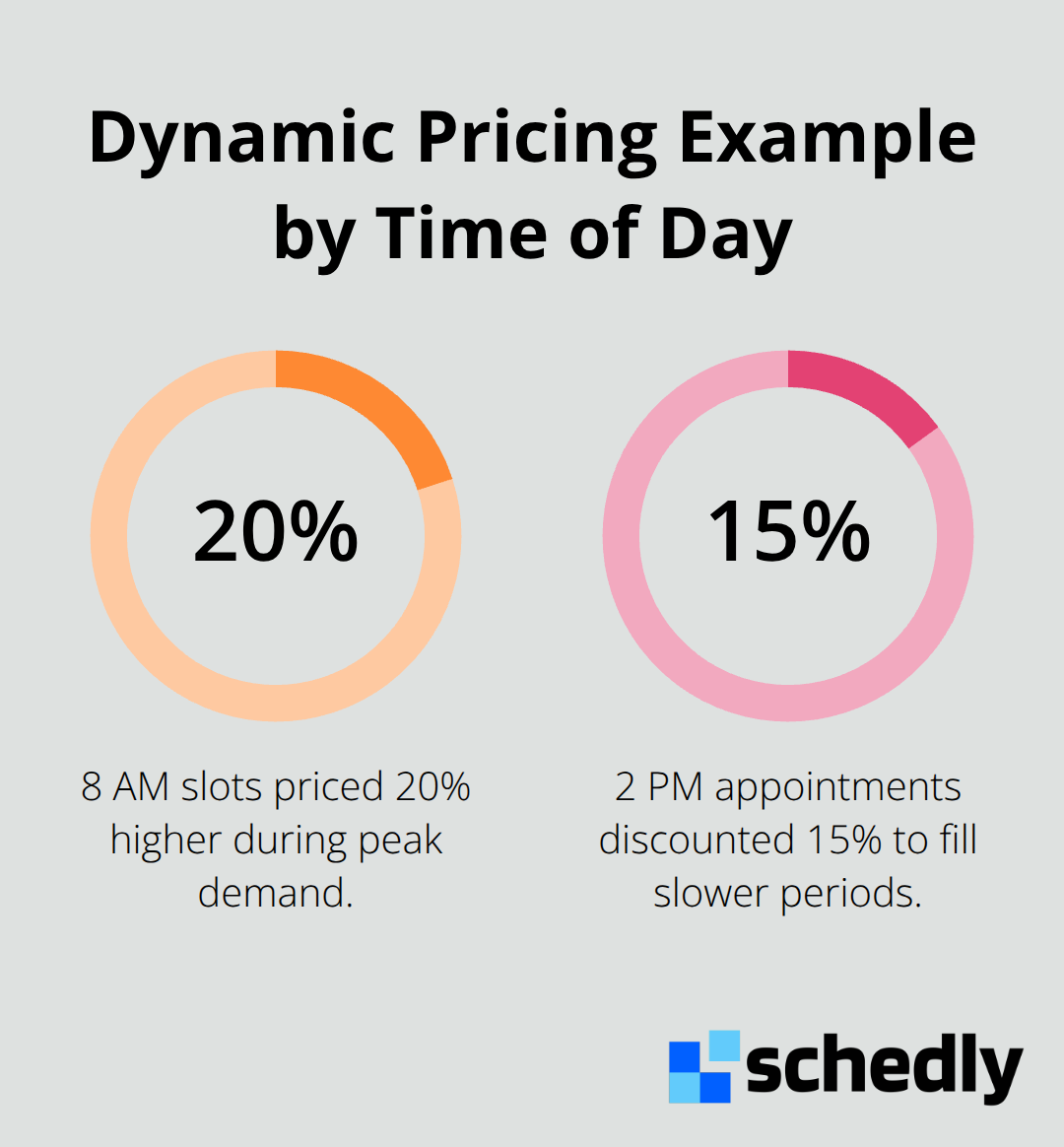
The second lever is matching your pricing to actual demand patterns rather than charging the same rate year-round. During your peak hours-the times your schedule fills fastest-raise prices. During slow periods, lower them. This isn't gouging customers; it's acknowledging that your capacity is finite and your time has different value depending on when it's used. A dental practice might charge 20 percent more for 8 AM slots that fill instantly and 15 percent less for 2 PM appointments that sit empty. A fitness studio could charge premium rates for 6 PM classes that have waiting lists and discount early morning or midday sessions.
Build Flexibility Through Cross-Training
The third critical move is building your team's flexibility through cross-training. When multiple staff members can deliver the same service, you eliminate the bottleneck where one person's unavailability forces you to turn away bookings. A salon where only one stylist can cut men's hair loses money every time that person takes a day off. A dental practice where only one hygienist handles complex procedures creates constant scheduling friction. Identify your bottleneck roles-the services or skill sets that create the most scheduling constraints-and systematically train a second person to handle them. This doesn't mean everyone learns everything; it means identifying which skills create the biggest capacity problems and addressing those specific gaps. When you combine realistic scheduling software, pricing that reflects actual demand, and cross-training in service businesses reduces scheduling bottlenecks, your staff works at sustainable utilization rates because you've matched bookings to genuine capacity.
Final Thoughts
Matching demand with actual staff capacity stops being a guessing game when you build your scheduling around operational reality instead of theoretical perfection. Use scheduling software that prevents overbooking before it happens, price your services to shift demand toward underutilized slots, and cross-train your team to eliminate bottleneck roles. These changes work together to transform how your business operates and improve your scheduling resource allocation immediately.
When your booking system shows only times your team can actually fulfill, customers experience shorter wait times and higher-quality service because your staff works at a sustainable pace instead of constant rushing. Your revenue becomes predictable because you stop accepting bookings you cannot deliver. Research on service operations confirms that businesses operating at 75 to 80 percent utilization see higher productivity and lower turnover than those pushing toward 100 percent capacity.
Start by auditing your actual no-show rates, service durations including buffer time, and staff skill variations over the past six months (this data becomes your foundation for realistic scheduling). Identify which roles or services create your biggest scheduling bottlenecks and prioritize cross-training in those areas. Schedly automates this process by capturing your no-show patterns, service durations, and staff availability, then using that data to show customers only times your team can genuinely fulfill.