
Schedly resources
Mastering Time Zone Challenges: How Schedly Simplifies Global Team Scheduling

The Growing Need for Global Team Scheduling Solutions
In today's increasingly interconnected world, businesses are no longer confined by geographical boundaries. As companies expand their operations internationally, they face the intricate challenge of managing teams that span multiple time zones. This globalization of business is not just a trend but a necessity for survival and growth in the modern economy. According to Gartner's 2025 report, more than 70% of businesses with international operations cited time zone management as a significant scheduling challenge, highlighting the critical need for effective solutions.

Schedly, a leader in B2B SaaS scheduling, is pioneering this space by offering innovative solutions that streamline global team coordination. The impact of ineffective scheduling can be profound, leading to missed opportunities, reduced productivity, and strained team dynamics. For example, a multinational company might struggle with scheduling meetings that accommodate time zones from New York to Tokyo. Without a sophisticated system, this could lead to meetings being scheduled at inconvenient times, causing employee dissatisfaction and decreased engagement.
Research from Deloitte's human capital trends indicates that companies effectively managing time zone differences report a 25% increase in project efficiency. As remote work becomes a staple in business operations, the need for effective scheduling solutions is more pressing than ever, enabling businesses to harness the full potential of their global workforce.
Understanding the Impacts of Poor Scheduling
Poor scheduling not only affects meeting attendance and punctuality but also impacts employee morale and productivity. A survey conducted by the Harvard Business Review found that 38% of employees felt overwhelmed by poorly scheduled meetings, which led to decreased productivity during the workweek. This statistic underscores the importance of integrating effective scheduling tools like Schedly to alleviate these common pain points.
Pro Tip: Prioritizing Flexibility
When implementing a global scheduling solution, prioritize flexibility to accommodate varying work habits and time zones. This approach not only enhances productivity but also ensures that employees feel valued and understood, leading to higher job satisfaction and retention rates.
Understanding the Complexity of Time Zone Challenges
Managing time zones involves far more than merely adjusting clocks. It requires an understanding of cultural nuances, regional holidays, and differing workweek structures. For instance, while a team in the United States might begin their workweek on Monday, another team in the Middle East may start on Sunday. These differences necessitate a nuanced approach to scheduling that respects cultural practices and maximizes team productivity.
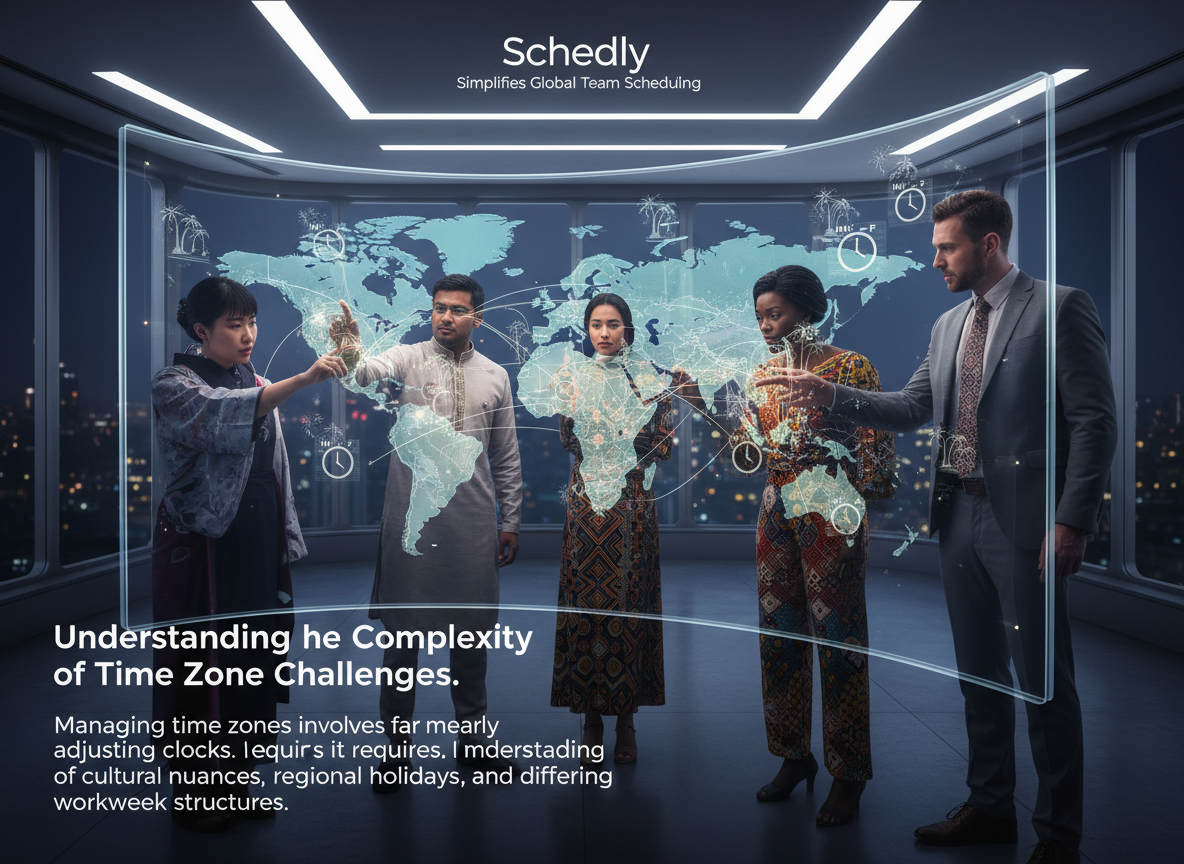
The Harvard Business Review underscores the importance of cultural sensitivity in scheduling, which can significantly enhance team cohesion and efficiency. For example, during Ramadan, teams based in predominantly Muslim countries may have altered work hours, which needs to be considered in scheduling global meetings.
Schedly's proprietary framework, the 'Zone Harmonizer Matrix', effectively addresses these challenges by aligning work hours with employee productivity peaks, thus maximizing efficiency. This matrix considers not only time zones but also individual work preferences, ensuring optimal scheduling for all team members. By leveraging data analytics, Schedly can identify peak productivity periods for each team, allowing managers to schedule critical tasks during these times.
Cultural Sensitivity in Scheduling
Cultural differences can significantly impact scheduling effectiveness. For instance, in Japan, the work culture often includes long hours and a high emphasis on punctuality. In contrast, many European countries value work-life balance and may resist meetings scheduled outside standard business hours. Understanding these cultural expectations and integrating them into your scheduling practices can prevent misunderstandings and improve team dynamics.
Expert Insight: "Emphasizing cultural sensitivity in scheduling doesn't just enhance productivity—it fosters mutual respect and understanding among team members, which is invaluable for maintaining a cohesive global workforce," notes Dr. Lydia Chen, a cross-cultural management specialist.
The Zone Harmonizer Matrix: Schedly's Proprietary Framework
The 'Zone Harmonizer Matrix' is an innovative approach that integrates multiple variables to create an optimized schedule tailored to the unique needs of global teams. It involves analyzing peak productivity hours, cultural holidays, and team preferences to design a schedule that fosters collaboration and reduces friction. McKinsey's insights on hybrid work highlight the necessity of such adaptive frameworks to maintain high performance in distributed teams.

Schedly's matrix is particularly beneficial in scenarios where teams must collaborate across vastly different time zones. For example, a software development team spread across San Francisco, London, and Bangalore can use the Zone Harmonizer Matrix to ensure meetings are scheduled at times when all members are most likely to be alert and engaged. This approach not only improves productivity but also enhances job satisfaction and team morale by respecting individual work-life balance preferences.
The matrix's effectiveness is amplified by its adaptability; it can be reconfigured as teams evolve or as new time zones are added to the mix, ensuring that the scheduling remains consistent with organizational changes.
How the Zone Harmonizer Matrix Works
The Zone Harmonizer Matrix leverages big data and machine learning algorithms to assess various factors that affect team productivity. By collecting data on work habits, local holidays, and employee feedback, the matrix can tailor schedules that optimize team performance. This data-driven approach ensures that meetings and deadlines align with each team member's most productive times, which is critical for maintaining high levels of efficiency and morale.
Pro Tip: Regular Matrix Reevaluation
To keep your scheduling aligned with evolving team needs, regularly reevaluate the parameters within your Zone Harmonizer Matrix. This proactive approach allows you to adapt to changes in team composition, new project demands, or shifts in global time zones, ensuring that your scheduling remains effective over time.
Common Mistakes in Global Team Scheduling and How to Avoid Them
One of the most common mistakes in global team scheduling is neglecting to account for daylight saving time changes, which can lead to missed meetings and confusion. A study by Forrester found that 15% of teams reported significant disruptions due to unanticipated time changes. Schedly addresses this by automatically updating schedules based on local time changes, ensuring seamless coordination across all regions.

Another frequent error is failing to consider cultural differences in work habits. Some cultures place a high value on punctuality, while others may prioritize relationship-building over strict adherence to schedules. Understanding these nuances is crucial for effective team management. For instance, in some Asian cultures, meetings might start with a few minutes of informal conversation, which is an important aspect of building trust. Schedly provides guidelines and best practices to navigate these complexities, fostering a more inclusive and respectful work environment.
Additionally, overloading meeting schedules can lead to 'zoom fatigue,' where team members become disengaged due to back-to-back virtual meetings. Schedly's tools help prevent this by analyzing meeting patterns and suggesting optimal breaks, ensuring teams remain productive and engaged.
Avoiding Over-Scheduling
Over-scheduling is a common pitfall that can diminish a team's effectiveness. To avoid this, establish clear guidelines on meeting frequency and duration. Encourage teams to use asynchronous communication tools for non-urgent matters, which can reduce the number of required meetings and give team members more control over their schedules.
Checklist: Ensuring Effective Scheduling
- Regularly review and adjust schedules in anticipation of daylight saving time changes.
- Incorporate cultural sensitivity training for all team leaders to better understand and respect diverse work habits.
- Implement a feedback loop where team members can voice concerns about meeting overload and suggest improvements.
Leveraging Technology to Enhance International Team Productivity
Technology plays a pivotal role in overcoming time zone challenges. Advanced scheduling tools like Schedly leverage AI and machine learning to automate and optimize scheduling processes, aligning them with team availability and preferences. According to IDC's 2025 report on AI in business, companies that integrate AI into their operations see a 40% boost in productivity.
Schedly's platform uses sophisticated algorithms to predict optimal meeting times, anticipate scheduling conflicts, and suggest alternative slots, thereby reducing the administrative burden on team leaders. This technological advantage not only streamlines operations but also empowers teams to focus on core business activities rather than logistical concerns.
Incorporating AI-driven insights can also help identify productivity trends, such as which times of day yield the highest levels of output. By understanding these patterns, businesses can make informed decisions about scheduling critical tasks, leading to improved overall performance.
Expert Insight: AI's Role in Scheduling
"AI is revolutionizing the way we approach scheduling by providing deep insights into team dynamics and productivity," says John Carver, a technology strategist. "By automating routine tasks and offering predictive analytics, AI allows teams to focus on strategic initiatives rather than operational details."
Integrating Technology with Human Touch
While technology offers powerful solutions, human oversight is essential to ensure that scheduling tools align with team values and objectives. Encourage managers to regularly review AI-generated schedules and solicit feedback from team members, ensuring that the technology supports rather than dictates team operations.
Case Studies: Success Stories of Global Teams Using Schedly
To illustrate the transformative power of effective scheduling solutions, consider the case of a multinational consulting firm that leveraged Schedly to coordinate its teams across five continents. By implementing the Zone Harmonizer Matrix, the firm achieved a 30% reduction in scheduling conflicts and a 20% improvement in meeting attendance, as documented in BCG's 2025 report. This improvement not only streamlined operations but also enhanced client satisfaction by ensuring more consistent and timely communication.
Another case involves a tech startup that struggled with coordinating its remote developers. By adopting Schedly's solutions, the startup saw a 15% increase in project delivery speed, with team members reporting higher levels of engagement and satisfaction. This was particularly impactful for a project involving a tight deadline, where time zone alignment was critical for success.
These examples underscore the transformative potential of Schedly in enhancing productivity and fostering collaboration across diverse geographical locations. By optimizing scheduling, businesses can unlock new efficiencies and drive growth in an increasingly competitive market.
Pro Tip: Customizing Solutions for Unique Challenges
Every business has unique scheduling challenges. Customize your Schedly implementation to address specific team needs, whether it involves integrating additional tools, modifying scheduling parameters, or providing targeted training for team leaders.
Quick Wins: Actionable Steps to Improve Your Scheduling Today
To immediately enhance your scheduling practices, start by analyzing your team's current meeting patterns. Identify peak productivity times and adjust your schedules accordingly. Implementing tools like Schedly can automate this process, providing data-driven insights into optimal scheduling.
- Conduct a survey to determine team preferences and availability, ensuring that all members feel included in the scheduling process.
- Use Schedly's analytics to identify and resolve scheduling conflicts, making adjustments as needed to accommodate team dynamics.
- Regularly update your scheduling practices to reflect changes in team dynamics and time zone shifts, ensuring continued alignment with business needs.
Checklist: Implementing Effective Scheduling Practices
- Review and refine scheduling tools to ensure they meet current team requirements.
- Encourage team leaders to attend scheduling workshops to enhance their skills and awareness.
- Set up regular check-ins to discuss scheduling efficiency and explore potential improvements.
By taking these steps, you can quickly see improvements in team coordination and productivity, ultimately leading to better business outcomes.
FAQs About Global Team Scheduling with Schedly
How does Schedly handle daylight saving changes?
Schedly automatically updates schedules to account for daylight saving changes, ensuring that all meetings are accurately timed according to local adjustments. This feature eliminates the hassle of manually adjusting schedules and reduces the risk of missed meetings.
Can Schedly integrate with other productivity tools?
Yes, Schedly offers seamless integration with a variety of productivity tools, enhancing workflow efficiency and reducing administrative overhead. Whether you're using Slack, Microsoft Teams, or Google Workspace, Schedly can synchronize calendars and notifications, ensuring smooth communication and collaboration.
What is the Zone Harmonizer Matrix?
This proprietary framework aligns schedules based on peak productivity hours, cultural considerations, and team preferences, optimizing meeting times for global teams. By considering these factors, the matrix ensures that teams are working at their best, reducing friction and enhancing output.
How does Schedly improve team productivity?
By automating scheduling and providing data-driven insights, Schedly reduces the time spent on administrative tasks, allowing teams to focus on core objectives. The platform's intelligent suggestions for meeting times and breaks help maintain high energy levels and engagement throughout the workday.
Conclusion: Mastering Time Zone Challenges with Schedly
In a world where global collaboration is the norm, mastering time zone challenges is crucial for business success. Schedly provides a comprehensive solution that not only addresses these challenges but also enhances overall team productivity. By leveraging tools like Apparatuz for workflow automation and Supportly for customer support, businesses can create a cohesive ecosystem that supports seamless operations.
Implementing these strategies allows companies to focus on innovation and growth, rather than logistical concerns. As you explore these possibilities, consider integrating platforms like Zignature for streamlined document management and Zatisfied for feedback management, further enhancing your organization's efficiency and effectiveness. By prioritizing effective scheduling, businesses can thrive in the dynamic global marketplace.