
Schedly resources
Multi-location Scheduling Management: Coordinating Across Sites With Ease
Managing schedules across multiple locations is one of the biggest headaches for operations teams. Staff availability shifts, communication breaks down, and inconsistent practices create chaos.
At Schedly, we've seen firsthand how the right multi-location scheduling management system transforms this complexity into streamlined operations. The good news is that modern software makes coordinating across sites far simpler than most teams realize.
What Makes Multi-Location Scheduling So Difficult
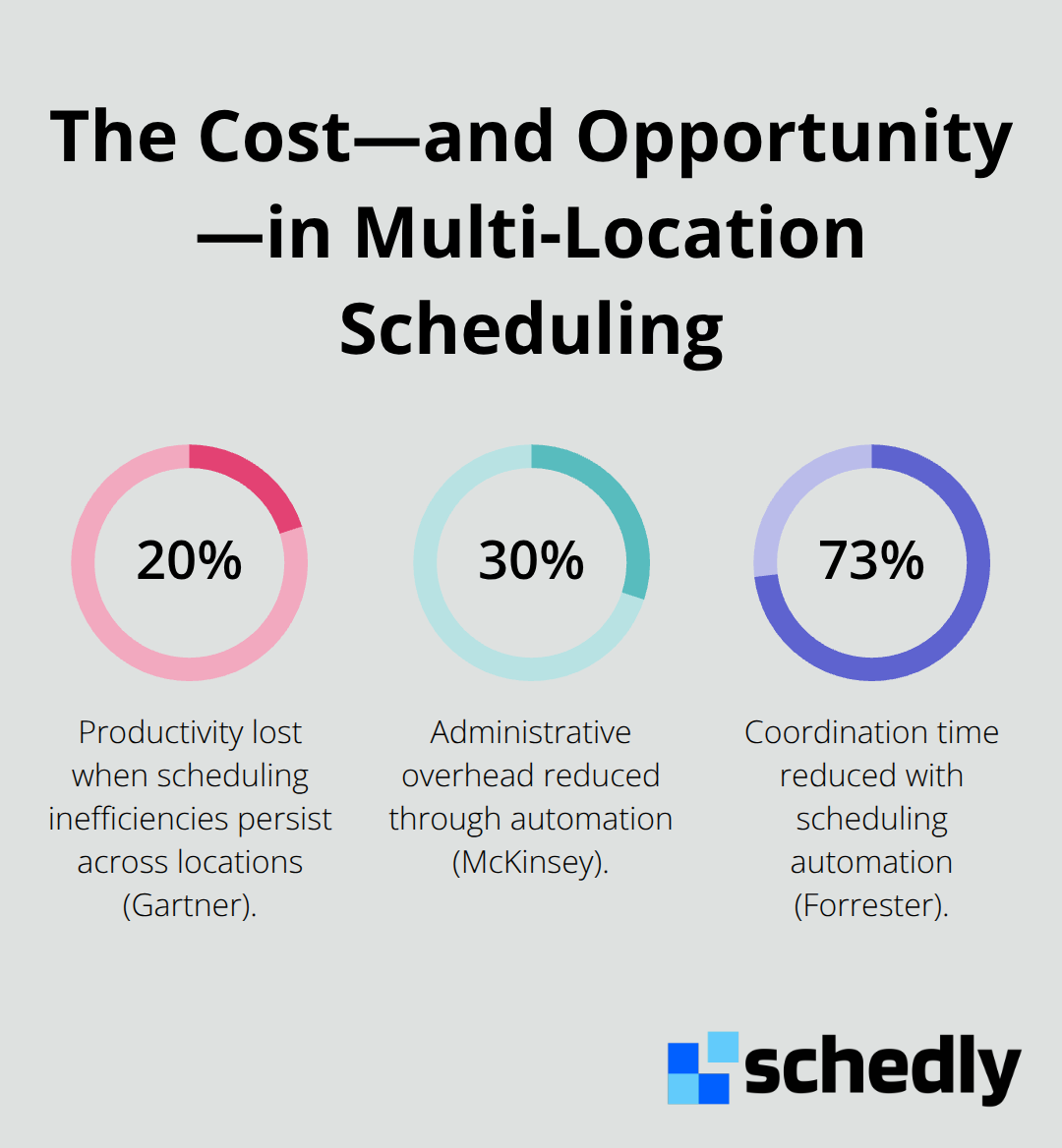
The real problem with multi-location scheduling isn't complexity for its own sake. It's that every location operates under different constraints. One site might face peak demand on weekends while another struggles with weekday coverage. Staff certifications differ by location. Labor laws vary by state or region. Overtime rules change depending on jurisdiction. When you manage five locations, you're essentially running five different scheduling systems in your head, and that's where mistakes happen. Gartner found that failure to address scheduling inefficiencies can cost up to 20% of annual productivity across locations. That's not a minor problem. That's money walking out the door while your team scrambles to fill gaps.
The availability puzzle nobody talks about
Staff availability doesn't remain static across sites. A team member who works full-time at your downtown location might only pick up weekend shifts at the suburban branch. Your best healthcare provider might only hold certification for one specific location. Cross-trained employees create flexibility, but most teams fail to track who can work where. Without that visibility, managers default to overstaffing safe locations while leaving others understaffed. McKinsey research shows that automation cuts administrative overhead by about 30%, yet teams still spend hours manually checking spreadsheets and sending messages to confirm who's available where. The coordination time alone eats into your budget before you even schedule the first shift.
Communication breakdown between sites
Location managers operate in silos. One manager uses a spreadsheet. Another prefers email. A third relies on group chat messages that disappear after two weeks. When a shift opens up at one location, the information doesn't reach the manager at another site until it's too late. Forrester data shows scheduling automation can reduce coordination time by 73%, yet most multi-location operations still rely on manual back-and-forth communication. This creates real problems. A nurse calls out sick at your morning clinic, but the evening clinic doesn't know until 4 PM. A retail location needs emergency coverage for an unexpected rush, but the neighboring store is already fully scheduled because nobody communicated about demand forecasts.
Standards that don't actually exist
Inconsistent scheduling practices across locations create compliance nightmares and fairness issues. One location might allow unlimited overtime while another strictly caps it at five hours per week. Break policies differ. Shift-swap procedures vary. Some managers approve time-off requests in minutes while others take days. Employees notice these inconsistencies immediately, and it breeds frustration. When staff at one location sees different rules at another, they lose trust in management. From a legal standpoint, inconsistent overtime tracking across locations is exactly how wage-and-hour violations happen. You need standardized scheduling rules that apply everywhere, with location-specific adjustments only where local law requires them.
Why these problems compound across your operation
Each of these challenges multiplies when you add more locations. A communication gap at two sites becomes a coordination nightmare at ten. Availability tracking that works for three locations breaks down at seven.
How Modern Software Ends Multi-Location Chaos
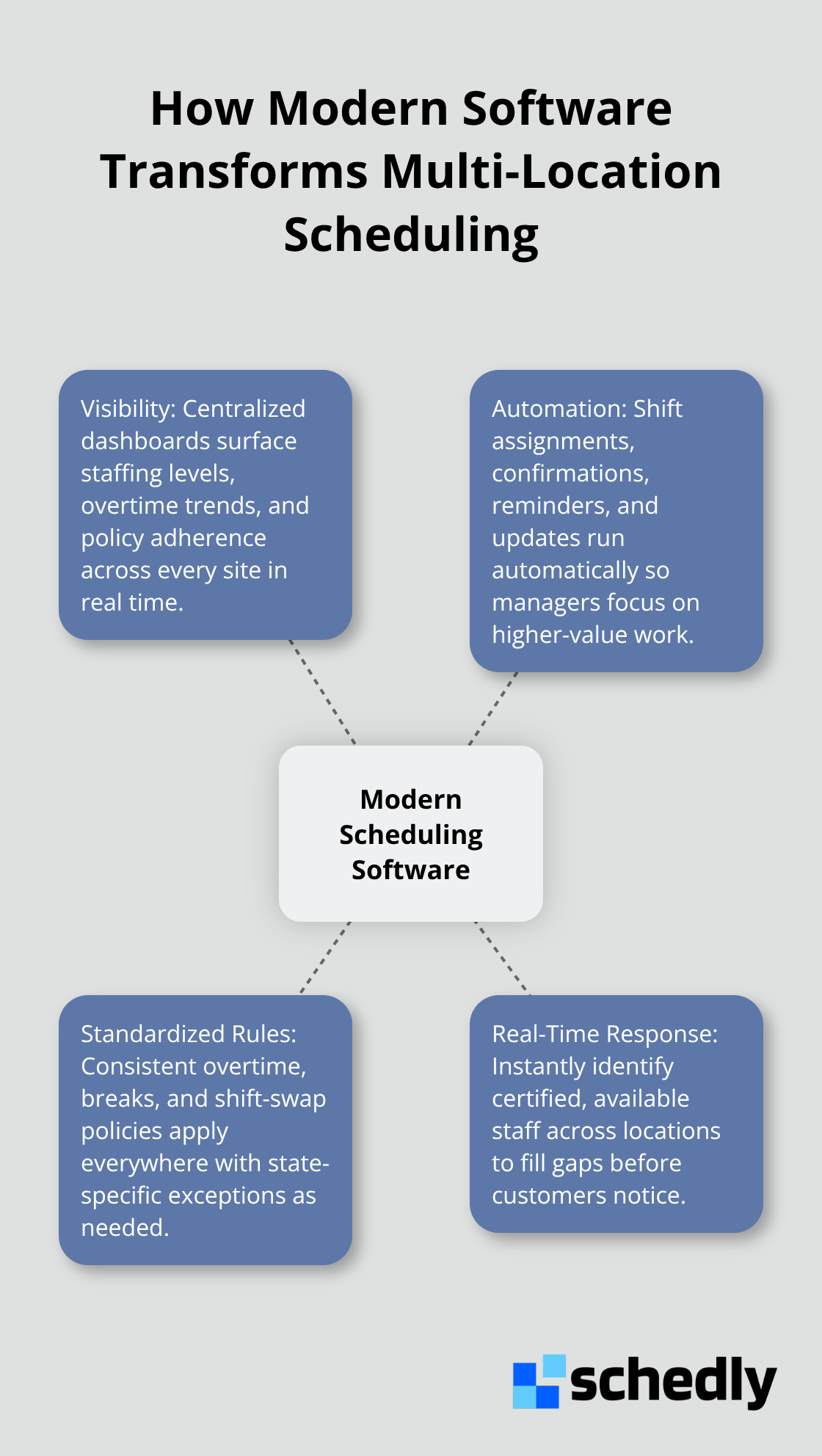
Modern scheduling software replaces the fragmented systems that created multi-location problems in the first place. When you consolidate all locations into one platform, you stop relaying messages between managers and start making decisions based on real data. The transformation happens in three ways: you gain visibility into what actually happens across every location, you automate the repetitive coordination tasks that consume manager time, and you enforce consistent standards without removing the flexibility each location needs.
Centralized dashboards reveal what spreadsheets hide
A centralized dashboard shows you every location's staffing status simultaneously. You see downtown is fully covered while the suburban clinic has a gap at 2 PM. You spot that overtime runs 40% higher at your eastern location than your western one. You notice that one manager consistently schedules fewer breaks than others, creating legal exposure. Without this visibility, each location manager solves problems independently, which means the downtown clinic overstaffs while the suburbs scramble. With real-time data, you reallocate a cross-trained employee to the gap, prevent the overtime spike before it happens, and correct the break policy immediately.
Scheduling automation delivers measurable returns, and centralized visibility is where that value actually comes from. You're not saving time through magic. You're making better decisions faster because you have accurate information instead of guesses.
Automation eliminates coordination work that drains manager productivity
Shift assignments, availability confirmations, reminder notifications, and schedule updates currently consume hours of manager time each week. Software automates these tasks without human intervention. When someone calls out sick, the system identifies qualified staff across all locations and notifies them instantly rather than forcing managers to text three people hoping someone responds. When a location faces unexpected demand, the scheduling tool highlights available staff from neighboring sites instead of requiring manual spreadsheet hunting.
Time-zone-aware automation matters if you operate across regions. A manager in New York shouldn't manually adjust for California time differences. The system handles it automatically. 82% of organizations experienced improved operational efficiency after adopting scheduling tools, and this automation is the mechanism behind that improvement. Your managers spend their energy on actual management, not administrative busywork.
Standardized rules applied everywhere prevent violations and unfair treatment
You set overtime caps, break policies, and shift-swap procedures once in the system. Every location follows the same rules automatically. Local law requires different overtime rules in California versus Texas? The system applies state-specific rules at each location while maintaining the same underlying framework elsewhere. This prevents the chaos where one location allows six consecutive shifts while another caps it at five.
Employees see fairness across the organization. Your legal team stops worrying about wage-and-hour violations happening in different locations due to inconsistent tracking. The system generates audit-ready reports showing that every location followed the same standards, with documented exceptions only where law required them. This standardization is non-negotiable in multi-location operations, and software is the only practical way to enforce it at scale.
Real-time visibility transforms how managers respond to staffing gaps
When you operate multiple locations, gaps appear constantly. A staff member calls out. Demand spikes unexpectedly. A certification expires. Without real-time visibility, managers discover these problems too late. With it, you spot gaps the moment they occur and fill them before customers notice. The system shows you which employees hold the right certifications for each location, who has availability at neighboring sites, and who has already worked overtime this week. This information (available instantly across all locations) eliminates the guesswork that leads to overstaffing one site while leaving another short-handed.
Your next challenge isn't visibility or automation. It's actually implementing these tools in a way that your team adopts them quickly and uses them consistently.
Making Multi-Location Scheduling Work in Practice
Set standardized policies that enforce themselves
Implementing effective standardized policies across locations doesn't mean removing flexibility. It means enforcing the rules that matter while letting each location adapt to local demand and regulations. Start with your overtime rules, break policies, and shift-swap procedures. Document exactly how these work at every location, then build them into your scheduling software so the system enforces them automatically. If California law requires meal breaks every five hours while Texas allows six, your software applies state-specific rules at each location without requiring manual intervention. The key is setting the rules once and letting technology handle the enforcement. Managers spend zero time checking whether policies were followed because the system simply doesn't allow violations to happen.
This approach matters enormously when you operate across jurisdictions with different labor laws. One location manager cannot accidentally override break requirements if the software blocks it. Your legal team stops worrying about inconsistency creating liability. A healthcare network implemented this approach and reduced wage-and-hour compliance violations across all sites within three months.
Use data to identify staffing imbalances
Data analytics for staffing patterns reveal staffing patterns that spreadsheets hide. Pull your scheduling data from the past twelve months and identify which locations consistently run overtime, which ones maintain excess capacity, and how demand actually fluctuates across your sites. If your downtown location averages thirty overtime hours monthly while your suburban branch averages five, that's not random. It signals either understaffing at one location, overstaffing at another, or a demand pattern you haven't adjusted for.
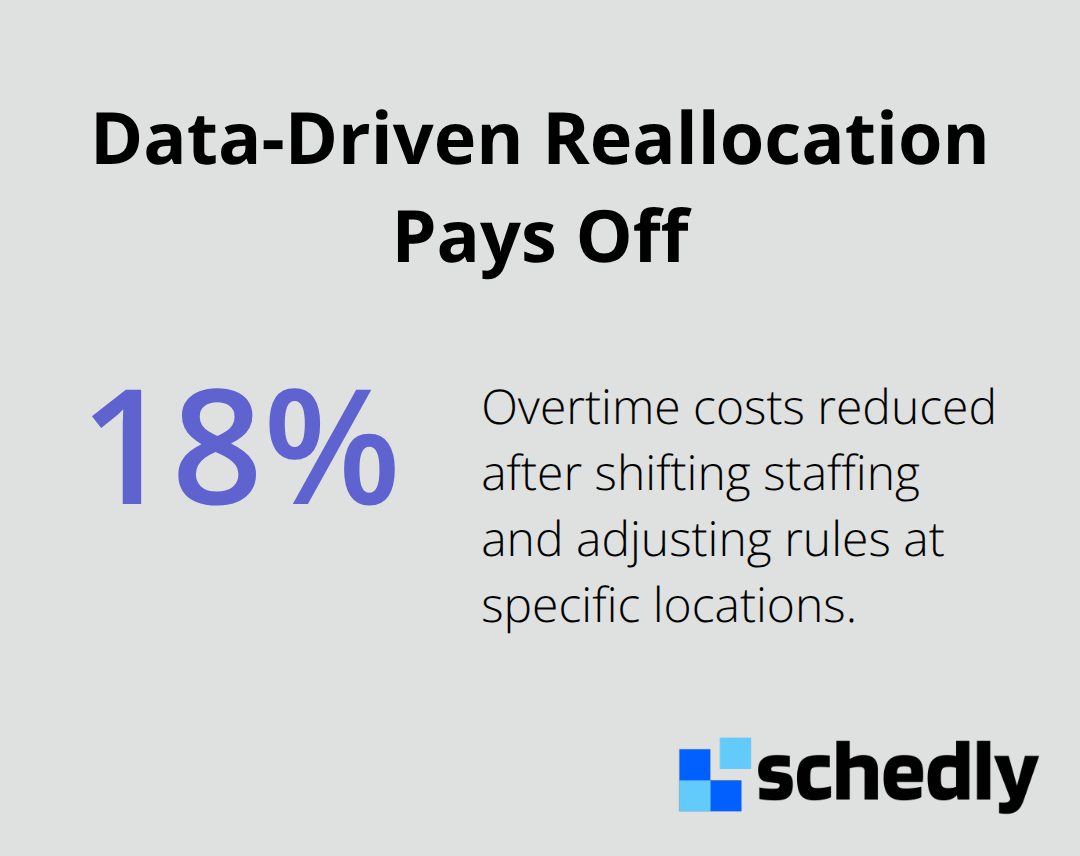
Use this data to reallocate permanent headcount or adjust your scheduling thresholds. A multi-location retail operation found that one store consistently needed more afternoon coverage while another struggled with morning demand. They shifted one full-time employee and adjusted scheduling rules per location, reducing overtime costs by 18% while improving service levels. This same principle applies whether you manage healthcare clinics, fitness studios, or legal offices.
Create a communication protocol that actually works
Real-time communication between location managers prevents the silo problem that destroys coordination. Schedule a weekly sync where managers share staffing challenges, demand forecasts, and availability updates. Use your scheduling software's centralized dashboard during these calls so everyone sees the same data. When one manager spots a staffing crisis, the others can immediately identify available employees to help. This weekly touchpoint costs thirty minutes and prevents the communication failures that lead to understaffing emergencies.
Most importantly, establish a single protocol for handling unexpected gaps. When someone calls out sick, the first manager checks internal availability across all locations before calling in someone on their day off. This simple rule-check everywhere first-reduces emergency overtime costs significantly because you're actually using your cross-trained staff instead of defaulting to whoever answers their phone first (which typically means the most expensive option).
Final Thoughts
Multi-location scheduling management succeeds when you combine three elements: visibility into what's actually happening across all sites, automation that eliminates repetitive coordination work, and standardized policies that prevent violations while allowing local flexibility. The businesses that master this approach stop firefighting staffing gaps and start making decisions based on real data. Your managers reclaim hours each week, your compliance risks drop, and your employees experience fairness across locations instead of frustration from inconsistent rules.
The right tools make this transformation possible. Software that centralizes your scheduling data, automates shift assignments, and enforces standardized policy removes the manual burden that currently consumes your team's energy. When a staff member calls out sick, the system identifies available employees across all locations instantly rather than forcing managers to text people hoping someone responds. When demand spikes at one location, you reallocate cross-trained staff from neighboring sites without delay, and when you need to verify compliance, the system generates audit-ready reports showing that every location followed the same standards.
Start by auditing your current scheduling process across all locations to identify where communication breaks down, where inconsistent practices create problems, and where you lose money to preventable overtime or understaffing. Then implement a scheduling platform that addresses these specific gaps-Schedly offers multi-location management with flexible employee scheduling, workflow automation, and an advanced analytics dashboard that reveals staffing patterns you cannot see in spreadsheets. Choose a scheduling tool, train your managers on the system, and establish a weekly communication protocol where location managers share staffing challenges and demand forecasts.