
Schedly resources
Online Payment Workflows That Streamline Transactions

Manual payment processing drains resources and slows down your business. At Schedly, we've seen firsthand how companies waste hours on invoice generation, data entry, and transaction tracking.
Online payment workflows eliminate these bottlenecks. Automation cuts administrative costs, reduces errors, and gets payments processed faster-letting your team focus on work that actually grows your business.
How Online Payment Workflows Reduce Manual Work
Automated Invoices Eliminate Hours of Administrative Overhead
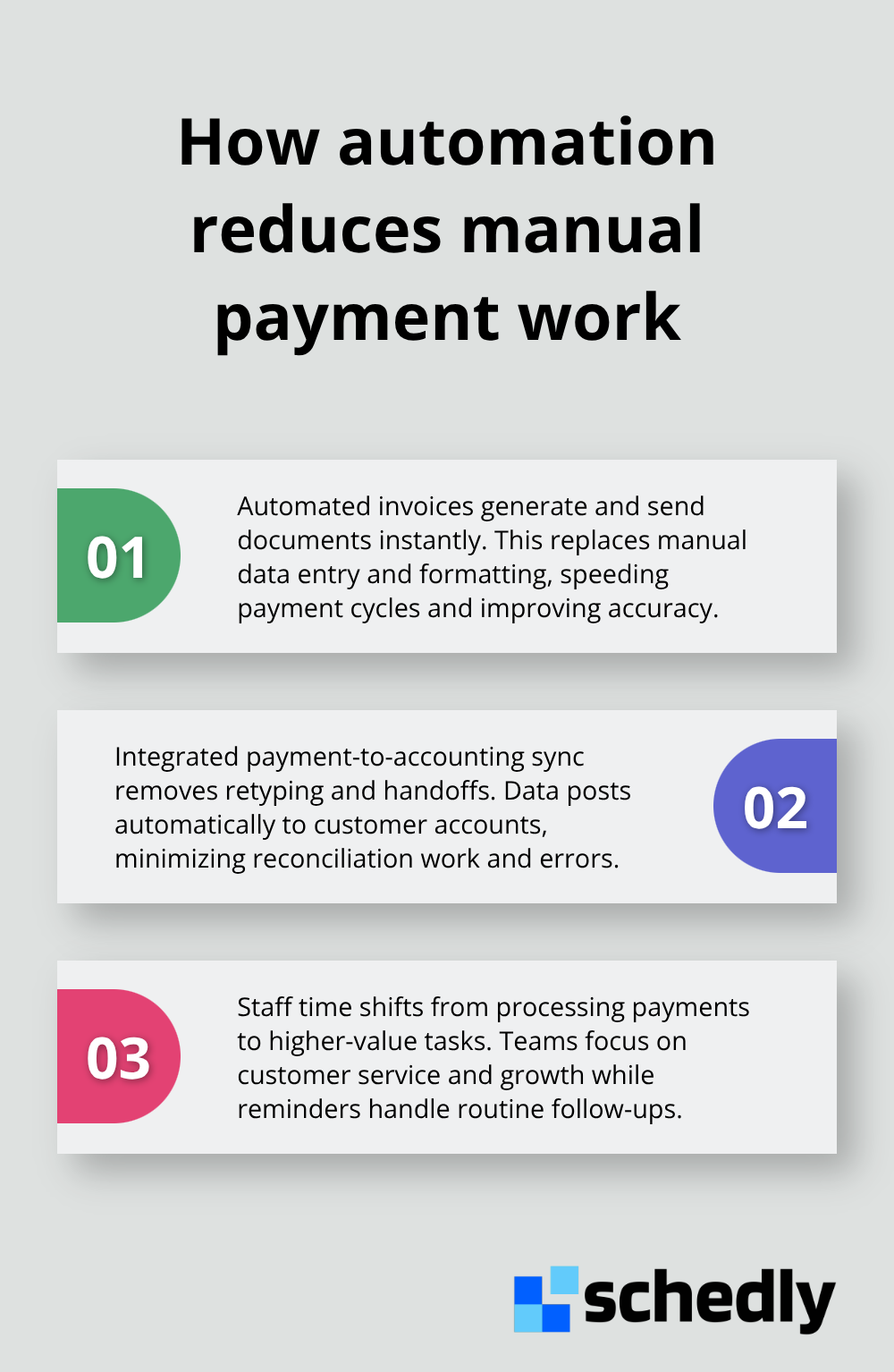
Automated invoice generation removes one of the most time-consuming tasks from your finance operations. Instead of manually creating invoices for each transaction, your system generates them instantly and sends them directly to customers. When you eliminate manual invoice generation, your staff stops spending hours copying client information, calculating amounts, and formatting documents. The process happens in seconds, and accuracy improves because no human transcription occurs. Companies using automated invoicing report faster payment cycles because customers receive invoices immediately after transactions occur, not days later.
Data Entry Errors Compound Into Reconciliation Nightmares
Manual data entry between your payment gateway and accounting system introduces errors that compound over time. When a payment arrives, someone must log it into your accounting software, match it to an invoice, and update customer records. Each handoff between systems creates a failure point. Digital payment automation reduces human error significantly because information flows directly from payment processing into your accounting stack without manual intervention. If you use tools like QuickBooks Online or Xero, integration with your payment system means transactions post automatically to client accounts in real-time. This eliminates the reconciliation nightmare where finance teams spend days hunting down discrepancies between payment records and accounting entries. One-click refunds and instant deposit posting further reduce the administrative burden because no paperwork trail requires management. Your team stops playing detective trying to match payments to invoices because the system does it automatically.
High-Value Staff Should Focus on Growth, Not Payments
When your skilled staff spends time on payment processing, you pay premium salaries for commodity work. Automation redirects that capacity toward customer relationships, strategic initiatives, and revenue-generating activities. A 24/7 veterinary hospital that consolidated accounts payable into a single online system saw immediate benefits because any employee could process payments from any workstation without specialized training. This flexibility matters in high-volume environments where peak periods create bottlenecks. Allowing staff to handle payments from anywhere in your facility (whether by phone or online portal) increases throughput during busy times. The result is faster customer service because billing friction disappears. When customers can pay through multiple channels without waiting for a specific person or time, they pay sooner. Your accounts receivable improves because payment barriers vanish. Automated reminders for overdue invoices further accelerate collections without requiring anyone to manually track delinquent accounts or send follow-up emails.
These operational improvements set the stage for the next critical consideration: how you actually connect your payment systems to work together seamlessly.
Payment Integration That Actually Works
Your payment system only works as well as its weakest connection. Most businesses treat payment integration as a technical checkbox rather than a strategic advantage, which costs them money through failed transactions, delayed reconciliation, and customer frustration.
Real-Time Data Transforms Financial Visibility
Seamless integration directly impacts your bottom line. When real-time data synchronization between payment gateways and accounting software connects properly, transactions post automatically without manual intervention. Tools like QuickBooks Online and Xero integrate with most modern payment processors, but integration quality varies dramatically. Some connections sync only once daily, leaving your financial data stale. Others sync in real-time, giving you immediate visibility into cash flow. The difference matters because delayed data means delayed decisions.
Real-time posting eliminates reconciliation delays where finance teams waste hours matching payments to invoices. Your payment gateway should feed directly into your accounting system without requiring anyone to manually log transactions or verify amounts. If your current setup requires manual data entry after payments arrive, integration is broken and you're leaving efficiency on the table.
Tokenization and Authentication Protect Customer Data
Security cannot be an afterthought in payment workflows. Tokenization encrypts payment data so sensitive information never sits in your system unprotected, and two-factor authentication adds a barrier against unauthorized access. Compliance requirements vary by industry and transaction type, but implementing security protocols upfront prevents expensive problems later. Your customers trust you with their payment information-protecting that data strengthens relationships and reduces liability.
Multiple Payment Methods Eliminate Customer Friction
Offering multiple payment methods directly increases success rates because different customers prefer different options. PayPal holds an estimated 43%–45% market share of the global online payment processing market, showing that digital wallets matter significantly. Supporting Apple Pay, Google Pay, and credit cards alongside traditional ACH transfers means customers can pay through their preferred channel rather than abandoning transactions because their option isn't available.
This flexibility reduces involuntary churn because payment barriers disappear. When customers hit friction during checkout, they leave. Multiple payment channels eliminate that friction. A 24/7 veterinary hospital that consolidated accounts payable into a single online system saw immediate benefits because staff could process payments through whatever channel customers preferred rather than forcing everyone through a single method. Your payment system should support whatever methods your customer base actually uses, not just the methods that are easiest for you to manage.
The strength of your payment infrastructure determines how well you can handle the next challenge: maintaining high transaction success rates even when volume spikes or systems face unexpected pressure.
Real-World Results from Payment Automation
Instant Posting Transforms Cash Flow and Reconciliation
Automated payment workflows produce measurable results that directly impact your bottom line. A 24/7 veterinary hospital that consolidated accounts payable into a single online system saw payments post to client accounts instantly instead of days later, transforming how quickly they accessed cash and reconciled accounts. This real-time posting capability matters because it eliminates the reconciliation delays that plague manual systems. When transactions sync automatically from your payment gateway into your accounting software without human intervention, your finance team stops hunting for discrepancies between payment records and ledger entries. Instead of spending hours matching payments to invoices, they verify that automation worked correctly and move forward.
Transaction Success Rates Rise When Manual Handoffs Disappear
Transaction success rates increase substantially when you eliminate manual handoffs between systems. Each time someone manually enters payment data, they introduce risk of error or delay. Automated workflows compress the entire payment lifecycle-from invoice generation through posting-into minutes. This speed directly reduces involuntary churn because customers who want to pay complete transactions immediately rather than waiting for someone to process their payment manually. A business processing 500 transactions monthly saves roughly 40 hours per month through the elimination of manual data entry and reconciliation tasks. That translates to 480 hours annually freed for work that actually generates revenue.
Administrative Costs Drop as Repetitive Work Vanishes
Administrative cost reduction follows naturally from eliminating repetitive manual work. When your accounting software integrates seamlessly with your payment gateway, you stop paying staff to perform tasks that automation handles better and faster. The veterinary hospital case demonstrates this clearly: allowing any employee to process payments from any workstation increased throughput during peak periods without hiring additional staff. This scalability matters because you handle volume spikes without proportional increases in labor costs. Real-time reconciliation through integrated systems reduces the audit and compliance burden because transaction records remain accurate and accessible without manual verification. Your team spends less time on payment administration and more time on strategic work like improving customer relationships or identifying inefficiencies in your billing process. When you measure the financial impact, automation typically pays for itself within months through reduced labor, fewer errors that require correction, and faster cash collection cycles. The key involves selecting payment infrastructure that integrates deeply with your existing accounting stack rather than creating another disconnected system that generates more manual work.
Final Thoughts
Streamlined online payment workflows aren't a luxury-they're a competitive necessity. Businesses that automate payment processing eliminate hours of administrative work, reduce errors that compound into reconciliation nightmares, and free their teams to focus on activities that actually drive growth. Real-time data synchronization, tokenized security, and multiple payment methods transform how quickly you collect cash and how accurately you track it.
The financial impact speaks for itself. A business processing 500 transactions monthly saves roughly 40 hours per month through automation-that's 480 hours annually redirected toward customer relationships, strategic initiatives, and revenue-generating work. Administrative costs drop as repetitive manual tasks vanish, transaction success rates rise when manual handoffs disappear, and your accounts receivable improves because payment barriers evaporate. Start by auditing your current payment system to identify where manual data entry occurs, where reconciliation delays happen, and which payment methods your customers actually request.
At Schedly, we've built scheduling software that integrates secure payment processing directly into the booking experience, eliminating the friction between scheduling and payment collection. When customers book appointments and pay in the same workflow, you capture revenue immediately while reducing administrative overhead. Your business becomes more scalable because you handle volume increases without proportional labor costs, your cash flow becomes more predictable because payments post automatically, and your team stops wasting skilled labor on commodity work.