
Schedly resources
PCI Compliant Payments: Why It Matters To Your Business
Payment security isn't optional anymore. Data breaches cost businesses an average of $4.45 million per incident, and customers expect their payment information to be protected.
At Schedly, we know that PCI compliant payments are the foundation of a trustworthy business. This guide walks you through what PCI compliance means, why your industry needs it, and how to implement it without disrupting your operations.
What PCI Compliance Really Means
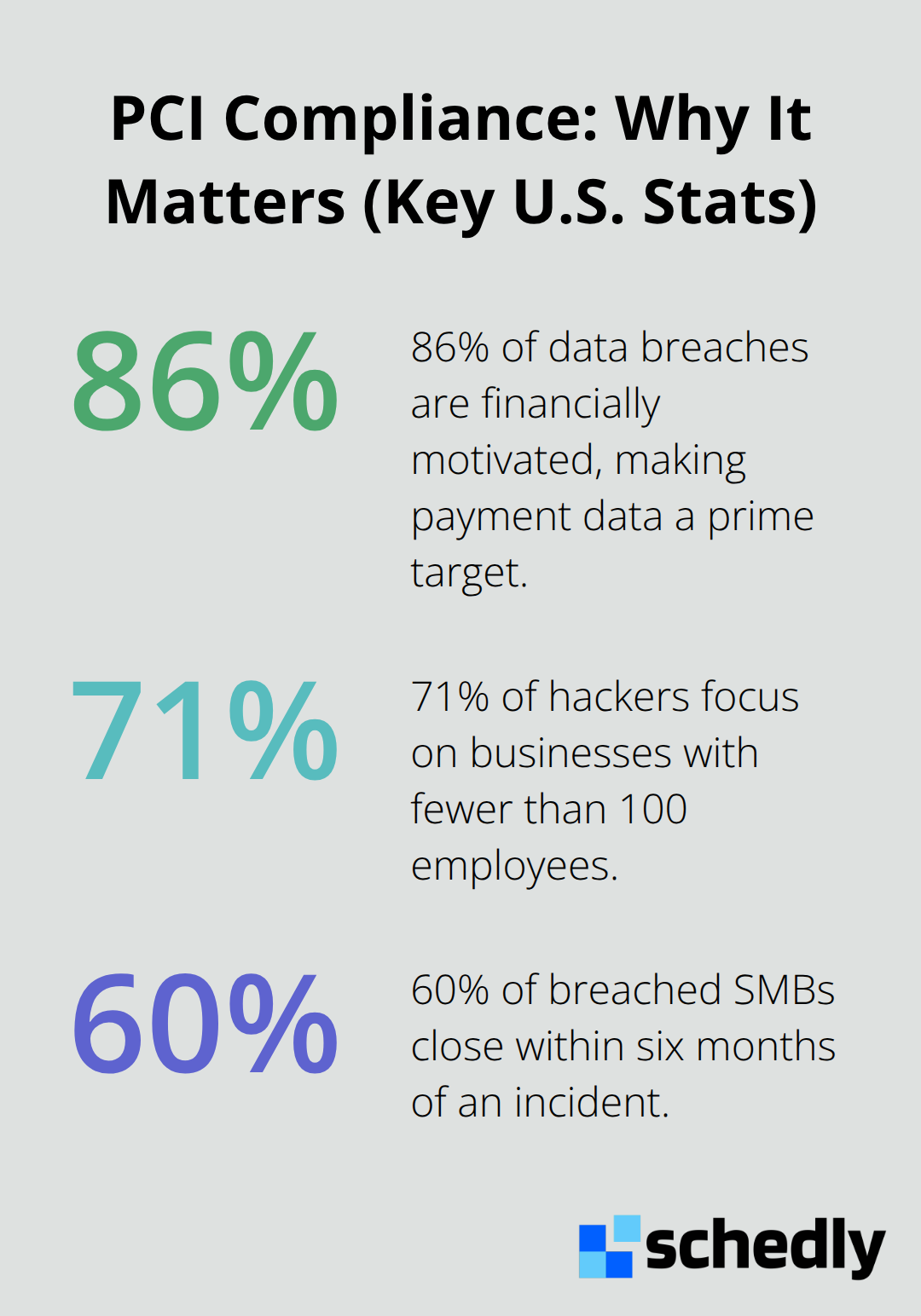
PCI DSS (Payment Card Industry Data Security Standard) is the security framework that protects cardholder data during storage, processing, and transmission. The PCI Security Standards Council established it in 2006, and it applies to every business that accepts even a single credit card payment. The standard consists of 12 core requirements covering everything from firewall maintenance and strong password protections to data encryption and access restrictions. Your acquiring bank or payment processor requires PCI compliance as a condition of doing business-this isn't negotiable. The framework exists because 86% of data breaches are financially motivated, making cardholder data a prime target for attackers. Non-compliance exposes you to fines ranging from $5,000 to $100,000 per month depending on severity and duration, plus the cost of mandatory forensic investigations if a breach occurs. Compliance protects your revenue and reputation, not just your legal standing.
What Happens When You Skip Compliance
Attackers deliberately target small businesses and merchants with fewer than 100 employees. According to the PCI Security Standards Council, 71% of hackers focus on this segment because smaller operations often lack robust security controls. If a breach occurs at a non-compliant business, the costs spiral quickly. You'll pay for the forensic audit itself, card re-issuance fees, potential liability for fraudulent transactions, and customer lawsuits. Payment brands can restrict or even terminate your card processing privileges, disrupting day-to-day operations. The National Cyber Security Alliance reports that 60% of breached small and medium-sized businesses closed within six months of an incident. Beyond the immediate financial hit, non-compliance signals negligence to customers, partners, and investors.
How Compliance Protects What Matters
Implementing PCI controls reduces your breach risk significantly. PCI compliance reduces breach risk based on Verizon data, because the 12 requirements address the most common attack vectors. Network segmentation isolates systems that touch cardholder data, encryption protects data in transit and at rest, and access controls limit sensitive information access to authorized personnel only. Regular vulnerability scans and penetration tests catch weaknesses before attackers exploit them. Compliance documentation-your Self-Assessment Questionnaire, vulnerability scan reports, and security policies-becomes evidence that you took reasonable precautions. If a breach somehow occurs despite your controls, this documentation protects you legally and demonstrates due diligence to regulators. Customer trust follows naturally. Shoppers expect their payment information to be handled securely, and compliance signals that expectation is met. You avoid the reputational damage that derails customer loyalty and revenue. Compliance also creates internal discipline: your team develops consistent security habits, incident response procedures, and awareness of data handling best practices.
Reducing Scope Over Time
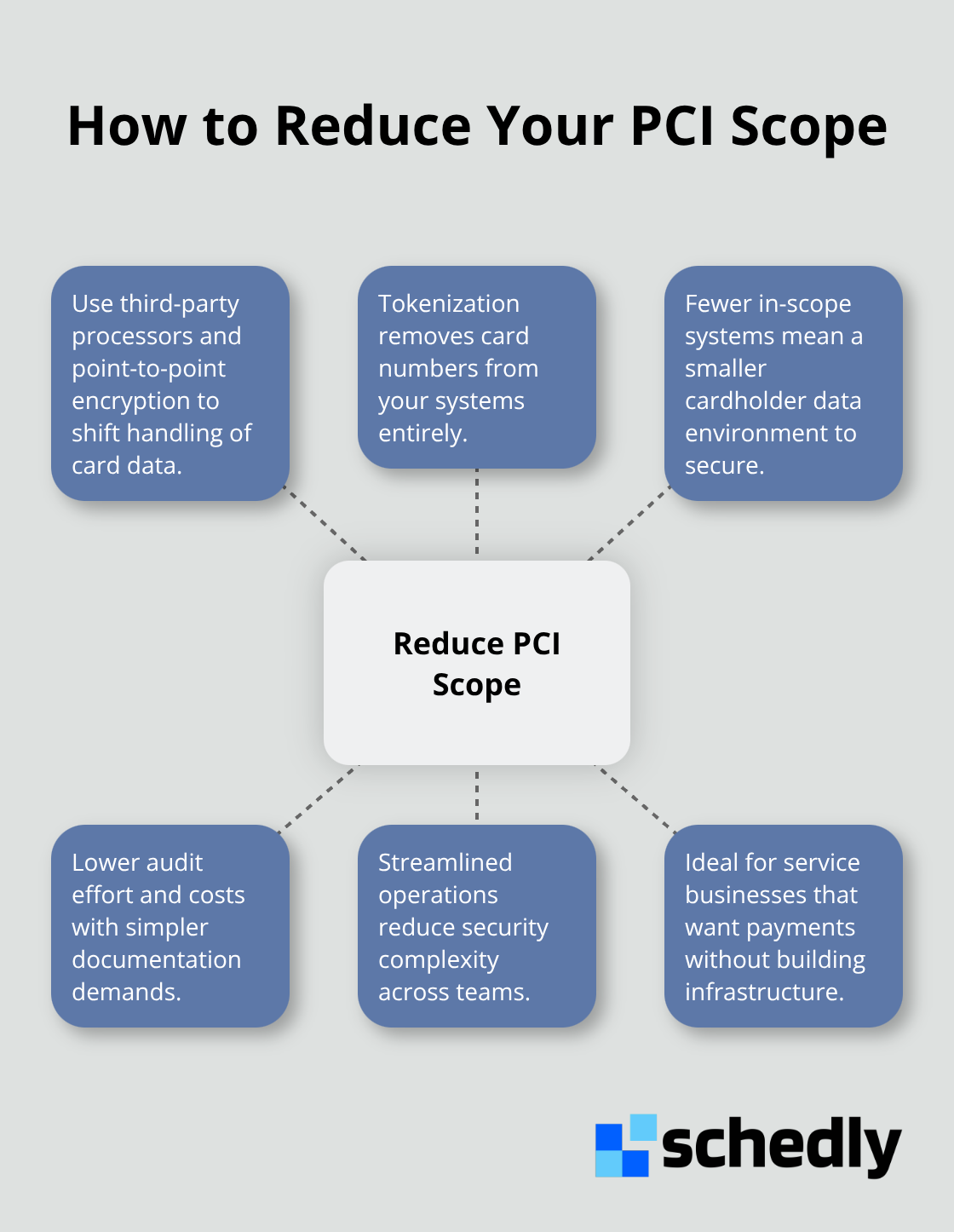
You can reduce your compliance burden by using third-party payment processors and point-to-point encryption, which means fewer systems you're responsible for securing. This approach (sometimes called tokenization) removes cardholder data from your direct control, shifting responsibility to specialized providers. The fewer systems that touch sensitive payment information, the smaller your cardholder data environment becomes. A smaller scope means lower audit costs, simpler documentation requirements, and less complexity in your security operations. This strategy works particularly well for service-based businesses that want to accept payments without building extensive payment infrastructure.
What Comes Next
Understanding what compliance means is the first step, but different industries face different compliance pressures and timelines. Retail stores, healthcare providers, and salons each operate under distinct regulatory environments that affect how they approach PCI requirements.
Industries That Must Prioritize PCI Compliance
Retail and E-Commerce Face the Highest Risk
Retail and e-commerce businesses process massive transaction volumes and store payment data across multiple systems, making them targets for attackers. A typical mid-sized retail chain processes thousands of card transactions daily across physical locations and online channels, expanding the cardholder data environment significantly. E-commerce businesses face even higher breach risk because they lack the physical security controls of brick-and-mortar stores. Attackers know that retail systems often integrate legacy point-of-sale terminals with modern inventory management platforms, creating fragmented security landscapes where vulnerabilities hide easily.
Compliance becomes mandatory, not optional, because acquiring banks won't process payments without documented controls. The complexity of retail operations means that non-compliance exposes you to fines, forensic investigations, and operational disruption. Payment brands can restrict or terminate card processing privileges if you fail to meet standards, shutting down your ability to accept payments entirely.
Healthcare and Financial Services Face Layered Obligations
Healthcare and financial services providers operate under additional regulatory pressure beyond PCI DSS itself. HIPAA and SOX compliance requirements layer on top of payment security standards, creating overlapping obligations that demand attention. A healthcare practice that accepts insurance copayments must satisfy both patient privacy rules and cardholder protection standards simultaneously. Financial institutions process high-value transactions, making them lucrative targets for attackers seeking account information and personal financial details.
These industries face the strictest audit requirements and the harshest penalties for non-compliance. A single breach exposes far more than payment data, amplifying liability and regulatory scrutiny in ways that smaller businesses don't experience.
Service Businesses Often Underestimate Their Risk
Salons, fitness centers, and consulting practices often underestimate their compliance obligations because they process lower transaction volumes. This assumption proves dangerous. Many service-based businesses operate with outdated systems that weren't designed for secure payment handling. A salon storing client credit card information in spreadsheets or email violates PCI requirements immediately. Service businesses frequently accept payments during client appointments without proper encryption or access controls, exposing cardholder data to unnecessary risk.
The good news is that these industries can reduce compliance complexity dramatically by using modern scheduling and payment platforms. Platforms that integrate with Stripe and PayPal mean payment processing happens through secure third-party gateways rather than your internal systems. This approach shrinks your cardholder data environment to nearly zero and shifts compliance responsibility to specialized providers. For service businesses, this strategy proves far more practical than building custom payment infrastructure.
Size Doesn't Protect You From Attackers
Regardless of industry, the threshold matters less than the decision to prioritize security. Small fitness studios and consulting practices often skip compliance thinking they're too small to attract attackers, but the data shows otherwise. According to the PCI Security Standards Council, 71% of hackers focus on businesses with fewer than 100 employees.
Compliance isn't about business size; it's about protecting the payment data you've promised to safeguard. The next section covers the specific practices that keep your systems secure and your compliance status current, regardless of your industry or transaction volume.
Best Practices for Maintaining PCI Compliance
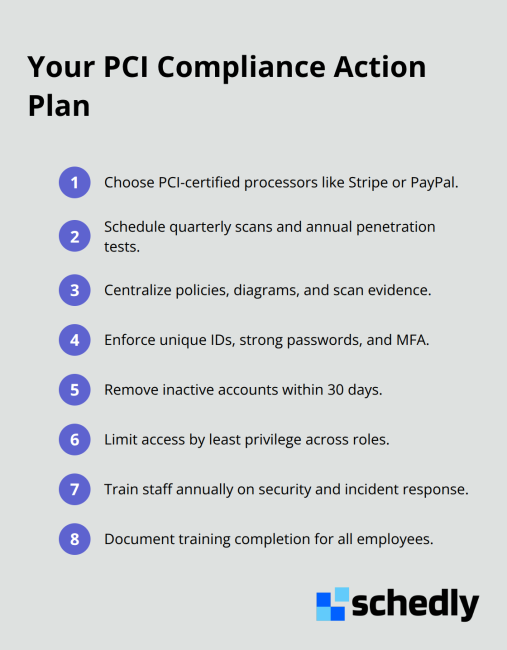
Choosing the right payment infrastructure determines whether compliance becomes a burden or a baseline. We at Schedly recommend using established payment gateways and processors like Stripe and PayPal that handle PCI compliance on your behalf. These platforms process payments through their secure infrastructure, meaning cardholder data never touches your servers. This approach eliminates the need to build and maintain custom payment systems, which is where most compliance failures occur. When you offload payment processing to specialized providers, your cardholder data environment shrinks dramatically, reducing audit scope and ongoing compliance costs.
Select Payment Processors That Carry PCI Certification
Your responsibility shifts from securing payment systems to verifying that your processor maintains current PCI certification. Established payment gateways publish their compliance documentation publicly, so you can confirm their security status before signing contracts. This is the practical path forward for most businesses, especially service-based operations that don't need custom payment infrastructure. Payment processors absorb the complexity of maintaining secure systems, allowing you to focus on your core business rather than payment security infrastructure.
Conduct Regular Vulnerability Scans and Penetration Tests
Regular vulnerability scanning and penetration testing catch weaknesses before attackers find them. Best practice involves quarterly vulnerability scans with an Approved Scanning Vendor, plus annual penetration tests to simulate real attack scenarios. Schedule these assessments consistently rather than waiting until audit time, because gaps discovered three months before your compliance validation give you time to remediate without rushing. Maintain detailed documentation of every scan result, remediation action, and completion date. When your Qualified Security Assessor reviews controls, this evidence demonstrates that you've been actively managing risk rather than passively hoping nothing breaks.
A centralized documentation repository containing security policies, network diagrams, scan reports, and configuration screenshots accelerates audit preparation significantly. Many businesses waste time during audits searching for evidence they already created, simply because it wasn't organized in one accessible location. Store these documents where your team can access them quickly when auditors request proof of your security practices.
Restrict Access Through Unique User IDs and Strong Passwords
Implement unique user IDs for every employee and disable default passwords immediately. Weak password practices represent a critical vulnerability across small and medium businesses. Use password vaults for complex credentials that teams can't memorize, ensuring that sensitive access information stays protected. Restrict access to cardholder data strictly to employees whose roles require it, applying the principle of least privilege across your entire operation.
Remove inactive accounts within 30 days of employment termination, because forgotten credentials become entry points for attackers. Multi-factor authentication for administrative access adds friction that prevents most automated attacks. For service businesses using scheduling platforms with integrated payment processing, this means limiting who can access the payment settings and client information, reducing exposure across your team.
Train Staff on Security Procedures and Incident Response
Conduct security training annually at minimum, covering data handling procedures, incident response protocols, and phishing awareness. Staff who understand why PCI compliance matters follow security procedures consistently rather than viewing them as obstacles. A recent report found that 45% of businesses failed compliance audits, and many failures traced to employee behavior rather than technical gaps. Train employees to recognize suspicious requests for payment data, report unusual access patterns, and escalate incidents immediately.
Document training completion for every staff member, because auditors verify that your team understands their security responsibilities. For businesses managing multiple locations or shift-based staffing, this training discipline becomes even more critical. Employees represent your first line of defense against social engineering attacks and careless data exposure.
Final Thoughts
PCI compliant payments protect your business, your customers, and your revenue through ongoing commitment rather than one-time effort. Non-compliance exposes you to fines up to $100,000 per month, mandatory forensic investigations, and operational disruption when payment processors restrict your access. Compliance reduces breach risk significantly by addressing the attack vectors that compromise cardholder data most frequently, and customers increasingly choose businesses that demonstrate strong security practices.
Start your compliance journey by assessing your current systems and transaction volume, then determine your PCI compliance level based on annual card transactions. If you process payments through your own infrastructure, engage a Qualified Security Assessor to guide your remediation plan. If you operate a service-based business accepting payments during client appointments, modern payment platforms handle compliance on your behalf-Schedly integrates with secure gateways like Stripe and PayPal, automating both booking and payment processing without exposing your systems to cardholder data.
Document your current payment processes today and identify which systems require immediate attention. Schedule your first vulnerability scan with an Approved Scanning Vendor, conduct staff training on data handling procedures, and establish a timeline for full compliance validation. The businesses that succeed with PCI compliance treat it as an ongoing discipline, reviewing controls regularly and adjusting practices as operations evolve.