
Schedly resources
Reminder Timing Optimization for Better Attendance
No-shows cost businesses real money. A missed appointment means lost revenue, wasted staff time, and frustrated customers.
At Schedly, we've seen firsthand that reminder timing optimization makes the difference between a packed schedule and empty slots. Send a reminder at the wrong time, and people ignore it. Send it at the right moment, and attendance rates climb.
This guide shows you exactly when to send reminders, what mistakes to avoid, and how to automate the process so you stop leaving money on the table.
When Should You Send Reminders for Maximum Attendance
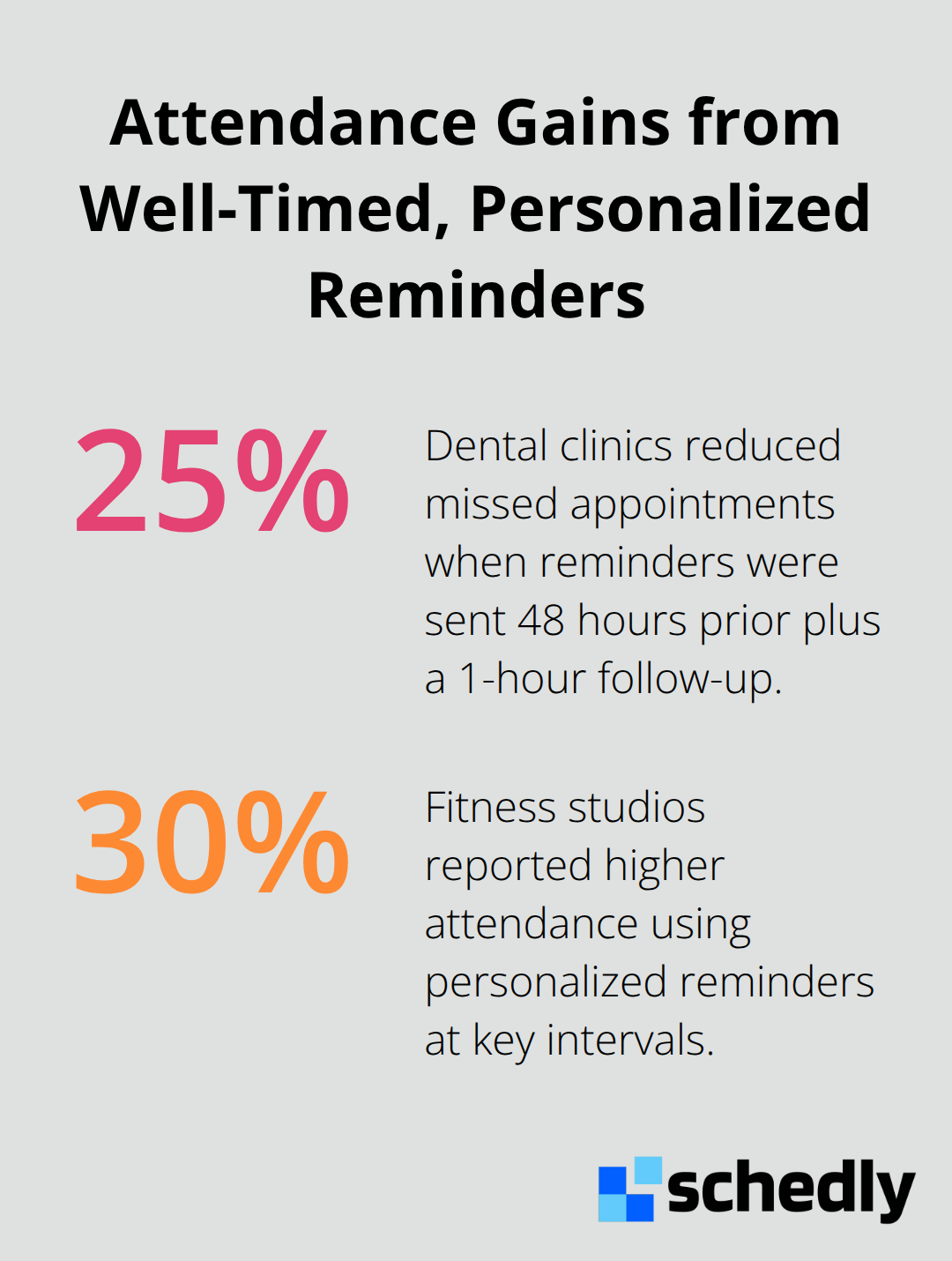
The timing of a reminder determines whether someone shows up or ignores your message entirely. Research from the TURNUP realist synthesis and Cochrane reviews shows that reminders improve attendance by around 6 to 10 percent on average, but this effect depends almost entirely on when you send them. A reminder that arrives too early fades from memory before the appointment. One that arrives too late finds people already committed elsewhere. The sweet spot is 24 to 48 hours before the appointment. Dental clinics reduced missed appointments by approximately 25 percent when they sent reminders 48 hours prior and added a second reminder 1 hour before. Fitness studios reported about 30 percent higher attendance when they used personalized reminders at key intervals.
The 48-Hour Window Works Across Industries
Healthcare settings have validated the 48-hour timing extensively, but the principle translates across sectors. For webinars and online events, schedule reminders at 1 week before, 1 day before, and 1 hour before the start. In-person events benefit from reminders at 2 weeks prior, 3 days before, and the morning of the event, with practical details like parking and dress code included. Hybrid events require separate reminder sequences for online and in-person attendees, since they face different friction points. For international events, time reminders to land during attendees' local business hours, not yours. The underlying principle remains: early reminders help people plan and adjust their schedules, while last-minute reminders create urgency. Morning delivery around 9 AM consistently outperforms evening sends at 7 PM because people act on messages they see during their work routine. Tuesday and Wednesday see higher engagement than other weekdays, so schedule your primary reminder for mid-week mornings when possible.
Frequency and Spacing Beat Single Messages
One reminder is better than nothing, but two or three reminders at the right intervals beat a single message. Research shows that spaced repetition outperforms a single prompt because it combats both forgetfulness and cognitive overload. The practical cadence is one reminder about 1 week before, another 1 to 2 days before, and a final one 2 to 3 hours before. However, avoid over-messaging. Studies indicate that 1 to 3 reminders is the optimal range, and going beyond that triggers reminder fatigue where people start ignoring your messages entirely. Use engagement metrics to identify the sustainable cadence for your specific audience.
Personalization and Two-Way Confirmations Drive Results
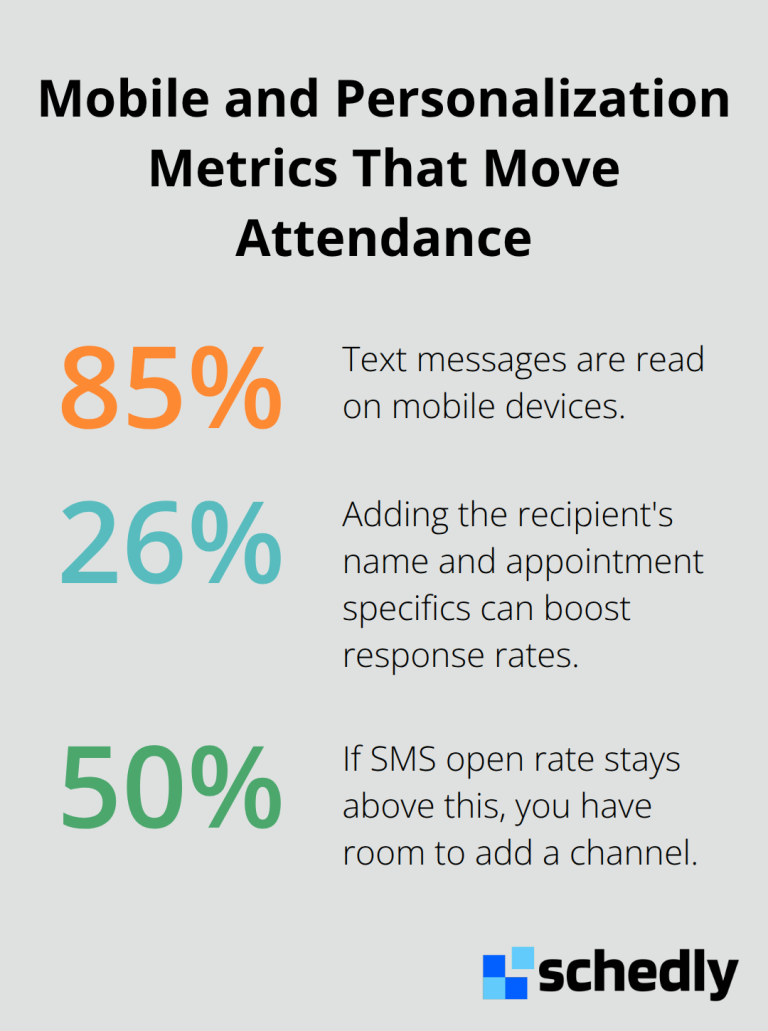
Personalization dramatically improves results: adding the recipient's name and appointment specifics can boost response rates by up to 26 percent. Two-way confirmations, where customers reply to confirm, work better than one-way reminders because they create an active commitment rather than passive receipt. This approach transforms a reminder from a broadcast message into a conversation that locks in attendance.
The next section covers the mistakes that undermine even well-timed reminders and shows you how to avoid them.
How to Build a Reminder Strategy That Works for Your Industry
Different industries have fundamentally different attendance patterns and customer expectations. Healthcare requires a different approach than fitness, which differs from real estate or education. The 48-hour window works as a baseline, but you need to adjust timing based on how your customers actually behave.
In healthcare settings, the 48-hour reminder plus a 1-hour follow-up has become standard because patients need time to arrange transportation or take time off work. Fitness studios send reminders at key intervals because members book classes impulsively and forget just as quickly. For webinars and virtual events, send reminders at 1 week before to catch early planners, 1 day before to re-engage fence-sitters, and 1 hour before to create final urgency.
The critical insight is that early reminders help people plan while last-minute reminders create urgency. Morning sends around 9 AM consistently outperform evening sends at 7 PM because people act during work hours. If your customers span multiple time zones, send reminders during their local business hours, not yours. This requires automation tools that respect timezone intelligence rather than blasting everyone at once.
Personalization Separates High-Attendance Businesses from the Rest
Personalization drives real results. Research shows that adding the recipient's name and specific appointment details boosts response rates by up to 26 percent. More importantly, two-way confirmations where customers actively reply to confirm attendance work better than passive one-way messages. A customer who types yes to confirm their appointment creates a real commitment, not just passive awareness.
Tailor your message to appointment type and customer context. Someone scheduling a first dental visit needs different information than a returning patient. A customer with a history of cancellations needs a message that emphasizes what they lose by not showing up, not what they gain by attending. Loss-framed reminders consistently outperform neutral messages.
Use Social Proof and Reduce Friction
Social proof influences behavior. Messages like "nine out of ten customers keep their scheduled appointments" set a behavioral norm that encourages compliance. You can also reduce friction in the confirmation process. One-click confirmations on mobile devices work better than forcing customers to call or email. Over 85 percent of text messages are read on mobile, so ensure your confirmation button is tappable and your link works seamlessly on phones.
For segments like older customers, offer voice calls instead of text. For younger audiences, SMS works better. The data from studies like the RemindMe research with seniors shows that people adopt reminder systems when they fit existing habits, not when they demand new routines.
Choose the Right Channels for Your Audience
Integrate reminders into the tools customers already use. Calendar invites matter. SMS matters. Email matters. Use multiple channels because different people prefer different communication methods, but avoid over-messaging across channels. One reminder via SMS and one via email at different times is effective. Three reminders via both channels becomes fatigue and triggers the very no-shows you want to prevent.
The next section reveals the specific mistakes that undermine even well-timed reminders and shows you how to avoid them.
What Mistakes Destroy Your Reminder Timing Strategy
The biggest mistake businesses make is sending reminders so far in advance that people forget about the appointment before it arrives. A reminder sent two weeks before an event feels theoretical. Your customer reads it, marks it mentally, then life happens. Research on spacing effects in reminder timing shows that reminders work best when spaced appropriately over time. The sweet spot remains 24 to 48 hours before, which gives people enough time to adjust their schedules without letting the message fade.
However, some businesses send initial confirmation emails weeks ahead, then add nothing until the day before. That gap wastes opportunity. Instead, structure your reminders in layers. Send a confirmation when they book, then stay silent for several days. Hit them again 1 week before with agenda details or speaker information. Follow with another reminder 1 to 2 days before with final logistics. Finish with a last-minute push 2 to 3 hours before. This spacing combats forgetfulness without triggering fatigue.
Over-Messaging Collapses Engagement
Over-messaging destroys attendance just as surely as under-messaging does. Dental clinics and fitness studios know this from experience. The optimal range of 1 to 3 reminders total keeps engagement strong, but many businesses send five or six across multiple channels. A customer receives an SMS, then an email, then a push notification, then a call. They stop reading all of it. Worse, they start actively ignoring your brand. Fitness studios that send excessive reminders see engagement collapse because members disable notifications entirely.
The solution is ruthless prioritization. Choose your strongest channel for your audience, then use one or two others sparingly. For most businesses, SMS at 48 hours before and a second SMS at 1 hour before beats sending emails, texts, and calls repeatedly. Avoid sending the same message across multiple channels on the same day. Instead, stagger them. If you send SMS on Tuesday, send email on Thursday. This respects customer preferences without creating noise.
Track your own engagement metrics. If your SMS open rate drops below 20 percent, you are over-messaging. If it stays above 50 percent, you have room to add a channel. The data from healthcare and fitness shows that personalized, sparse reminders outperform frequent, generic ones every time.
Timezone Misalignment Kills International Attendance
Ignoring timezones is an invisible killer for businesses serving multiple regions. A reminder sent at 9 AM Eastern Time hits West Coast customers at 6 AM when they are still asleep, and arrives in Europe at 2 PM when the workday is already half over. Your carefully timed message lands at the wrong moment for most of your audience.
For international events, you must send reminders during local business hours for each region. This requires automation tools that understand timezone logic, not manual sending or blunt scheduling. A webinar with attendees across North America and Europe needs three separate send times to hit everyone during morning hours when they actually respond to messages. Without this capability, you either send too early for some regions or too late for others, and attendance suffers across the board.
Weak Confirmation Processes Leave Slots Empty
Many businesses treat reminders as one-way broadcasts instead of two-way conversations. A customer receives a message but never confirms attendance. This creates uncertainty. Did they see it? Do they plan to show up? Without confirmation, you cannot reallocate slots or prepare resources accurately.
Two-way confirmations where customers reply to confirm attendance work better than passive one-way messages. A customer who types yes to confirm their appointment creates a real commitment, not just passive awareness. One-click confirmations on mobile devices work especially well since over 85 percent of text messages are read on phones. Make the confirmation button tappable and ensure your link works seamlessly on mobile devices. This simple friction reduction increases confirmation rates substantially and gives you accurate headcount data for staffing and preparation.
Final Thoughts
Reminder timing optimization works because it respects how people actually behave. Send reminders at 24 to 48 hours before an appointment, add a second reminder 1 to 2 hours before, and personalize each message with the recipient's name and appointment details. This approach consistently reduces no-shows across healthcare, fitness, education, and service industries, with businesses reporting attendance improvements of 6 to 10 percent immediately and reductions in missed appointments as high as 25 to 30 percent.
The challenge is execution. Manual reminder scheduling fails because it requires tracking dozens of appointments across multiple time zones and personalizing each message at the right moments. Most businesses either over-message and trigger fatigue or under-message and watch attendance drop. Automation solves this problem entirely by sending personalized messages at exactly the right moments for each customer, respecting their time zone and communication preferences.
Start by auditing your current reminder process and measuring your actual no-show rate. Then implement a baseline system with one reminder at 48 hours before and one at 1 hour before, both personalized with the customer's name. Measure your results for 30 days, adjust timing or personalization based on what you learn, and use scheduling software to automate the process so you stop leaving money on the table.