
Schedly resources
Secure Payments Made Simple With Credit Card Processing Platform
Payment security isn't optional-it's the foundation of customer trust. When you process credit cards, every transaction carries risk, from data breaches to fraud losses that can cripple a business.
At Schedly, we've seen firsthand how the right credit card processing platform transforms this challenge. The difference between a secure, efficient payment system and a vulnerable one often comes down to understanding what actually protects your data and your customers.
How Credit Card Processing Protects Your Data in Real Time
The Authorization and Verification Process
When a customer enters their card details at checkout, the transaction doesn't simply move from their account to yours. A series of security checkpoints and verification steps happen in seconds. The payment gateway captures the card data and sends it to the acquiring bank, which contacts the card network (Visa, Mastercard, American Express, or Discover) to verify the transaction. The issuing bank-the customer's bank-checks whether the card is valid, has sufficient funds, and hasn't been flagged for fraud.
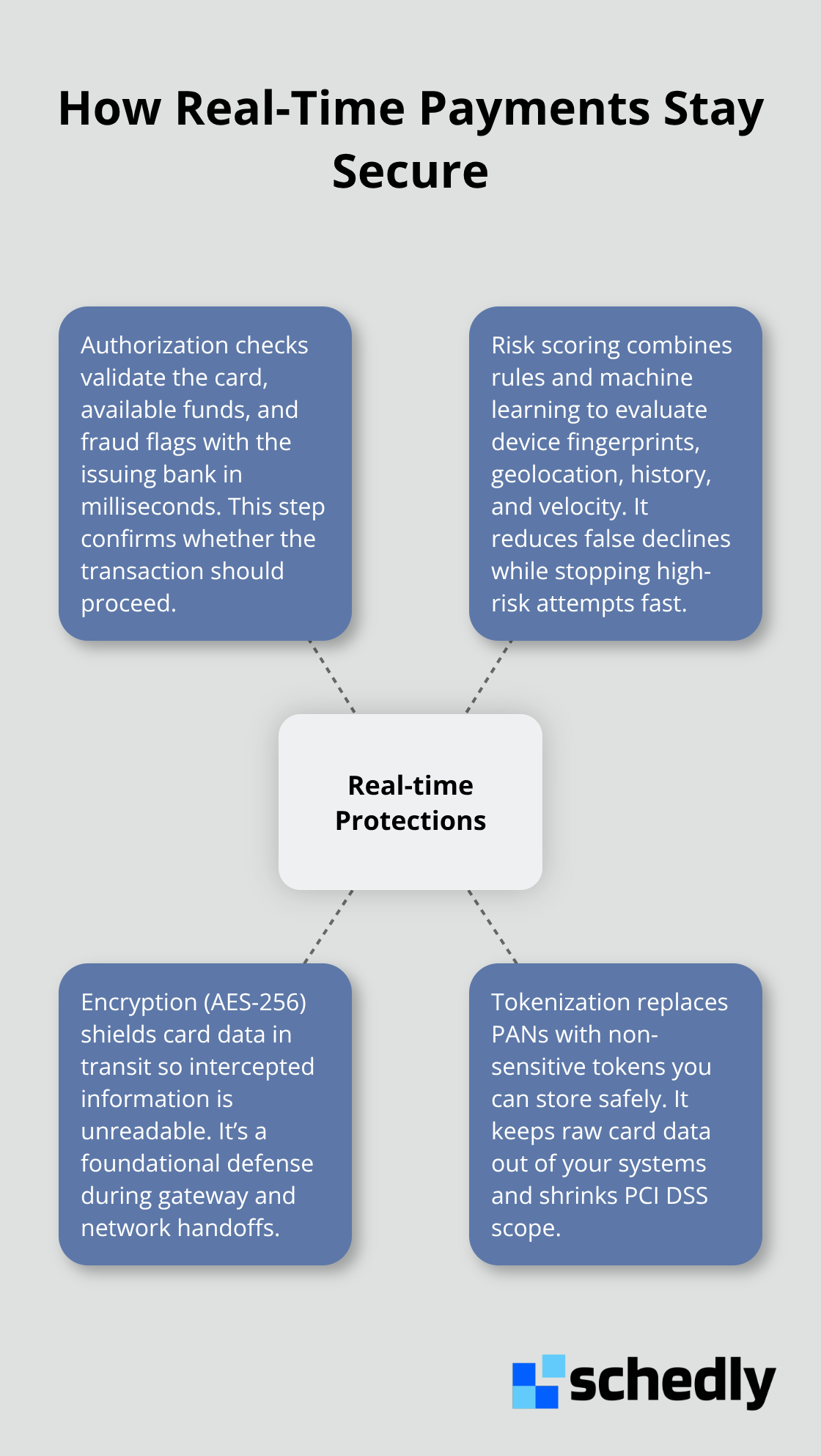
During this phase, the payment processor applies fraud detection rules and machine learning models to assess risk. If everything checks out, the transaction receives an authorization code. This is where encryption becomes your first real defense. The payment platform uses AES-256 encryption to protect card data in transit, rendering it unreadable if intercepted. Many modern processors also employ tokenization, which replaces sensitive card information with a non-sensitive token that can be safely stored. This dramatically reduces your exposure under PCI DSS compliance requirements because you no longer directly handle raw card data.
Why Settlement Takes Days, Not Minutes
Most merchants assume funds arrive immediately after authorization. They don't. Settlement typically takes one to three business days after the authorization completes. This timeline matters for your cash flow. During this window, the acquiring bank batches your transactions, sends them through the card networks, and waits for funds to arrive from the issuing banks. Only then does your merchant account receive the deposit. Understanding this timeline prevents confusion and helps you forecast revenue accurately.
Some payment platforms now offer real-time payment options and faster settlement speeds, which can meaningfully improve working capital for high-volume businesses. The PCI Security Standards Council establishes the framework protecting this entire process, requiring secure infrastructure, access controls, regular monitoring, and documented security policies.
The Real Cost of Inadequate Security
Data breaches remain expensive-the global average cost reached around 4.5 million dollars according to IBM Security research, with US businesses facing even higher costs near 9.5 million dollars. This underscores why selecting a processor with PCI DSS Level 1 certification and proven fraud detection isn't just compliance theater; it's financial protection. Multifactor authentication, digital wallets, and EMV chip technology add additional verification layers that make unauthorized transactions substantially harder to execute.
The stakes are high enough that your choice of payment processor directly impacts your bottom line. What separates a secure platform from a vulnerable one comes down to the specific security measures it implements and how consistently it maintains them. The next section examines the key features that modern payment platforms use to stay ahead of fraud and protect both your business and your customers.
What Makes a Payment Platform Truly Secure
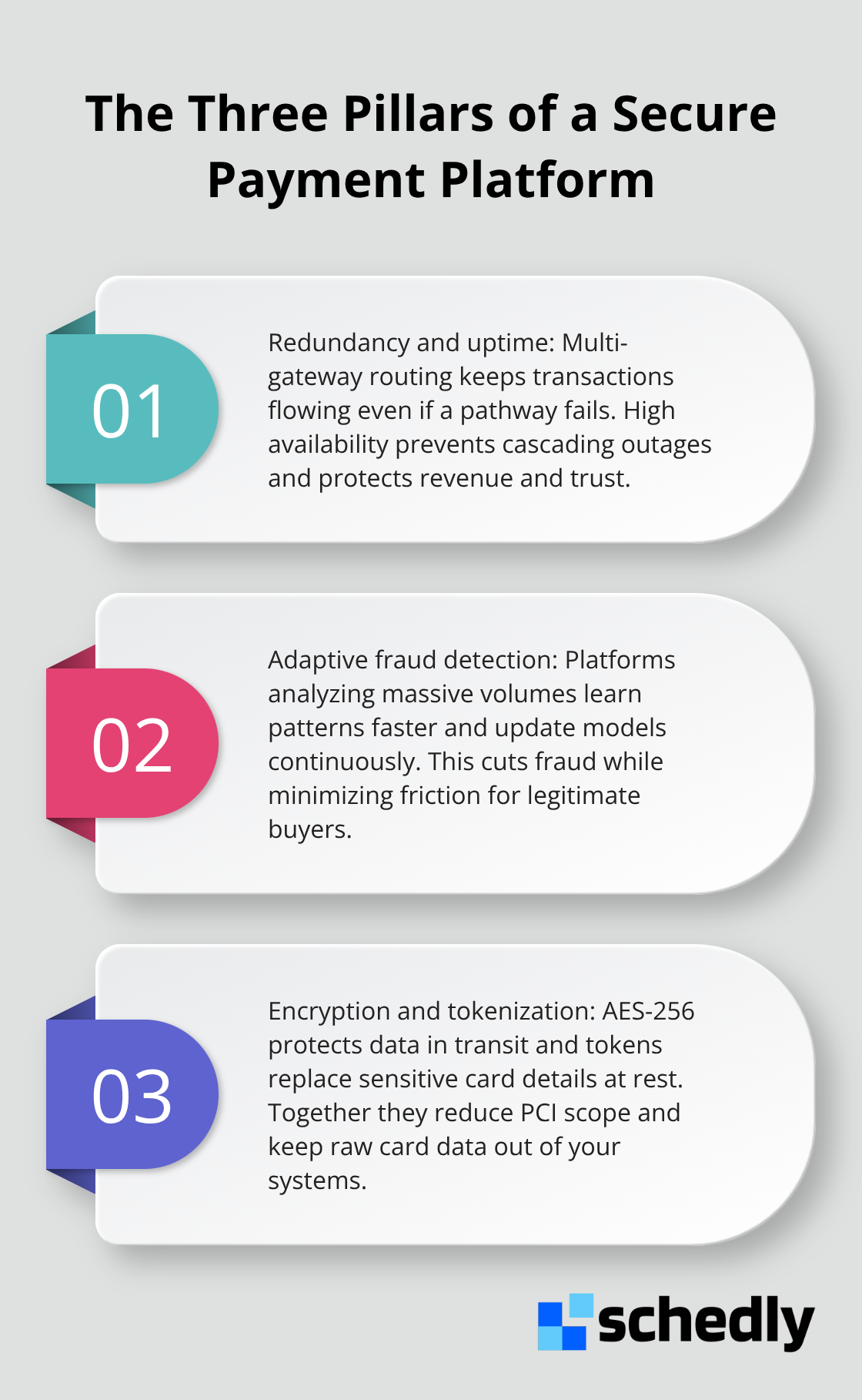
A payment platform's security isn't determined by a single feature-it's built on multiple overlapping systems that work together to stop fraud before it happens. PCI DSS Level 1 certification matters, but it's only one part of the equation. The platform needs to combine compliance frameworks with active fraud detection, system redundancy, and continuous monitoring. When you evaluate processors, look beyond marketing claims and examine what they actually do. Does the platform use tokenization to keep card data out of your systems entirely? Does it employ machine learning models that learn from millions of transactions to flag suspicious patterns in real time? These specifics determine whether you receive genuine protection or just checkbox compliance.
Redundancy Isn't Luxury, It's Necessity
Payment processing must work every single day without interruption. When transactions fail because your processor goes down, you lose revenue and customer trust simultaneously. Leading payment platforms now guarantee 99.999% uptime, which allows for only about 5 minutes of downtime each year. This reliability comes from multi-gateway architecture-the platform routes transactions through multiple independent pathways so that if one gateway fails, transactions automatically reroute to another. This redundancy prevents the cascading failures that can cripple a business. When comparing processors, ask directly about their uptime guarantees and whether they provide real-time status dashboards. Major processors handle over 500 million API requests daily, demonstrating the infrastructure needed to support high-volume, mission-critical payments. Your processor should offer this level of transparency about their actual performance, not just theoretical capabilities.
Fraud Detection That Learns Faster Than Criminals
Real-time transaction monitoring uses machine learning to examine dozens of data points-device fingerprints, geographic patterns, purchase history, velocity checks-and make accept or decline decisions within milliseconds. What separates effective fraud detection from mediocre systems is the speed of learning. Processors that handle billions of transactions monthly identify fraud patterns faster and adapt their models continuously. This matters because fraud tactics evolve constantly.
Encryption and Tokenization Work Together
Two technologies form the backbone of data protection in modern payment systems. Encryption uses AES-256 standards to protect card data in transit, rendering it unreadable if intercepted. Tokenization replaces sensitive card information with non-sensitive tokens that you can safely store without expanding your PCI DSS compliance burden. Together, these technologies mean your systems never directly handle raw card data. This dual approach reduces your exposure substantially and simplifies your security infrastructure. When a processor implements both encryption and tokenization, you transfer the responsibility for protecting sensitive data to a specialized provider rather than managing it yourself.
Compliance Frameworks Provide Structure, Not Protection Alone
PCI DSS establishes the framework protecting payment systems, requiring secure infrastructure, access controls, regular monitoring, and documented security policies. However, compliance alone doesn't stop fraud. The framework creates the structure; active systems create the defense. A processor with PCI DSS Level 1 certification has passed rigorous audits, but you still need to verify that the platform actively monitors transactions, updates fraud detection models, and responds to threats in real time. Multifactor authentication, digital wallets, and EMV chip technology add additional verification layers that make unauthorized transactions substantially harder to execute. The cost of inadequate security remains high-data breaches cost businesses an average of USD 12.6 million in the finance sector. This underscores why selecting a processor with proven fraud detection and active security measures protects your bottom line directly. The next section examines how to evaluate and compare processors so you select the platform that matches your business needs and security requirements.
How Processor Pricing Actually Works
Selecting a credit card processor means understanding exactly what you'll pay, not just the headline percentage rate. The industry quotes three primary pricing models, and each one favors different business types.
Flat-Rate vs. Interchange-Plus Pricing
Flat-rate pricing charges a fixed percentage plus per-transaction fee regardless of card type or transaction size-typically around 2.9% plus 30 cents per charge. This simplicity appeals to startups and low-volume businesses because you know your costs upfront without complexity. However, flat-rate pricing becomes expensive fast. A $5,000 transaction costs you $145 plus 30 cents; ten $500 transactions totaling the same amount cost $145 plus $3 in per-transaction fees.
Interchange-plus pricing instead passes through the card network's actual interchange rate plus your processor's fixed markup, usually 20 to 25 basis points. This transparency matters when your monthly volume exceeds $10,000. A business processing $50,000 monthly in transactions typically saves 30 to 50 basis points annually by switching from flat-rate to interchange-plus.
Avoiding Hidden Fees and Tiered Pricing Traps
The third model, tiered pricing, segments transactions into qualified, mid-qualified, and non-qualified categories based on card type and risk-but this approach introduces hidden costs because processors control the tier definitions. Avoid tiered pricing unless you have no alternative.
Your processor should disclose all fees explicitly: transaction percentages, per-transaction amounts, monthly minimums, PCI compliance fees, chargeback penalties, and setup costs. Hidden fees buried in contracts represent thousands in unexpected annual costs.
Integration Capabilities That Save Time
The integration question separates processors that integrate seamlessly from those that create operational friction. Your payment processor must connect to your e-commerce platform, accounting software, POS system, and any invoicing tools you use. Processors supporting direct integrations with Shopify, WooCommerce, Salesforce, and hundreds of other platforms reduce implementation time to days rather than weeks.
If your processor requires custom API development or manual reconciliation between systems, you've selected the wrong vendor. Test integrations in a sandbox environment before committing; processors offering no-code setup and pre-built connectors save your team hundreds of hours annually on manual data entry and reconciliation.
Uptime Guarantees and Support Quality
Uptime guarantees matter more than you might think because processing failures don't just cost transaction fees-they cost revenue. When your payment system goes down during peak hours, you lose sales immediately. The number 100% seems to be not appropriate for this chart. Please use a different chart type. Processors guaranteeing 99.999% uptime allow only about 26 seconds of downtime monthly. Ask potential processors for transparent uptime dashboards showing actual performance, not theoretical maximums.
Support quality determines whether payment issues get resolved in minutes or days. Evaluate whether processors offer 24/7 phone support rather than email-only channels; payment problems demand immediate responses. Read independent reviews on G2 and Capterra focusing on support response times and resolution quality, not just feature lists. The processor offering the lowest fees but mediocre support will cost you more in lost time and revenue than a slightly more expensive alternative with responsive, knowledgeable support teams available when emergencies occur.
Final Thoughts
Secure payment processing comes down to selecting systems that protect your business and your customers simultaneously. The credit card processing platform you choose determines whether transactions flow smoothly or create operational friction, and the stakes extend beyond convenience to your bottom line. Throughout this guide, we've examined what happens during authorization, why settlement timelines affect cash flow, and how modern processors combine encryption, tokenization, and fraud detection to stop threats before they materialize.
The best processors actively monitor transactions, maintain 99.999% uptime, and integrate seamlessly with your existing systems without hidden fees or surprise charges. When evaluating options, focus on concrete details: What encryption standards do they use? How quickly do they detect fraud? What does their actual uptime performance show? Can they integrate directly with your accounting and e-commerce platforms? A processor with poor fraud detection costs you in chargebacks and disputes, while one with mediocre uptime costs you in lost revenue during outages.
If you manage customer bookings or appointments alongside payment processing, Schedly combines secure payment processing through trusted gateways with automated scheduling, eliminating the friction of managing payments and bookings separately. Start by auditing your current processor against the criteria outlined here, and request demos from alternatives to test their integrations in sandbox environments before committing. Implementation takes days, not weeks, when you select a processor designed for straightforward onboarding.