
Schedly resources
SMS Reminders Boost Attendance: Texts That Drive Better Compliance
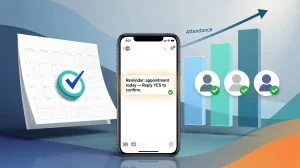
Missed appointments cost businesses billions every year. A single no-show at a medical clinic, fitness studio, or law firm disrupts schedules and erodes revenue.
SMS reminders boost attendance by cutting through the clutter of email inboxes and notifications. At Schedly, we've seen how text messages deliver open rates above 98%, making them the most reliable way to reach people before their appointments.
How SMS Reminders Actually Move the Attendance Needle
Why Email Fails and Text Messages Win
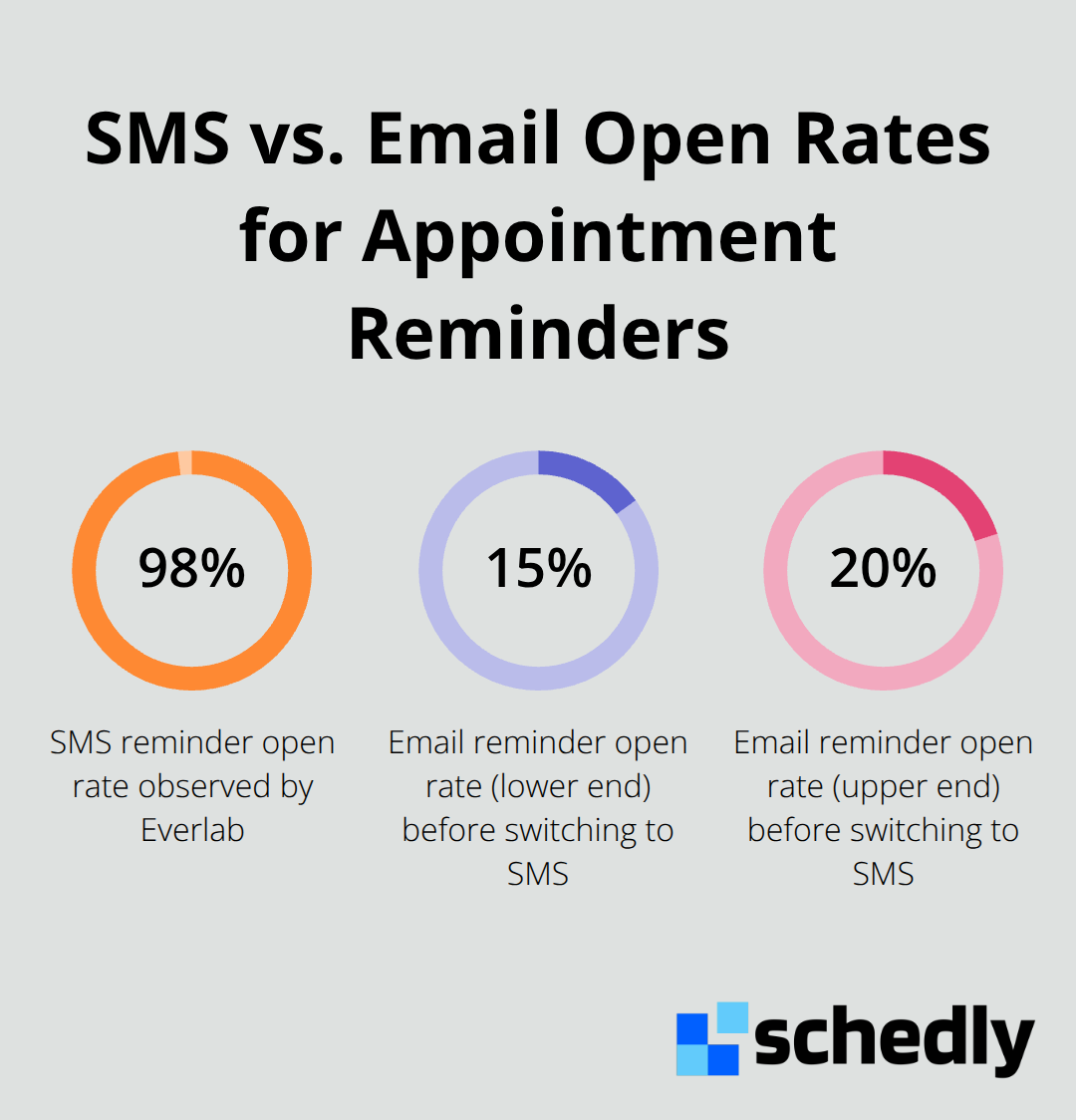
Email reminders vanish into crowded inboxes. A text message sits on someone's phone, visible and impossible to ignore. The data backs this up decisively. Everlab's experience with SMS appointment confirmations and reminders showed open rates hitting 98%, while their email reminders achieved only 15–20% open rates before switching to SMS. That gap isn't marginal-it's transformative.
A meta-analysis published in the Journal of Medical Systems in 2016 examined 28 studies from 2005–2015 and found that SMS reminders increased appointment attendance odds by 62% compared with no reminders. Across randomized controlled trials within that analysis, the pooled odds ratio was 1.62, meaning SMS reminders consistently moved attendance upward across healthcare settings, fitness facilities, and professional services.
Real Attendance Numbers That Matter
Real-world attendance rates tell the story even more directly. Research from the Cochrane Review showed absolute attendance rates of 67.8% with no reminders but 78.6% with mobile SMS reminders-a gain of nearly 11 percentage points. When SMS reminders combined with postal reminders, attendance climbed to 80.3%. These aren't theoretical improvements; they reflect actual people showing up to their appointments because a text message reminded them.

The Psychology Behind SMS's Power
Text messages arrive as notifications on devices people check constantly throughout the day. The 2016 meta-analysis found no significant differences in effectiveness based on reminder content, tone, or frequency-SMS works because of the medium itself, not because of clever copywriting. Most effective reminders arrived within 48 hours before the appointment, giving people enough time to rearrange their schedule if needed without fading from memory.
Everlab's implementation using SMS via Sinch MessageMedia integrated with HubSpot reduced their missed appointments by 40%, demonstrating how automation paired with SMS timing delivers real operational wins.
The Economics of SMS Reminders
Cost matters too. SMS reminders cost approximately 55–65% of what phone call reminders cost while delivering similar attendance outcomes. For businesses managing dozens or hundreds of appointments weekly, that efficiency compounds quickly. A single SMS costs pennies and requires no staff time to deploy, making it the only reminder channel that scales without proportional increases in labor costs.
The real question isn't whether SMS reminders work-the evidence settles that decisively. The question becomes how to implement them effectively within your existing systems and workflows.
Industries Where SMS Reminders Transform Attendance
Healthcare: Reducing No-Shows and Recovering Revenue
Healthcare facilities no-show rates reach 30% or higher, directly affecting patient outcomes and clinic revenue. A meta-analysis of 28 studies found SMS reminders increased appointment attendance odds by 62%, with real-world data showing attendance climbing from 67.8% without reminders to 78.6% with SMS. Medical practices that implemented SMS confirmations saw missed appointments drop significantly. Everlab's case demonstrated a 40% reduction in no-shows after integrating SMS reminders with their scheduling system.
Patients receive a text 24–48 hours before their appointment, have time to adjust their schedule, and actually show up. Healthcare administrators now treat SMS reminders as operational infrastructure, not optional extras. A single clinic running 50 appointments per week at typical no-show costs of $50–$150 per slot can recover $130,000–$390,000 annually just by reducing no-shows by 10 percentage points.
Fitness Studios: Engagement Beyond Attendance
Fitness facilities struggle with membership retention when members skip classes without notice. SMS reminders function as a retention tool as much as an attendance driver. A text message the day before class prompts members to commit mentally and physically to showing up.
Facilities that send SMS reminders see higher engagement rates and longer member lifespans. The reminder signals that the studio values the member's participation and creates accountability. Members who receive confirmations feel more connected to the community and less likely to cancel or ghost.
Legal and Consulting: Quality Meetings Through Preparation
Legal and consulting firms face different challenges than healthcare or fitness. Missed client meetings delay billable work and damage relationships. These industries benefit from SMS because appointment confirmations signal professionalism and reduce friction in client interactions.
Timing matters more in legal and consulting than in healthcare. A reminder 48 hours before a consultation gives clients time to prepare documents or questions, improving the quality of the meeting itself. Consulting firms that send SMS reminders see higher-quality appointments because clients arrive prepared rather than rushed. The reminder becomes a tool for meeting success, not just attendance.
Tailoring Content Across Industries
Each industry should tailor reminder content accordingly. Healthcare focuses on appointment details and preparation instructions (bring insurance cards, arrive 15 minutes early). Fitness emphasizes the class time and location with motivational language. Legal and consulting includes meeting objectives or preparation steps so clients know what to expect.
The common thread across all three sectors is that SMS reaches people reliably and prompts action when it matters most. The medium works universally, but the message must fit the context. This alignment between channel and content is what separates effective reminder programs from those that merely send texts and hope for results. Understanding how to craft and time these messages for each industry sets the foundation for implementation success.
How to Time, Personalize, and Automate Your SMS Reminders
The 48-Hour Window That Works
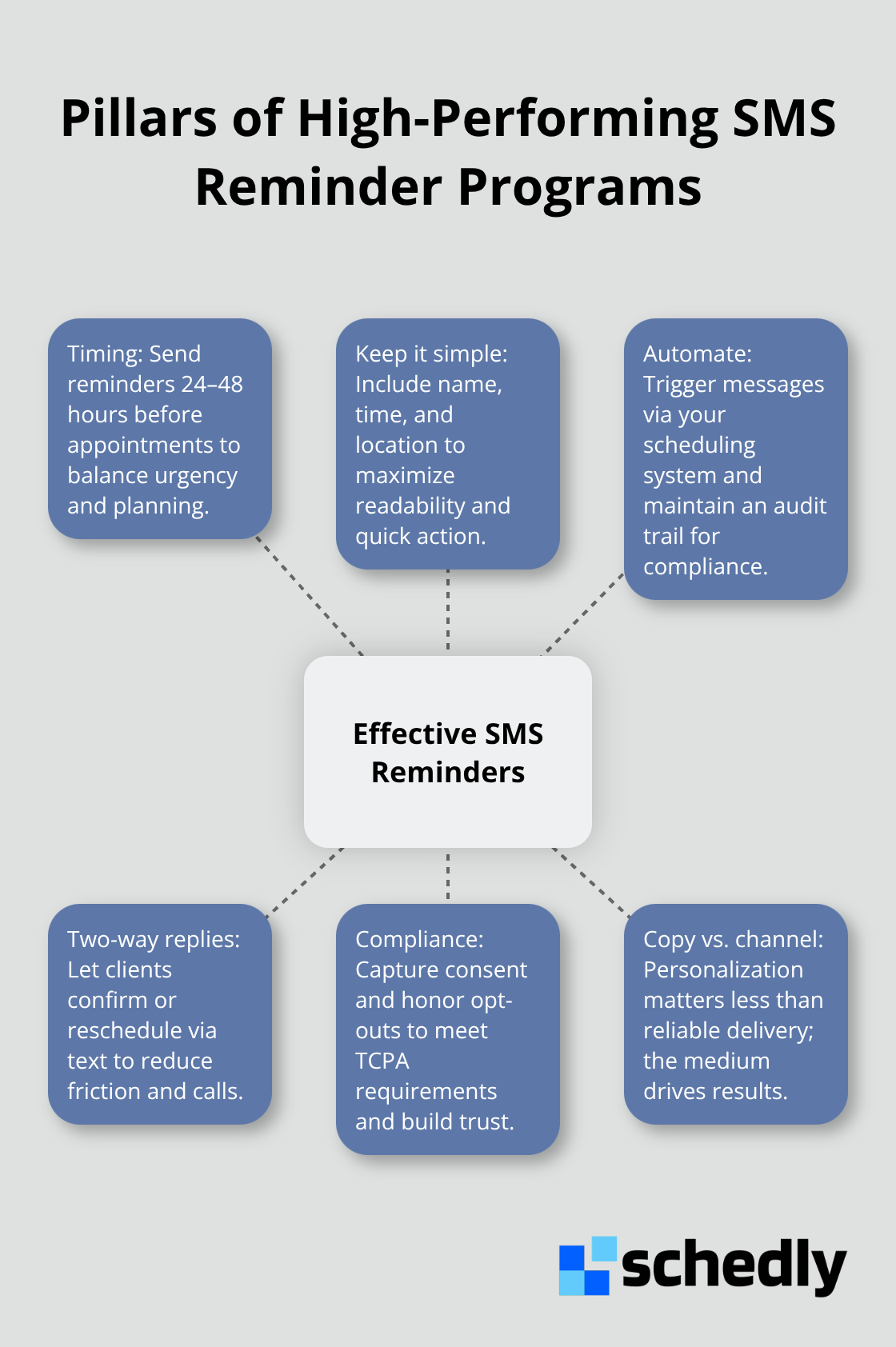
Timing matters more than message cleverness. Studies consistently found that reminders arriving 24–48 hours before an appointment delivered the strongest results, giving people enough time to rearrange schedules without the message fading from memory. Send a reminder too early and it competes with dozens of other notifications. Send it too late and someone has already committed to something else. The 48-hour window sits in the sweet spot where urgency meets practicality. Healthcare facilities and fitness studios that respect this timing see measurably higher show rates than those sending reminders randomly or too close to appointment time.
Keep Messages Simple and Direct
Personalization sounds important but research from the 2016 meta-analysis found that SMS reminders helped improve patient medical compliance and appointment attendance. This means you should stop worrying about crafting the perfect message and start focusing on consistent, automated delivery. Include the person's name, appointment time, and location-that's sufficient. Everlab's experience with SMS showed 98% open rates whether messages were brief or detailed, proving the medium carries more weight than the copy. Brevity actually wins because people read texts faster than emails. A reminder stating the person's name, appointment time, and a single action (confirm or reschedule) works better than elaborate explanations. Try keeping messages under 160 characters when possible so they display completely on any phone without requiring scrolling.
Automate Everything Through Your Scheduling System
Automation through your scheduling system eliminates manual sending, reduces errors, and scales effortlessly. When SMS integrates directly with your booking platform, reminders trigger automatically at the optimal 48-hour mark without staff intervention. Systems that require manual sending always miss appointments because reminders either go out inconsistently or get forgotten entirely. Automation also creates an audit trail showing when each reminder was sent, which matters for compliance with TCPA regulations requiring documented consent and opt-out processing within 10 business days. Your team focuses on serving clients rather than managing message queues.
Enable Two-Way Conversations
Two-way SMS capabilities strengthen automation further by letting people confirm or cancel directly through text, eliminating the need for phone calls or email responses. Storing these conversation records in your CRM helps support teams resolve scheduling conflicts without asking clients to repeat information. This bidirectional approach transforms reminders from one-way broadcasts into actual conversations that build trust and reduce friction in your booking process.
Final Thoughts
The evidence proves that SMS reminders boost attendance across every industry we examined. Attendance rates jump from 67.8% to 78.6% or higher when you implement SMS, and that improvement translates directly to recovered revenue and stronger client relationships. Your scheduling platform must handle SMS automation natively, triggering reminders at the optimal 48-hour mark without manual intervention, and two-way messaging capabilities let clients confirm or reschedule through text rather than phone calls.
At Schedly, we built SMS reminders directly into our platform because we recognized that attendance problems stem from broken communication, not client indifference. Our software automates the entire booking and reminder workflow, from initial scheduling through post-appointment follow-up, so reminders send consistently at the right moment every time. Businesses using Schedly see measurable improvements in show rates because the system handles timing, personalization, and compliance without requiring staff attention.
Stop relying on email and phone calls as your primary reminder channels. Start using Schedly to automate scheduling, reminders, payments, and client management in one integrated platform designed for your industry. Within weeks, you'll see no-show rates drop and revenue recover.