
Schedly resources
Stripe Payment Processing Integration: Seamless Billing Across Apps

Payment processing can make or break your business. At Schedly, we've seen firsthand how a Stripe payment processing integration transforms billing operations-reducing errors, speeding up transactions, and building customer confidence.
This guide walks you through everything you need to know: how Stripe works, why it matters for your bottom line, and how to handle real-world challenges during setup and scaling.
How Stripe Processes Payments End-to-End
Stripe operates as a unified payment platform that handles everything from accepting customer payments to managing recurring billing across your apps. The system works by converting payment data into secure tokens, which replace raw card information throughout your infrastructure. When a customer enters their payment details at checkout, Stripe immediately tokenizes that information, meaning your systems never directly handle sensitive card data. This tokenization approach is why Stripe maintains PCI Level 1 certification, the highest security standard in the payment industry. Stripe's architecture supports 135 currencies and over 100 payment methods, including cards, digital wallets, bank transfers, and regional payment options like SEPA and local payment schemes. The platform processes up to 200,000 events per second for usage-based billing scenarios, making it suitable for everything from small startups to enterprise-scale operations handling millions of transactions monthly.
The Four Core Components of Stripe Billing
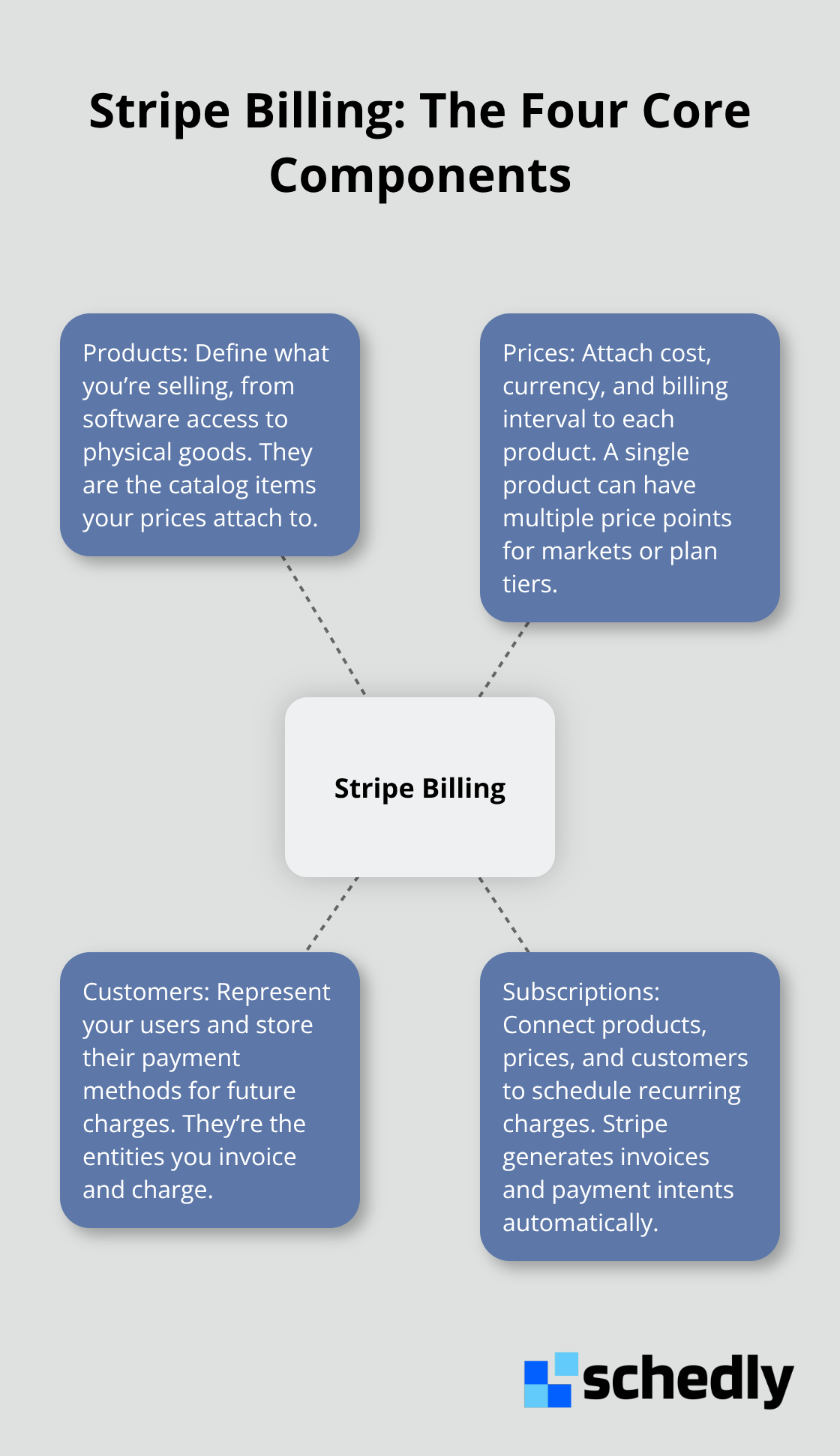
Stripe's billing infrastructure relies on four core components that work together seamlessly. Products define what you're selling, whether that's software access or physical goods. Prices attach the cost, currency, and billing interval to each product, so a single product can have multiple price points for different markets or plan tiers. Customers represent your actual users in the system and store their payment methods for future charges. Subscriptions connect these elements by scheduling recurring charges at your specified intervals, whether monthly, annual, or based on usage. When you create a subscription through Stripe Checkout, the platform automatically generates invoices at each billing cycle and creates payment intents to collect money from your customer's stored card.
How Stripe Recovers Failed Transactions
Payment failures happen regularly-card expiration, insufficient funds, fraud blocks. Stripe reports recovering over 6.5 billion dollars in failed payments during 2024 through its recovery tools, which is substantially more than most businesses recover on their own. Stripe's dunning management automatically retries failed payments using intelligent timing, increasing recovery rates significantly. The platform also offers card updater functionality that refreshes expired card information directly from your customers' banks, allowing you to retry charges without asking customers to manually update their payment details. Revenue recovery isn't just about retrying; it's about reducing involuntary churn caused by payment failures. Smart retry logic combined with automated customer notifications means fewer customers leave your service because of a billing hiccup. For international operations, Stripe's fraud prevention system Radar flags suspicious transactions while minimizing false positives that would otherwise decline legitimate payments from new markets or unusual purchasing patterns.
What Happens Next in Your Integration
Understanding how Stripe processes payments is one thing-actually integrating it into your systems is another. The next section covers the real benefits you'll see once Stripe handles your payment operations, from reducing manual work to building customer confidence at checkout.
Why Stripe Integration Reduces Business Friction
Stripe handles the operational weight that most businesses don't talk about until it becomes a crisis. Manual payment tracking creates bottlenecks, spreadsheet errors compound during tax season, and failed transactions silently drain revenue month after month. Stripe's infrastructure addresses three specific areas that directly affect your bottom line.
Automation Eliminates Administrative Overhead
Your team stops spending hours on payment administration and starts focusing on customer experience. Instead of manually logging transactions, sending payment reminders, or chasing down failed charges, Stripe's dunning management retries failed payments automatically using intelligent timing patterns. These automated workflows recover substantially more revenue than manual attempts ever could. The system handles the repetitive work that consumes your team's attention without adding measurable value to your business.
Payment Failures Stop Draining Revenue
Stripe recovered over $6.5 billion in failed payments during 2024 through automated recovery workflows that most businesses handle sporadically or ignore entirely. This matters because involuntary churn from billing failures often goes unnoticed until you analyze your retention metrics. Stripe's card updater functionality refreshes expired card information directly from your customers' banks, allowing the system to retry charges without asking customers to manually update their payment details. Revenue recovery isn't just about retrying-it's about reducing involuntary churn caused by payment failures.
Checkout Optimization Increases Conversion Rates
Conversion rates improve measurably when customers encounter a checkout experience built on Stripe's infrastructure. Stripe's checkout optimization tools increased conversions by approximately 2 to 3 percent for businesses using Optimized Checkout, which removes friction points that cause cart abandonment.

Security and Compliance Build Customer Trust
Customer trust increases because Stripe maintains PCI Level 1 certification, the highest security standard, which means your customers' card data never touches your infrastructure. You can confidently display security badges at checkout knowing the infrastructure behind those promises is actually there. This also eliminates your compliance burden-you don't need to audit your own payment security practices because Stripe owns that responsibility. For multi-location businesses or platforms with multiple revenue streams, Stripe Connect enables transparent seller onboarding across 46 countries in 14 languages with automated identity verification and regulatory compliance built in, meaning you can expand payment operations without hiring compliance specialists.
Real-time visibility into payment data replaces guesswork about your revenue health. Stripe Sigma provides custom reporting on payment trends, failed transaction patterns, and revenue recognition across all your apps without requiring your accounting team to reconcile disparate systems. Understanding these metrics becomes the foundation for the next critical step: actually implementing Stripe into your technical infrastructure and navigating the integration challenges that arise during setup.
What to Expect When Building Your Stripe Integration
Integrating Stripe into your systems feels straightforward until you hit the first real challenge. The API documentation is extensive, but knowing where to start matters more than reading everything. Your development team should visit the Stripe Developers section to grab API keys, then move directly to the specific integration path that matches your business model-whether that's Checkout for subscriptions, Payment Intents for one-time charges, or Connect for marketplace payments. Test in the sandbox environment before pushing anything to production; run actual transactions with test card numbers to verify your setup works correctly.
Payment Method Diversity Requires Upfront Planning
One critical mistake teams make is underestimating how payment method diversity affects your checkout flow. Stripe supports over 100 payment methods globally, which means your integration must handle more than just card payments. A customer in Southeast Asia expects local bank transfers, a customer in Europe expects SEPA, a customer in North America expects card payments. Build conditional logic that surfaces the right payment method for each customer during the initial design phase, not after launch. Retrofitting payment method logic later creates technical debt and frustrates customers who encounter payment flows that don't match their region.
Timeline and Resource Considerations
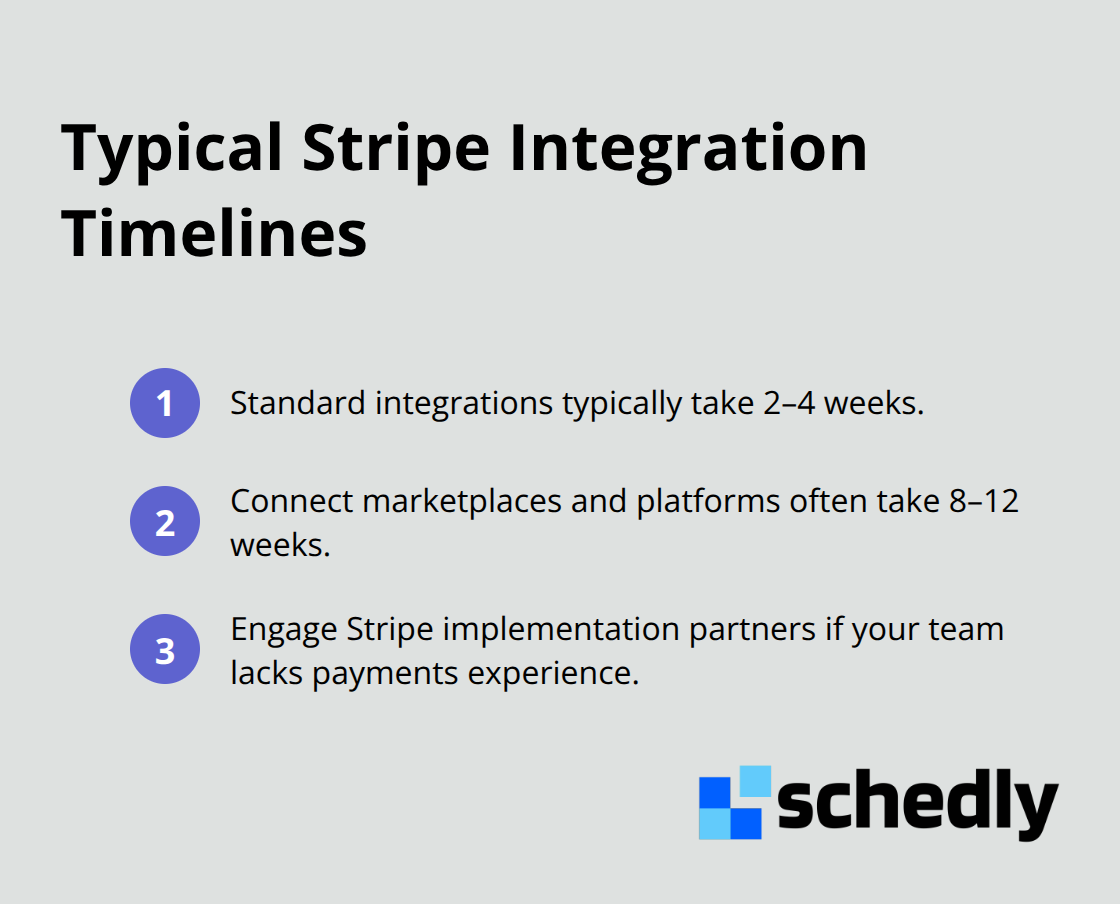
The integration timeline typically spans two to four weeks for straightforward implementations. Marketplaces and platforms using Connect often require eight to twelve weeks because you're not just processing payments-you're managing seller onboarding, payout routing, and regulatory compliance across multiple jurisdictions.
Failed Payments and Refund Strategy
Failed payments and refunds demand specific handling because they directly impact your revenue recovery strategy. Stripe's intelligent retry logic handles most failed transactions automatically, but your system still needs to track which payments succeeded, which are pending retry, and which failed permanently. Set up webhooks to listen for payment events-when a payment fails, your system should immediately log that failure, trigger a customer notification, and prepare for Stripe's retry attempts. Refunds require a different mindset than failed payments; implement a clear refund policy before you go live because Stripe processes refunds instantly to customer accounts, and reversing a refund after the fact creates accounting headaches.
Proration and Mid-Cycle Changes
For subscription businesses, proration becomes critical when customers upgrade or downgrade mid-cycle. Stripe handles proration automatically, but you need to decide upfront whether you credit customers for unused time or charge immediately for upgrades. This decision shapes your customer experience and your revenue timing, so clarify it before launch. Your finance team should understand these proration rules before your first customer changes plans mid-month.
Monitoring Payment Health at Scale
As your transaction volume grows, monitoring payment health becomes essential. Set up alerts for unusual patterns-a sudden spike in failed transactions might indicate fraud, a payment method issue, or a problem with your checkout flow. Stripe Sigma lets you write custom queries to identify these patterns without waiting for your finance team to manually review reports. Teams that scale payment infrastructure without monitoring typically discover problems through customer complaints rather than proactive alerts, which costs both revenue and reputation.
Final Thoughts
Stripe payment processing integration solves the operational problems that drain revenue and consume your team's attention. The platform tokenizes payment data, automates failed transaction recovery, and handles billing across multiple currencies and payment methods without requiring your team to rebuild infrastructure for each new market. Implementation starts with a clear decision about your business model-subscription businesses need different setup than marketplaces, which need different setup than one-time payment processors.
Failed payment recovery alone justifies the integration effort, as Stripe recovered over $6.5 billion in 2024 through automated recovery workflows. Real-time analytics through Stripe Sigma replace guesswork about revenue health, while checkout optimization increases conversion rates by 2 to 3 percent. International expansion becomes feasible because customers pay using their preferred local methods instead of being forced into unfamiliar payment flows.
For businesses managing customer scheduling and payments together, Schedly integrates Stripe directly into its platform, automating both booking workflows and payment processing. This combination eliminates the friction between scheduling and billing-customers book appointments and pay in a single flow, your team stops managing payments separately, and your revenue recognition becomes automatic. Test in sandbox this week, plan for the payment methods your customers actually use, and monitor payment health from day one.