
Schedly resources
Tutoring Session Scheduling: Keep Learners On Track

Inconsistent tutoring sessions derail student progress. When learners miss appointments or face irregular schedules, they lose momentum and struggle to retain what they've learned.
At Schedly, we've seen firsthand how tutoring session scheduling makes the difference between students who thrive and those who fall behind. The right system keeps everyone accountable and learning on track.
Why Consistent Scheduling Drives Academic Progress
How Regular Sessions Build Learning Momentum
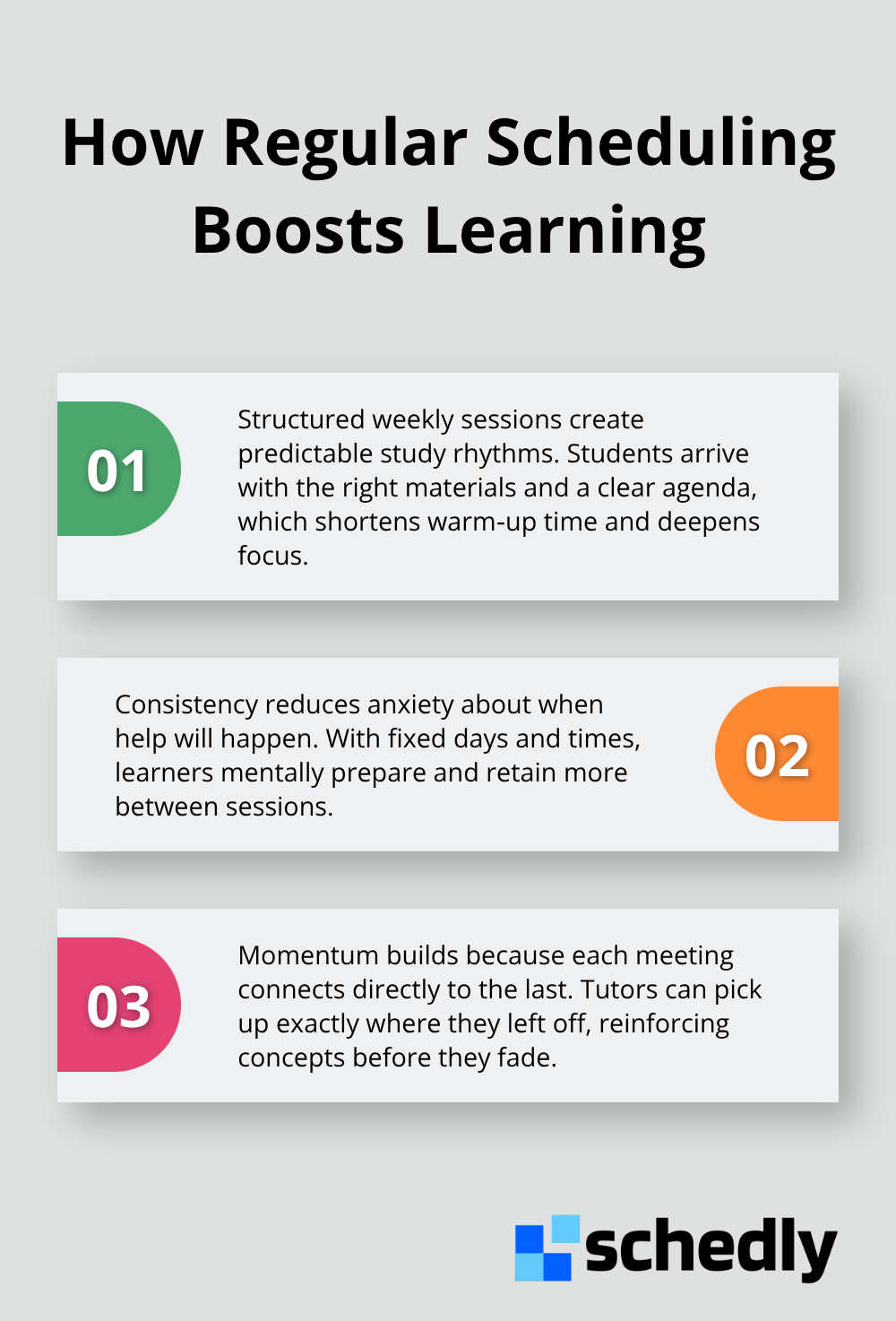
Regular tutoring sessions at predictable intervals cement learning in ways that sporadic sessions never can. Research from the National Student Support Accelerator and IES studies shows that students who receive at least three 30–60 minute sessions per week make measurable gains, typically moving from the 50th to 66th percentile in academic performance. When sessions happen on fixed days and times, students build routines that reduce anxiety and improve preparation. They know exactly when they'll sit down with their tutor, so they can mentally prepare and organize materials ahead of time. This consistency transforms tutoring from an afterthought into a core part of their week.
The Cost of Missed and Irregular Sessions
Missed or irregular sessions fracture this progress. A student who had a tutoring appointment cancelled last week and another rescheduled three times loses the thread of what they're learning. They forget concepts covered two weeks prior. They stop expecting help at predictable moments. Studies on tutoring effectiveness consistently show that attendance and frequency matter more than session length alone. When tutoring becomes unreliable, students disengage. They stop preparing before sessions. Motivation drops. Grades stagnate or decline. The tutor-student relationship weakens because there's no stable foundation to build trust and accountability.
How Structure Creates Natural Accountability
A structured schedule eliminates this chaos. When both tutor and student commit to fixed times, accountability flows naturally. The tutor shows up ready to teach. The student shows up ready to learn. Progress accelerates because neither party wastes mental energy on rescheduling logistics or wondering whether the session will actually happen. This predictability matters especially for neurodivergent learners, who thrive with consistent routines and reduced uncertainty around their academic support.
The foundation of reliable scheduling now leads directly into the practical obstacles that tutors face when they try to maintain these consistent sessions.
What Gets in the Way of Reliable Tutoring Schedules
Time Zones Create Scheduling Friction
Even tutors committed to consistency hit real obstacles. Time zone differences create genuine friction when serving remote students across regions. A student in California and a tutor in New York have only a narrow window of overlap, and that window shrinks further when a third student in London enters the picture. Tutors end up either waking at 5 a.m. for sessions or staying up past 10 p.m., which burns them out fast. The tutor's health and availability suffer, and students notice when their tutor shows fatigue or resentment.
Last-Minute Cancellations Cascade Through Schedules
Last-minute cancellations compound this problem significantly. A student's soccer game runs late. A parent's work meeting extends into tutoring time. A family illness forces a reschedule with two hours' notice. Each cancellation cascades backward through the tutor's week. The tutor's evening suddenly opens up. Another student might have filled that slot. The tutor loses income. The cancelled student falls further behind. Without a system that handles rescheduling automatically and alerts other students to newly available slots, tutors spend hours on email threads trying to piece together a workable week.
Supply and Demand Create Inefficient Schedules
The third challenge is the mismatch between tutor supply and student demand. Peak times like 4 p.m. to 6 p.m. on weekday evenings see requests pile up, while mid-morning slots sit empty. Tutors who work only evenings cannot fill their schedules efficiently. Families who need morning sessions cannot find availability. This imbalance forces tutors to either turn away students or stretch themselves across inconvenient hours just to survive financially.
Manual Coordination Breaks Down at Scale
These three obstacles share a common root: manual coordination breaks down at scale. Spreadsheets and email chains do not flag double-bookings across time zones. Text message reminders do not automatically update when a session gets cancelled. A tutor managing five students might handle chaos through sheer determination, but ten students or twenty makes the system collapse entirely.

Automation transforms this landscape. Real-time calendar sync with Google Calendar, Outlook, and iCloud prevents double-bookings instantly. Smart time zone detection removes confusion for remote students. Automated reminders via email and SMS cut no-shows. A scheduling platform shows tutors exactly which time slots are open across all their students, eliminating the guesswork. When a student cancels, the system notifies the tutor immediately so they can offer that slot to someone else or reclaim personal time. The booking link stays live 24/7, so students request sessions whenever they need them, not just during business hours. This shift from reactive scheduling to automated coordination means tutors spend minutes managing calendars instead of hours, and students get sessions scheduled without the back-and-forth that delays help and creates gaps in learning.
With these obstacles addressed, tutors can finally focus on what matters most: designing schedules that actually work for their students' learning patterns and life circumstances.
How to Build a Tutoring Schedule That Actually Works
Set Frequency Before You Optimize for Convenience
Start with frequency, not flexibility. Research shows that students need at least three sessions per week to see meaningful academic gains. Fewer sessions produce weaker results. More sessions risk burnout unless a student prepares for finals or recovers from an extended absence.
Most high school students thrive on two to three weekly sessions, scheduled on the same days and times each week. This consistency matters more than finding the perfect time slot. A Tuesday and Thursday afternoon schedule at 4 p.m., even if slightly inconvenient, beats a rotating schedule that changes week to week.
Students who know their tutor arrives every Tuesday at 4 p.m. prepare differently. They organize materials ahead of time. They mentally shift into learning mode. They show up ready to work. The tutor builds momentum in the content because they know exactly what was covered last session and where to pick up.
Align Sessions with Academic Deadlines and Energy Levels
Schedule fixed sessions around your student's academic calendar. If a major exam or essay deadline falls on Friday, place a reinforcement session on Wednesday. If homework stress peaks on certain nights, avoid scheduling tutoring when the student is already overwhelmed.
Neurodivergent learners benefit from predictable tutoring schedules because it reduces anxiety and supports executive function. Start with a baseline of two sessions per week and monitor progress through homework completion rates, test scores, and whether the student initiates studying independently. If those indicators improve within four to six weeks, the frequency is working. If the student still struggles with motivation or concept retention, add a third session. If the student stops preparing before sessions or shows signs of fatigue, reduce frequency slightly and maintain quality over quantity.
Eliminate Scheduling Friction with Automation
Manual rescheduling through text messages and email chains guarantees missed sessions because requests get lost, confirmations never arrive, or tutors double-book themselves. A scheduling platform with real-time calendar sync prevents this disaster. When a student requests a session, the system checks the tutor's Google Calendar, Outlook, or iCloud instantly and shows only available slots.
When a cancellation happens, the system notifies the tutor immediately and alerts other students on a waitlist if one exists. Automated reminders reduce no-shows significantly. Platforms with automated reminders see attendance rates climb because families and students receive notifications they actually see, not emails buried in inboxes.
Offer 24/7 Booking and Smart Time Zone Handling
A 24/7 online booking link means students request sessions whenever they need them, not just during your business hours. A student struggling with a math problem at 8 p.m. on a Sunday can submit a request immediately instead of waiting until Monday to send an email. You respond during business hours and confirm the booking in seconds. The tutor knows the session is locked in. The student can plan around it.
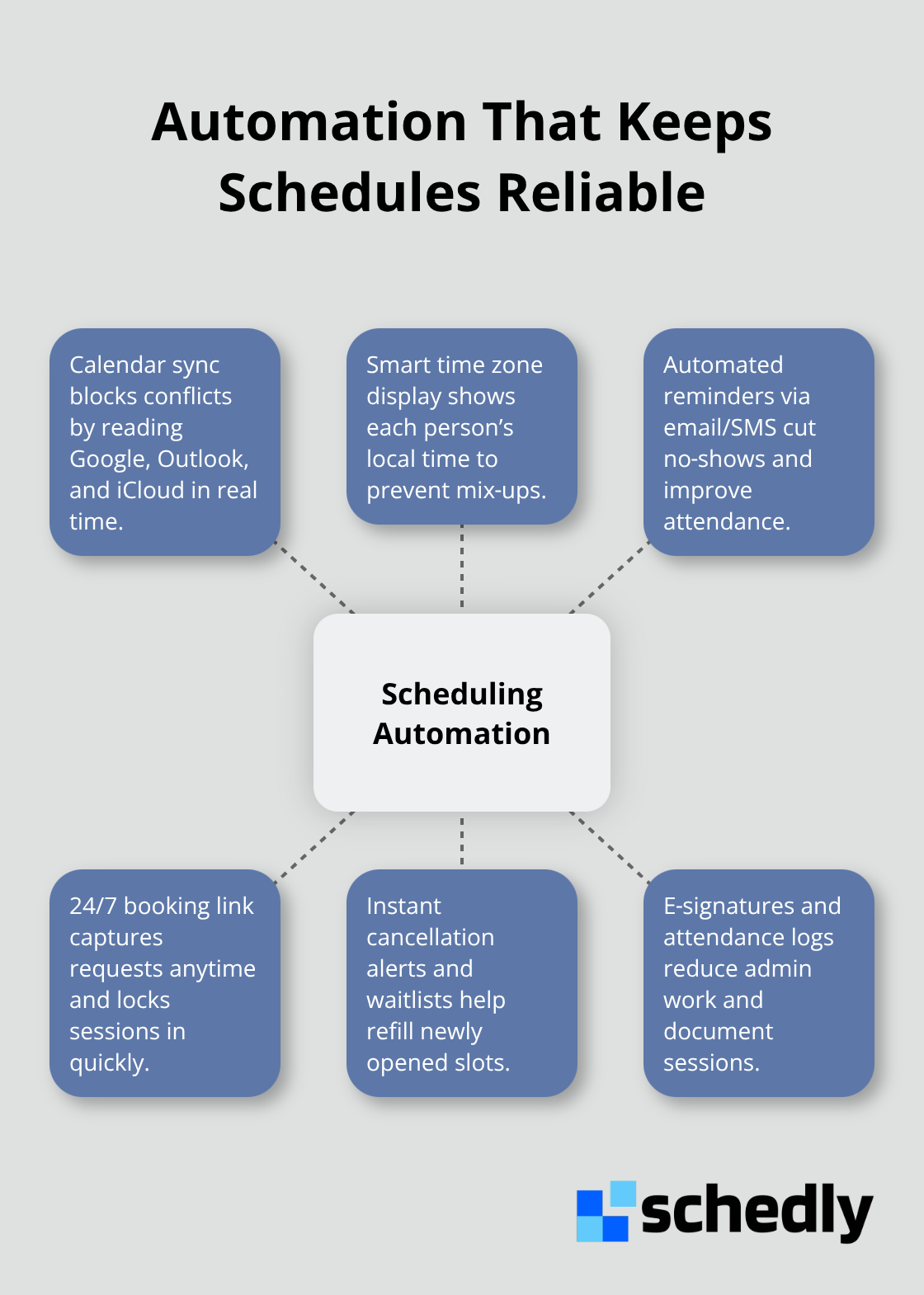
Smart time zone detection removes another source of chaos. Instead of tutors and students calculating offsets manually and booking sessions at wrong times, the system displays availability in each person's local timezone. A tutor in Eastern Time and a student in Pacific Time see their own local times throughout the booking process.
Streamline Documentation and Reclaim Administrative Time
Electronic signatures attached to each session provide compliance documentation and proof of attendance without extra administrative work. These automation features collectively slash the time tutors spend on scheduling logistics from hours per week down to minutes. That reclaimed time goes toward actual instruction and student relationships instead of calendar management.
Final Thoughts
Reliable tutoring session scheduling forms the foundation of student success. When sessions happen consistently at predictable times, students build momentum, retain concepts, and develop confidence in their academic abilities. Research shows that students who attend regular tutoring sessions move from the 50th to 66th percentile in academic performance, and that measurable gain comes directly from showing up week after week.
The long-term benefits extend far beyond test scores. Students who experience consistent tutoring develop better study habits, reduced anxiety around academics, and stronger relationships with their tutors. They prepare materials in advance and mentally shift into learning mode at the same time each week. Over months and years, this consistency compounds into genuine academic transformation.
Proper scheduling also protects tutor sustainability by eliminating the chaos of manual rescheduling, time zone confusion, and last-minute cancellations. A scheduling platform handles these obstacles automatically through real-time calendar sync, smart time zone detection, and automated reminders that cut no-shows. Schedly automates the entire booking process with 24/7 online scheduling and calendar integration so you focus on teaching while the platform handles the rest.