
Schedly resources
Why Your Accounting Team Dreads Month-End [Guide]
![Why Your Accounting Team Dreads Month-End [Guide]](/wp-content/uploads/emplibot/Why-Your-Accounting-Team-Dreads-Month-End-_Guide__1784524240.jpeg)
Month-end closes are brutal. Your accounting team faces manual data entry, payment reconciliation challenges, and impossible deadlines all at once.
At Schedly, we've seen firsthand how this chaos impacts productivity and accuracy. The good news: automation and better planning can transform your entire close process.
Why Month-End Closes Drain Your Team
The Manual Reconciliation Trap
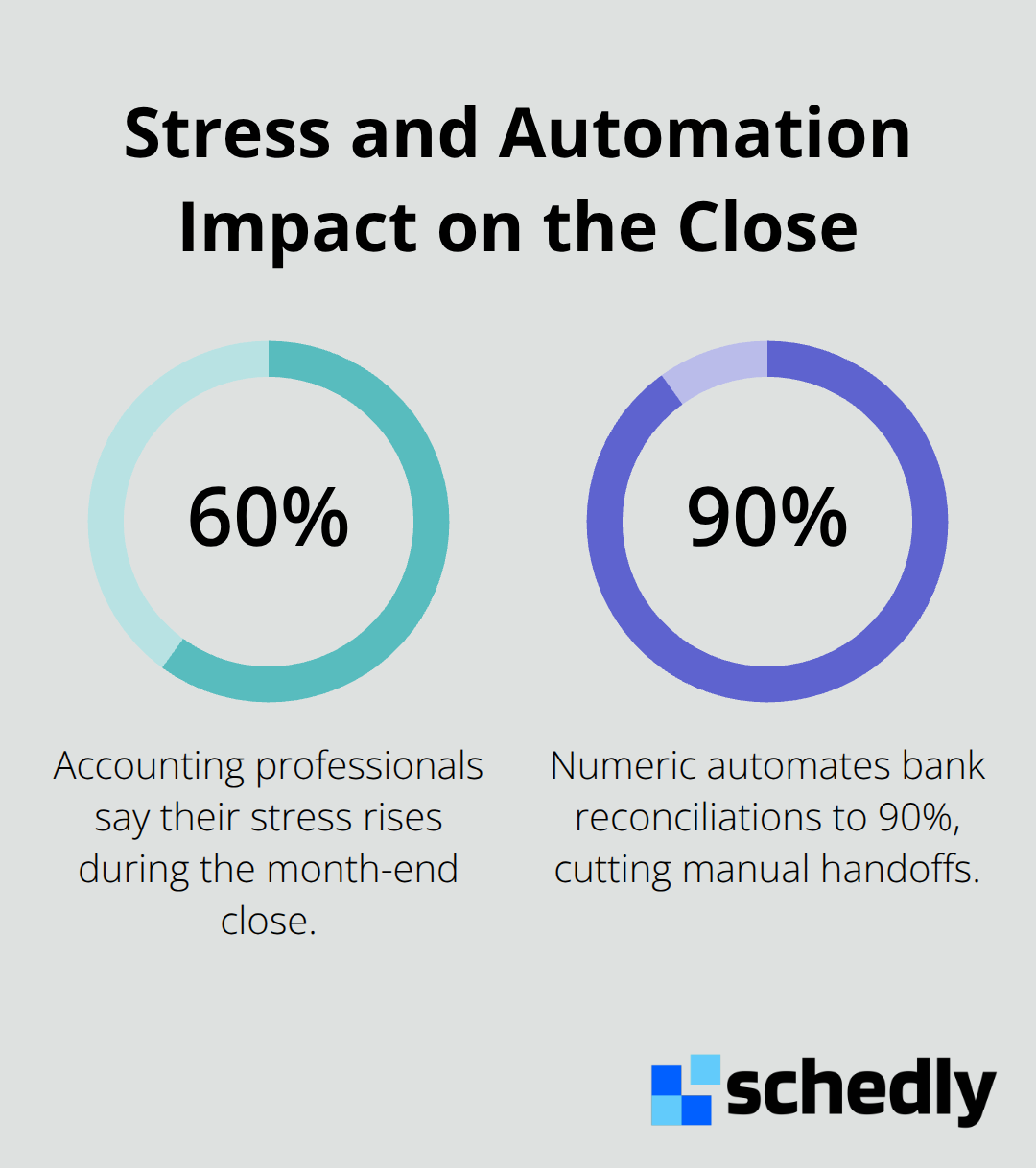
Your accounting team spends the last week of every month trapped in a cycle of manual data entry and spreadsheet reconciliation, and constant firefighting. According to a survey, 60% of accounting professionals report stress levels rise during the month-end close, yet most teams still rely on outdated processes that guarantee stress. The problem isn't laziness or incompetence-it's that month-end closes force your team to work against broken systems. Data arrives late from multiple departments, bank statements don't match ledger entries, and someone inevitably discovers a missing invoice at 5 PM on the last day of the month. These aren't minor inconveniences. They're systemic failures that compound throughout the close cycle.
The manual reconciliation burden alone destroys productivity. Your team must match transactions across bank accounts, credit card statements, and your accounting system-often by hand. When data silos exist, accountants spend hours copying numbers between spreadsheets instead of analyzing what those numbers mean.
Tight Deadlines Amplify the Chaos
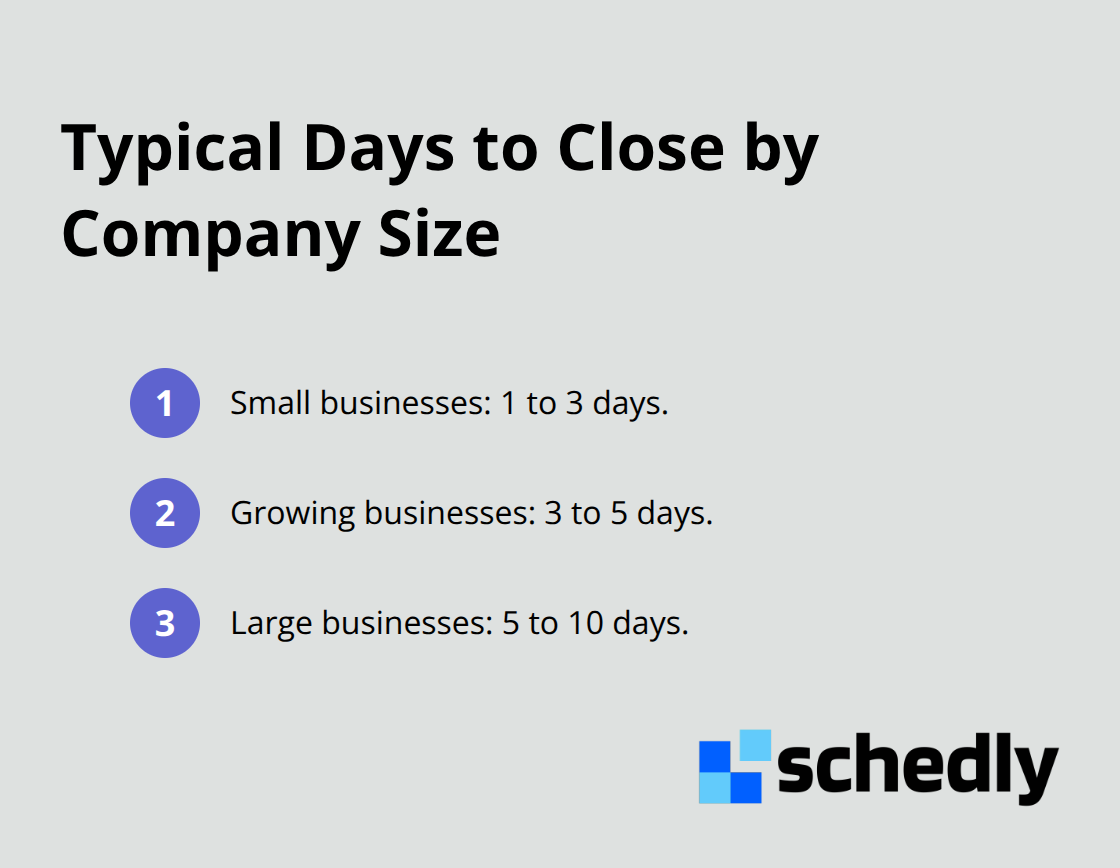
Time pressure makes everything worse. Small businesses typically close in 1 to 3 days, growing businesses in 3 to 5 days, and large businesses in 5 to 10 days. If your close takes longer than these benchmarks, process gaps create bottlenecks that cascade through the entire month.
The combination of manual work, tight deadlines, and fragmented systems creates an environment where mistakes flourish. Unreconciled accounts, misclassified expenses, and math errors slip through because your team rushes to hit arbitrary deadlines rather than building quality into the process itself.
The Cost of Broken Processes
This stress is why your team could redirect effort toward strategic initiatives-work that actually moves the business forward instead of just keeping the books accurate. Your team possesses the skills to analyze financial performance and identify opportunities for improvement, yet month-end chaos consumes the time they need for that work.
The real problem isn't the close itself. It's the systems and workflows that force your team to operate inefficiently. When you fix those underlying issues, everything changes.
How Automation and Real-Time Visibility Transform the Close
Auto-Matching Transactions Eliminates Hours of Manual Work
Automation removes the manual drudgery that makes month-end closes miserable. Accounting software can auto-match transactions using pre-built rules instead of your team manually matching transactions across bank feeds. This alone saves hours of repetitive work. When Avenue One implemented direct NetSuite integration, they recovered 10 to 15 hours per month that previously went to reconciliation. Signifyd saved about 15 hours monthly on receipt collection and reconciliation after adopting automated receipt capture with Brex. These aren't marginal improvements-they're the difference between a close that ends at midnight and one that wraps by mid-afternoon.
The key is connecting your bank accounts, credit cards, and accounting system so data flows automatically. Manual spreadsheet reconciliation becomes obsolete when your ledger updates in real time from your bank feeds.
AI-Powered Systems Catch Errors Before They Spread
Workflow automation enforces consistency and catches errors before they become problems. AI-powered systems detect policy violations in expense reports and flag unusual patterns-like a duplicate invoice or a transaction posted to the wrong account. Numeric's platform automates bank reconciliations to 90% and posts journal entries directly to NetSuite, eliminating another manual handoff. These systems work continuously, not just during the final week of the month.
Real-time dashboards show your finance leadership exactly where the close stands at any moment: which tasks are complete, which are stuck, and where bottlenecks exist. This visibility means problems surface immediately rather than on the final day when fixing them becomes impossible.
Clear Ownership and Shared Visibility Drive Accountability
Assign ownership for each close task and track progress in a shared system so accountability is clear and delays are visible to the whole team. A structured close checklist combined with automation can reduce days to close. The combination of automated data matching, real-time progress tracking, and clear task ownership transforms the close from a crisis sprint into a manageable workflow.
When your team knows exactly what they own and can see how their work affects others, they move faster and catch mistakes earlier. This shift from individual scrambling to coordinated effort changes everything about how your team experiences month-end.
Build Your Close Around Systems, Not Spreadsheets
Your close process moves only as fast as your slowest system. Most accounting teams operate across disconnected tools: bank accounts feed into one place, supplier invoices live in another, and your general ledger sits in a third. Your team manually bridges these gaps with spreadsheets and email, which means data entry happens multiple times and errors compound at each handoff.
Map Your Systems and Eliminate Redundant Entry Points
The first step is mapping exactly what systems feed into your close and where manual work happens. Document every data source: bank feeds, credit card statements, accounts payable software, payroll systems, inventory platforms, and any spreadsheets your team maintains. Once you see the full picture, you can eliminate redundant entry points.
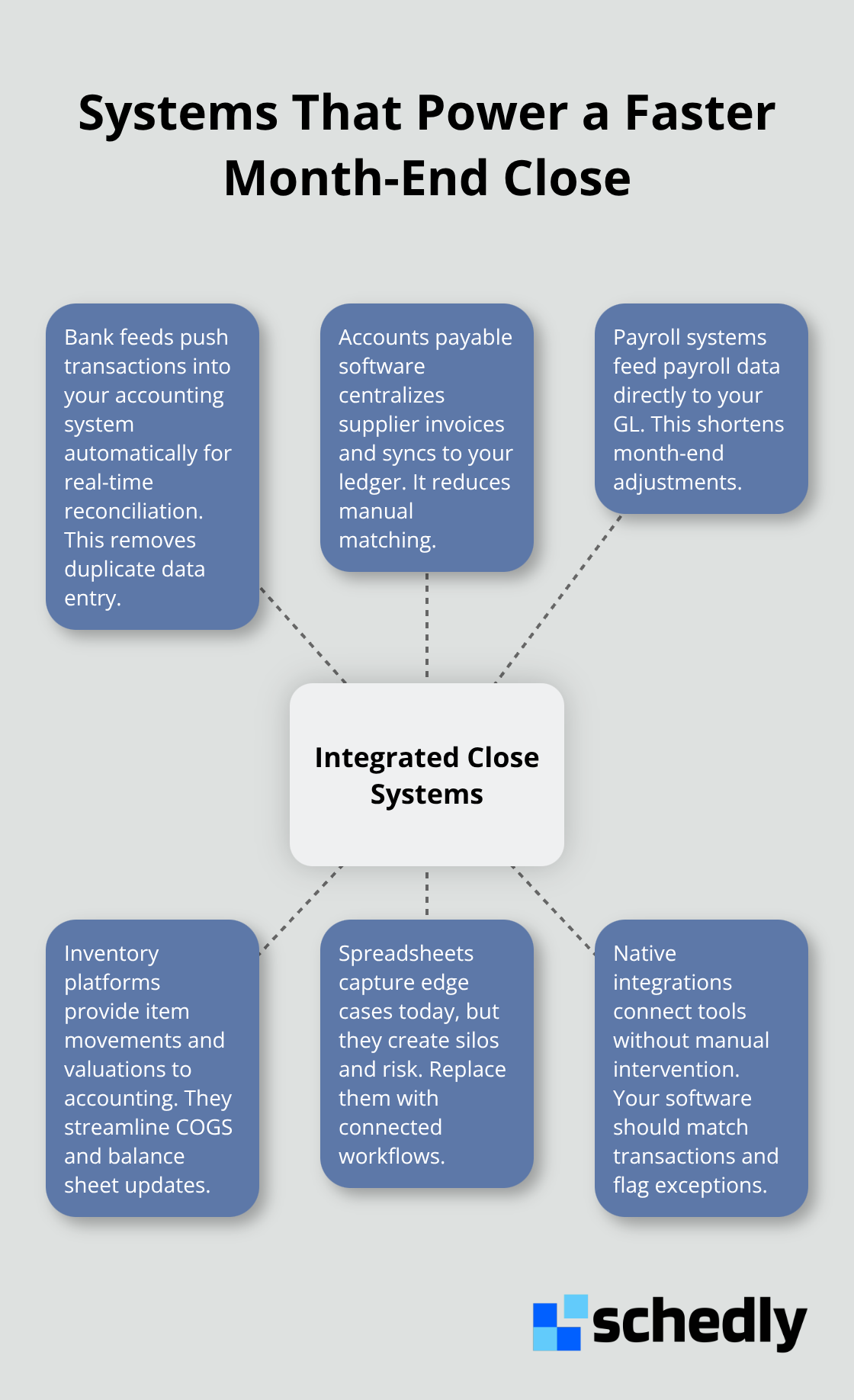
When you connect your bank accounts directly to your accounting system through native integrations, transaction data automatically flows into your accounting system, enabling seamless reconciliation. That improvement matters when your team works nights and weekends. The key is choosing tools that talk to each other without manual intervention. Your accounting software should pull bank data automatically, match transactions based on amount and date, and flag exceptions for human review rather than requiring your team to manually verify every transaction.
Create a Close Checklist That Prevents Chaos
Documentation and task ownership matter far more than most teams realize. Build a close checklist specific to your business that lists every task, who owns it, when it's due, and what system it depends on. This prevents the chaos where someone assumes another person handled reconciliation and nobody actually did.
Distribute close tasks so no single person becomes the bottleneck. If your controller is the only person who understands revenue recognition or intercompany eliminations, your close stalls the moment they take vacation. Spread knowledge across your team (one person handles cash and receivables, another manages payables and accruals, a third reviews balance sheet accounts). Set internal deadlines three to four days before your official close date so late-arriving data doesn't force last-minute scrambling.
Track Progress in Real Time to Surface Problems Early
Track progress in a shared system where every team member sees which tasks are complete and which are blocked. This transparency eliminates the back-and-forth emails asking for status updates and creates peer accountability that naturally accelerates the work. When tasks have clear owners and early deadlines, problems surface when there's time to fix them rather than on the final day when panic sets in.
Final Thoughts
Your accounting team's month-end dread stems from three interconnected problems: manual data entry across disconnected systems, payment reconciliation challenges that consume hours, and artificial deadlines that force rushed work. These aren't separate issues to solve independently-they're symptoms of processes built around spreadsheets and manual handoffs instead of integrated systems and automation. The path forward requires two changes working together: connect your systems so data flows automatically, and build accountability through clear task ownership and real-time visibility.
Technology alone won't fix your close. A checklist and shared tracking system matter just as much as automation. Distribute tasks across your team so no single person becomes the bottleneck. Set internal deadlines before your official close date so problems surface when there's time to fix them. Document your process so knowledge doesn't live only in one person's head.
Start by mapping your current close: every system involved, every manual step, every data handoff. Identify where your team spends the most time and where errors most often occur. Then prioritize connecting those systems and automating those steps. Schedly helps teams streamline their close process through better planning and coordination, so your team reclaims the time and energy they need for work that actually moves your business forward.